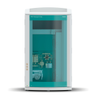
Waters Corporation ACQUITY UPLC M-Class System with 2D Technology

Description
Expand the dynamic range of your analysis with 2D separations.The ACQUITY UPLC® M-Class System with 2D Technology expands the use of sub-2-micron particles to achieve high peak capacity separations. This innovative system effectively uses two-dimensional (2D) UPLC for better chromatographic resolution of complex proteomic samples by using a dual reversed-phase (RP) approach. High-resolution in both dimensions by exploiting the wide-ranging ionic and hydrophobic structure of peptides Better protein identifications, quantification, and sequence coverage Improved separation, method generation wizards, and enhanced data algorithms Comprehensive 2D - Expanding the impact. Conventional 2D-LC uses ion exchange (IEX) followed by reversed- phase (RP). Any IEX approach will use salt-containing buffers that can cause ionization background and fouling problems if they enter a mass spectrometer (MS). Since IEX separations are based solely on the charge of the peptide, the IEX dimension often results in poor chromatographic resolution with peptides appearing in multiple fractions, making data interpretation difficult. This improved 2D approach uses RP at pH 10 in the first dimension, followed by RP at pH 2 in the second dimension for results that far exceeds those of conventional IEX methodologies. High resolution in both dimensions. When ion exchange is used as the first separation dimension, poor resolution and bleed between fractions could occur. Using a highly resolving support in the first step provides you with better information in the last step. A reversed phase support at pH 10, followed by a sub-2-micron separation at lower pH, useful, orthogonal separations that yield high quality data is obtained.
Description
Expand the dynamic range of your analysis with 2D separations.The ACQUITY UPLC® M-Class System with 2D Technology expands the use of sub-2-micron particles to achieve high peak capacity separations. This innovative system effectively uses two-dimensional (2D) UPLC for better chromatographic resolution of complex proteomic samples by using a dual reversed-phase (RP) approach. High-resolution in both dimensions by exploiting the wide-ranging ionic and hydrophobic structure of peptides Better protein identifications, quantification, and sequence coverage Improved separation, method generation wizards, and enhanced data algorithms Comprehensive 2D - Expanding the impact. Conventional 2D-LC uses ion exchange (IEX) followed by reversed- phase (RP). Any IEX approach will use salt-containing buffers that can cause ionization background and fouling problems if they enter a mass spectrometer (MS). Since IEX separations are based solely on the charge of the peptide, the IEX dimension often results in poor chromatographic resolution with peptides appearing in multiple fractions, making data interpretation difficult. This improved 2D approach uses RP at pH 10 in the first dimension, followed by RP at pH 2 in the second dimension for results that far exceeds those of conventional IEX methodologies. High resolution in both dimensions. When ion exchange is used as the first separation dimension, poor resolution and bleed between fractions could occur. Using a highly resolving support in the first step provides you with better information in the last step. A reversed phase support at pH 10, followed by a sub-2-micron separation at lower pH, useful, orthogonal separations that yield high quality data is obtained.

Suppliers

Company
Product
Description
Supplier Links
ACQUITY UPLC M-Class System with 2D Technology -  - Waters Corporation
Milford, MA, USA
ACQUITY UPLC M-Class System with 2D Technology
Expand the dynamic range of your analysis with 2D separations.The ACQUITY UPLC® M-Class System with 2D Technology expands the use of sub-2-micron particles to achieve high peak capacity separations. This innovative system effectively uses two-dimensional (2D) UPLC for better chromatographic resolution of complex proteomic samples by using a dual reversed-phase (RP) approach. High-resolution in both dimensions by exploiting the wide-ranging ionic and hydrophobic structure of peptides Better protein identifications, quantification, and sequence coverage Improved separation, method generation wizards, and enhanced data algorithms Comprehensive 2D - Expanding the impact. Conventional 2D-LC uses ion exchange (IEX) followed by reversed- phase (RP). Any IEX approach will use salt-containing buffers that can cause ionization background and fouling problems if they enter a mass spectrometer (MS). Since IEX separations are based solely on the charge of the peptide, the IEX dimension often results in poor chromatographic resolution with peptides appearing in multiple fractions, making data interpretation difficult. This improved 2D approach uses RP at pH 10 in the first dimension, followed by RP at pH 2 in the second dimension for results that far exceeds those of conventional IEX methodologies. High resolution in both dimensions. When ion exchange is used as the first separation dimension, poor resolution and bleed between fractions could occur. Using a highly resolving support in the first step provides you with better information in the last step. A reversed phase support at pH 10, followed by a sub-2-micron separation at lower pH, useful, orthogonal separations that yield high quality data is obtained.

Expand the dynamic range of your analysis with 2D separations.The ACQUITY UPLC® M-Class System with 2D Technology expands the use of sub-2-micron particles to achieve high peak capacity separations. This innovative system effectively uses two-dimensional (2D) UPLC for better chromatographic resolution of complex proteomic samples by using a dual reversed-phase (RP) approach.

  • High-resolution in both dimensions by exploiting the wide-ranging ionic and hydrophobic structure of peptides
  • Better protein identifications, quantification, and sequence coverage
  • Improved separation, method generation wizards, and enhanced data algorithms

Comprehensive 2D - Expanding the impact.

Conventional 2D-LC uses ion exchange (IEX) followed by reversed- phase (RP). Any IEX approach will use salt-containing buffers that can cause ionization background and fouling problems if they enter a mass spectrometer (MS). Since IEX separations are based solely on the charge of the peptide, the IEX dimension often results in poor chromatographic resolution with peptides appearing in multiple fractions, making data interpretation difficult.

This improved 2D approach uses RP at pH 10 in the first dimension, followed by RP at pH 2 in the second dimension for results that far exceeds those of conventional IEX methodologies.

High resolution in both dimensions.

When ion exchange is used as the first separation dimension, poor resolution and bleed between fractions could occur. Using a highly resolving support in the first step provides you with better information in the last step. A reversed phase support at pH 10, followed by a sub-2-micron separation at lower pH, useful, orthogonal separations that yield high quality data is obtained.

Supplier's Site

Technical Specifications

  Waters Corporation
Product Category High Performance Liquid Chromatographs (HPLC)
Product Name ACQUITY UPLC M-Class System with 2D Technology
Instrument Type Fixtured
Unlock Full Specs
to access all available technical data

Similar Products

Prominence Prep LC - Liquid Chromatograph - Prominence Prep LC - Shimadzu Scientific Instruments, Inc.
Specs
Instrument Type Fixtured
Analysis Method Preparative
Display Digital
View Details
High-Speed Amino Acid Analyzer LA8080 AminoSAAYA -  - Hitachi High-Tech America
Specs
Instrument Type Fixtured
Analysis Method Analytical
Detector Type Spectrophotometer: Aberration-corrected
View Details