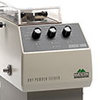
A large amount of work is carried out on a daily basis to characterize particle size distributions of the active drug discharged from a metered dose inhaler (MDI). However, until recently, very little was known of the behavior of the particles in the MDI canister. Did they agglomerate? If they did agglomerate, were they re-dispersed by the action of being discharged from the MDI when it was used? What was the particle size distribution of the particles in the canister? Were there storage problems associated with the sedimentation of the particles over extended periods of time? The problem associated with finding the answers to these questions was that the particles are suspended in a liquid propellant gas, typically a CFC replacement at high pressure. Once the pressure is released, the gas reverts to its gaseous phase and the behavior of the particles can no longer be studied. The high pressure dispersion unit for the Mastersizer S was developed in co-operation with one of the word's leaders in the production of MDI's to maintain the propellant gas in its liquid phase and allow the particles in an MDI canister to be measured under conditions that closely replicated the conditions inside the canister. The unit supplied includes a high pressure cell tested to 10 bar (1 Mpa) which replaces the standard flow cell of the Mastersizer S. This is connected to the dispersion unit by high pressure tubing and fittings. Special spring pressure valves allow the unit to be easily filled from a pressurized can of propellant and a similar valve allows the contents of the MDI to be discharged into the unit for circulation through the laser beam of the Mastersizer S.
| Malvern Instruments, Inc. | |
|---|---|
| Product Category | Autosamplers |
| Product Number | High Pressure Cell |
| Product Name | Wet Dispersion |
| Injection Style | Cell |