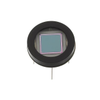
OSI Optoelectronics Tetra-Lateral Positions Sensing Detector SC-10D

Description
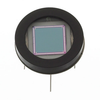
Tetra-lateral position sensing detectors are manufactured with one single resistive layer for both one and two dimensional measurements. They feature a common anode and two cathodes for one dimensional position sensing or four cathodes for two dimensional position sensing. These detectors are best when used in applications that require measurement over a wide spatial range. They offer high response uniformity, low dark current, and good position linearity over 64% of the sensing area. A reverse bias should be applied to these detectors to achieve optimum current linearity when large light signals are present. The circuit on the opposite page represents a typical circuit set up for two dimensional tetra-lateral PSDs. For further details as well as the set up for one dimensional PSDs refer t the "Photodiode Characteristics" section of the catalog. Note that the maximum recommended incident power density is 10 mW / cm2. Furthermore, typical uniformity of response for a 1 mm ? spot size is ± 5% for SC-25D and SC-50D and ± 2% for all other tetra-lateral devices.
Request a Quote Datasheet
Description
Tetra-lateral position sensing detectors are manufactured with one single resistive layer for both one and two dimensional measurements. They feature a common anode and two cathodes for one dimensional position sensing or four cathodes for two dimensional position sensing. These detectors are best when used in applications that require measurement over a wide spatial range. They offer high response uniformity, low dark current, and good position linearity over 64% of the sensing area. A reverse bias should be applied to these detectors to achieve optimum current linearity when large light signals are present. The circuit on the opposite page represents a typical circuit set up for two dimensional tetra-lateral PSDs. For further details as well as the set up for one dimensional PSDs refer t the "Photodiode Characteristics" section of the catalog. Note that the maximum recommended incident power density is 10 mW / cm2. Furthermore, typical uniformity of response for a 1 mm ? spot size is ± 5% for SC-25D and SC-50D and ± 2% for all other tetra-lateral devices.
Request a Quote Datasheet

Suppliers

Company
Product
Description
Supplier Links
Tetra-Lateral Positions Sensing Detector - SC-10D - OSI Optoelectronics
Hawthorne, CA, United States
Tetra-Lateral Positions Sensing Detector
SC-10D
Tetra-Lateral Positions Sensing Detector SC-10D
Tetra-lateral position sensing detectors are manufactured with one single resistive layer for both one and two dimensional measurements. They feature a common anode and two cathodes for one dimensional position sensing or four cathodes for two dimensional position sensing. These detectors are best when used in applications that require measurement over a wide spatial range. They offer high response uniformity, low dark current, and good position linearity over 64% of the sensing area. A reverse bias should be applied to these detectors to achieve optimum current linearity when large light signals are present. The circuit on the opposite page represents a typical circuit set up for two dimensional tetra-lateral PSDs. For further details as well as the set up for one dimensional PSDs refer t the "Photodiode Characteristics" section of the catalog. Note that the maximum recommended incident power density is 10 mW / cm2. Furthermore, typical uniformity of response for a 1 mm ? spot size is ± 5% for SC-25D and SC-50D and ± 2% for all other tetra-lateral devices.

Tetra-lateral position sensing detectors are manufactured with one single resistive layer for both one and two dimensional measurements. They feature a common anode and two cathodes for one dimensional position sensing or four cathodes for two dimensional position sensing. These detectors are best when used in applications that require measurement over a wide spatial range. They offer high response uniformity, low dark current, and good position linearity over 64% of the sensing area. A reverse bias should be applied to these detectors to achieve optimum current linearity when large light signals are present. The circuit on the opposite page represents a typical circuit set up for two dimensional tetra-lateral PSDs. For further details as well as the set up for one dimensional PSDs refer t the "Photodiode Characteristics" section of the catalog. Note that the maximum recommended incident power density is 10 mW / cm2. Furthermore, typical uniformity of response for a 1 mm ? spot size is ± 5% for SC-25D and SC-50D and ± 2% for all other tetra-lateral devices.

Supplier's Site Datasheet
Photodiodes - 2640-SC-10D-ND - DigiKey
Thief River Falls, MN, United States
Photodiodes
2640-SC-10D-ND
Photodiodes 2640-SC-10D-ND
Photodiode 670nm 1µs Radial

Photodiode 670nm 1µs Radial

Buy Now Datasheet

Technical Specifications

  OSI Optoelectronics DigiKey
Product Category Photodiodes Photodiodes
Product Number SC-10D 2640-SC-10D-ND
Product Name Tetra-Lateral Positions Sensing Detector Photodiodes
Photodiode Type PIN Photodiode
Photodiode Spectral Response Visible; IR
Spectral Response Range 350 to 1100 nm (3500 to 11000 Å)
Photodiode Material Silicon
Photodiode Package 44 / Special Leaded; THT; Radial
Unlock Full Specs
to access all available technical data

Similar Products

Photodiodes - 2121833 - RS Components, Ltd.
RS Components, Ltd.
Specs
Photodiode Spectral Response IR
Peak Sensitivity Wavelength 5000 nm (50000 Å)
Photodiode Package Ceramic
View Details
InGaAs photodiodes - G12182-010K - Hamamatsu Photonics Europe
Hamamatsu Photonics Europe
Specs
Spectral Response Range 900 to 2100 nm (9000 to 21000 Å)
Peak Sensitivity Wavelength 1950 nm (19500 Å)
Photodiode Material Indium Gallium Arsenide
View Details
Molded Photodiodes - PIN-16-CSL - OSI Optoelectronics
Specs
Photodiode Type PIN Photodiode
Photodiode Spectral Response Visible; IR
Spectral Response Range 350 to 1100 nm (3500 to 11000 Å)
View Details