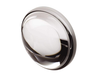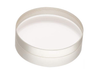
Newport MKS Achromatic Triplet Lens, Visible, 38.1 mm, 125 mm EFL, 400-700 nm PAC076

Description
The PAC076 Visible Achromatic Triplet Lens is a 400 to 700 nm antireflection coated, 1.5 inch (38.1 mm) diameter, N-BaSF2, N-SF4, and N-BaSF2 precision achromatic triplet lens with an effective focal length of 125 mm. Our Steinheil achromatic triplets are optimized for finite conjugate 1:1 imaging. Formed using two identical negative meniscus lenses cemented to a biconvex lens. These lenses are diffraction limited at 488, 514.5, and 632.8 nm. This achromat is computer designed to effectively minimize spherical aberration and coma when operating at infinite conjugate ratio, yielding smaller focused spot sizes. Unlike singlet lenses, this results in a constant focal length independent of aperture and far better off-axis performance. Achromats are superior to singlet lenses for monochromatic applications at any visible wavelength. Achromatic Lens Design An Achromat, or Achromatic lens, is usually made up of multiple optical elements, which can be air-spaced or cemented together. These typically alternate a positive lens of low index material, such as crown glass, and a negative lens of high index material, such as flint glass. The elements are selected and optimized so that dispersion in the positive element is corrected by the negative element, resulting in minimized chromatic aberration at two well-separated wavelengths. Achromats offer a nearly constant focal length across the visible spectrum, providing superior off-axis performance. Doublet lenses offer users many more design options than singlet lenses, which allows for superior performance in visual imaging and laser beam manipulation applications. Our lenses are computer designed, minimizing aberrations and providing a smaller focused spot size. They are offered with multi-layer or single-layer AR coatings. Standard diameters and focal lengths may be interchanged with our singlet lenses. Further, achromats are available in a wide variety of configurations, including positive, negative, triplet, and aspherized. These lenses are produced as doublets or triplets (three elements). The collimated beam should enter or depart from the surface (R1 in drawing) with higher curvature (smaller radius) for optimized performance. MgF2 Visible Antireflection Coating Our single layer Magnesium Fluoride visible AR coating is the most common choice that offers extremely broad wavelength range at a reasonable price. It is standard on achromats and optional on our N-BK7 plano-convex spherical lenses and cylindrical lenses. Comparing to the uncoated surface, the MgF2 provides a significant improvement by reducing the reflectance to less than 1.5%. It works extremely well over a wide range of wavelengths (400 nm to 700 nm) at angles of incidence less than 15 degrees. Superior Performance in Monochromatic Applications Achromats are superior to singlet lenses for monochromatic applications at any visible wavelength. Negative achromatic lenses are used primarily to extend focal lengths, which is often combined with positive achromatic mirror systems and imaging lenses. Generally a diffraction limited spot may be achieved when using a monochromatic source such as laser.
Request a Quote
Description
The PAC076 Visible Achromatic Triplet Lens is a 400 to 700 nm antireflection coated, 1.5 inch (38.1 mm) diameter, N-BaSF2, N-SF4, and N-BaSF2 precision achromatic triplet lens with an effective focal length of 125 mm. Our Steinheil achromatic triplets are optimized for finite conjugate 1:1 imaging. Formed using two identical negative meniscus lenses cemented to a biconvex lens. These lenses are diffraction limited at 488, 514.5, and 632.8 nm. This achromat is computer designed to effectively minimize spherical aberration and coma when operating at infinite conjugate ratio, yielding smaller focused spot sizes. Unlike singlet lenses, this results in a constant focal length independent of aperture and far better off-axis performance. Achromats are superior to singlet lenses for monochromatic applications at any visible wavelength. Achromatic Lens Design An Achromat, or Achromatic lens, is usually made up of multiple optical elements, which can be air-spaced or cemented together. These typically alternate a positive lens of low index material, such as crown glass, and a negative lens of high index material, such as flint glass. The elements are selected and optimized so that dispersion in the positive element is corrected by the negative element, resulting in minimized chromatic aberration at two well-separated wavelengths. Achromats offer a nearly constant focal length across the visible spectrum, providing superior off-axis performance. Doublet lenses offer users many more design options than singlet lenses, which allows for superior performance in visual imaging and laser beam manipulation applications. Our lenses are computer designed, minimizing aberrations and providing a smaller focused spot size. They are offered with multi-layer or single-layer AR coatings. Standard diameters and focal lengths may be interchanged with our singlet lenses. Further, achromats are available in a wide variety of configurations, including positive, negative, triplet, and aspherized. These lenses are produced as doublets or triplets (three elements). The collimated beam should enter or depart from the surface (R1 in drawing) with higher curvature (smaller radius) for optimized performance. MgF2 Visible Antireflection Coating Our single layer Magnesium Fluoride visible AR coating is the most common choice that offers extremely broad wavelength range at a reasonable price. It is standard on achromats and optional on our N-BK7 plano-convex spherical lenses and cylindrical lenses. Comparing to the uncoated surface, the MgF2 provides a significant improvement by reducing the reflectance to less than 1.5%. It works extremely well over a wide range of wavelengths (400 nm to 700 nm) at angles of incidence less than 15 degrees. Superior Performance in Monochromatic Applications Achromats are superior to singlet lenses for monochromatic applications at any visible wavelength. Negative achromatic lenses are used primarily to extend focal lengths, which is often combined with positive achromatic mirror systems and imaging lenses. Generally a diffraction limited spot may be achieved when using a monochromatic source such as laser.
Request a Quote

Suppliers

Company
Product
Description
Supplier Links
Achromatic Triplet Lens, Visible, 38.1 mm, 125 mm EFL, 400-700 nm - PAC076 - Newport MKS
Irvine, CA, United States
Achromatic Triplet Lens, Visible, 38.1 mm, 125 mm EFL, 400-700 nm
PAC076
Achromatic Triplet Lens, Visible, 38.1 mm, 125 mm EFL, 400-700 nm PAC076
The PAC076 Visible Achromatic Triplet Lens is a 400 to 700 nm antireflection coated, 1.5 inch (38.1 mm) diameter, N-BaSF2, N-SF4, and N-BaSF2 precision achromatic triplet lens with an effective focal length of 125 mm. Our Steinheil achromatic triplets are optimized for finite conjugate 1:1 imaging. Formed using two identical negative meniscus lenses cemented to a biconvex lens. These lenses are diffraction limited at 488, 514.5, and 632.8 nm. This achromat is computer designed to effectively minimize spherical aberration and coma when operating at infinite conjugate ratio, yielding smaller focused spot sizes. Unlike singlet lenses, this results in a constant focal length independent of aperture and far better off-axis performance. Achromats are superior to singlet lenses for monochromatic applications at any visible wavelength. Achromatic Lens Design An Achromat, or Achromatic lens, is usually made up of multiple optical elements, which can be air-spaced or cemented together. These typically alternate a positive lens of low index material, such as crown glass, and a negative lens of high index material, such as flint glass. The elements are selected and optimized so that dispersion in the positive element is corrected by the negative element, resulting in minimized chromatic aberration at two well-separated wavelengths. Achromats offer a nearly constant focal length across the visible spectrum, providing superior off-axis performance. Doublet lenses offer users many more design options than singlet lenses, which allows for superior performance in visual imaging and laser beam manipulation applications. Our lenses are computer designed, minimizing aberrations and providing a smaller focused spot size. They are offered with multi-layer or single-layer AR coatings. Standard diameters and focal lengths may be interchanged with our singlet lenses. Further, achromats are available in a wide variety of configurations, including positive, negative, triplet, and aspherized. These lenses are produced as doublets or triplets (three elements). The collimated beam should enter or depart from the surface (R1 in drawing) with higher curvature (smaller radius) for optimized performance. MgF2 Visible Antireflection Coating Our single layer Magnesium Fluoride visible AR coating is the most common choice that offers extremely broad wavelength range at a reasonable price. It is standard on achromats and optional on our N-BK7 plano-convex spherical lenses and cylindrical lenses. Comparing to the uncoated surface, the MgF2 provides a significant improvement by reducing the reflectance to less than 1.5%. It works extremely well over a wide range of wavelengths (400 nm to 700 nm) at angles of incidence less than 15 degrees. Superior Performance in Monochromatic Applications Achromats are superior to singlet lenses for monochromatic applications at any visible wavelength. Negative achromatic lenses are used primarily to extend focal lengths, which is often combined with positive achromatic mirror systems and imaging lenses. Generally a diffraction limited spot may be achieved when using a monochromatic source such as laser.

The PAC076 Visible Achromatic Triplet Lens is a 400 to 700 nm antireflection coated, 1.5 inch (38.1 mm) diameter, N-BaSF2, N-SF4, and N-BaSF2 precision achromatic triplet lens with an effective focal length of 125 mm. Our Steinheil achromatic triplets are optimized for finite conjugate 1:1 imaging. Formed using two identical negative meniscus lenses cemented to a biconvex lens. These lenses are diffraction limited at 488, 514.5, and 632.8 nm. This achromat is computer designed to effectively minimize spherical aberration and coma when operating at infinite conjugate ratio, yielding smaller focused spot sizes. Unlike singlet lenses, this results in a constant focal length independent of aperture and far better off-axis performance. Achromats are superior to singlet lenses for monochromatic applications at any visible wavelength.

Achromatic Lens Design

An Achromat, or Achromatic lens, is usually made up of multiple optical elements, which can be air-spaced or cemented together. These typically alternate a positive lens of low index material, such as crown glass, and a negative lens of high index material, such as flint glass. The elements are selected and optimized so that dispersion in the positive element is corrected by the negative element, resulting in minimized chromatic aberration at two well-separated wavelengths. Achromats offer a nearly constant focal length across the visible spectrum, providing superior off-axis performance. Doublet lenses offer users many more design options than singlet lenses, which allows for superior performance in visual imaging and laser beam manipulation applications. Our lenses are computer designed, minimizing aberrations and providing a smaller focused spot size. They are offered with multi-layer or single-layer AR coatings. Standard diameters and focal lengths may be interchanged with our singlet lenses. Further, achromats are available in a wide variety of configurations, including positive, negative, triplet, and aspherized. These lenses are produced as doublets or triplets (three elements). The collimated beam should enter or depart from the surface (R1 in drawing) with higher curvature (smaller radius) for optimized performance.

MgF2 Visible Antireflection Coating

Our single layer Magnesium Fluoride visible AR coating is the most common choice that offers extremely broad wavelength range at a reasonable price. It is standard on achromats and optional on our N-BK7 plano-convex spherical lenses and cylindrical lenses. Comparing to the uncoated surface, the MgF2 provides a significant improvement by reducing the reflectance to less than 1.5%. It works extremely well over a wide range of wavelengths (400 nm to 700 nm) at angles of incidence less than 15 degrees.

Superior Performance in Monochromatic Applications

Achromats are superior to singlet lenses for monochromatic applications at any visible wavelength. Negative achromatic lenses are used primarily to extend focal lengths, which is often combined with positive achromatic mirror systems and imaging lenses. Generally a diffraction limited spot may be achieved when using a monochromatic source such as laser.

Supplier's Site

Technical Specifications

  Newport MKS
Product Category Optical Lenses
Product Number PAC076
Product Name Achromatic Triplet Lens, Visible, 38.1 mm, 125 mm EFL, 400-700 nm
Lens Type Achromats
Focal Length 118 mm (4.63 inch)
Center Thickness 21.6 mm (0.8504 inch)
Edge Thickness 18.5 mm (0.7283 inch)
Diameter / Length 38.1 mm (1.5 inch)
Unlock Full Specs
to access all available technical data

Similar Products

Meniscus Lens, ZnSe, 38.1 mm, 5 in. Focal Length, 9 mm Edge, DURALENS - 631079-117 - Newport MKS
Specs
Lens Type Meniscus
Edge Thickness 9 mm (0.3543 inch)
Diameter / Length 38.1 mm (1.5 inch)
View Details
Bi-Concave Lens, N-BK7, 12.7 mm Diameter, -75 mm EFL, 430-700nm - KBC019AR.14 - Newport MKS
Specs
Lens Type Spherical Lens
Focal Length -75.82 mm (-2.99 inch)
Center Thickness 2.5 mm (0.0984 inch)
View Details
Negative Achromatic Doublet Lens, Visible, 12.5 mm, -35 mm EFL, 400-700 nm - NAC025 - Newport MKS
Specs
Lens Type Achromats
Focal Length -36.51 mm (-1.44 inch)
Center Thickness 3.56 mm (0.1402 inch)
View Details
Bi-Convex Lens, N-BK7, 12.7 mm Diameter, 12.7 mm EFL, 430-700nm - KBX022AR.14 - Newport MKS
Specs
Lens Type Spherical Lens
Focal Length 10.26 mm (0.4039 inch)
Center Thickness 6.68 mm (0.2630 inch)
View Details