Additional Properties
Hydrolytic Sensitivity 8: reacts rapidly with moisture, water, protic solvents Safety
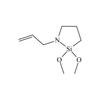
Packaging Under Nitrogen Olefin Functional Dialkoxy Silane Silane coupling agents have the ability to form a durable bond between organic and inorganic materials to generate desired heterogeneous environments or to incorporate the bulk properties of different phases into a uniform composite structure. The general formula has two classes of functionality. The hydrolyzable group forms stable condensation products with siliceous surfaces and other oxides such as those of aluminum, zirconium, tin, titanium, and nickel. The organofunctional group alters the wetting or adhesion characteristics of the substrate, utilizes the substrate to catalyze chemical transformations at the heterogeneous interface, orders the interfacial region, or modifies its partition characteristics, and significantly effects the covalent bond between organic and inorganic materials. Cross-Linking Cyclic Azasilane Cyclic azasilanes react rapidly, less than one minute, with any and all surface hydroxyl groups is therefore of unique interest for surface modification. Volatile cyclic azasilanes afford high functional density monolayers on inorganic surfaces such as nanoparticles and other nanofeatured substrates without a hydrolysis step or the formation of byproducts. They exploit the Si–N and Si–O bond energy differences affording a thermodynamically favorable ring-opening reaction with surface hydroxyls at ambient temperature. N-Allyl-aza-2,2-dime
thoxysilacyclopentan
e
Coupling agent for nanoparticles
Conventional analog available: SIA0400.0
Gelest, Inc.
Done
Datasheet
Description
Additional Properties
Hydrolytic Sensitivity 8: reacts rapidly with moisture, water, protic solvents Safety
Packaging Under Nitrogen Olefin Functional Dialkoxy Silane Silane coupling agents have the ability to form a durable bond between organic and inorganic materials to generate desired heterogeneous environments or to incorporate the bulk properties of different phases into a uniform composite structure. The general formula has two classes of functionality. The hydrolyzable group forms stable condensation products with siliceous surfaces and other oxides such as those of aluminum, zirconium, tin, titanium, and nickel. The organofunctional group alters the wetting or adhesion characteristics of the substrate, utilizes the substrate to catalyze chemical transformations at the heterogeneous interface, orders the interfacial region, or modifies its partition characteristics, and significantly effects the covalent bond between organic and inorganic materials. Cross-Linking Cyclic Azasilane Cyclic azasilanes react rapidly, less than one minute, with any and all surface hydroxyl groups is therefore of unique interest for surface modification. Volatile cyclic azasilanes afford high functional density monolayers on inorganic surfaces such as nanoparticles and other nanofeatured substrates without a hydrolysis step or the formation of byproducts. They exploit the Si–N and Si–O bond energy differences affording a thermodynamically favorable ring-opening reaction with surface hydroxyls at ambient temperature. N-Allyl-aza-2,2-dime
thoxysilacyclopentan
e
Coupling agent for nanoparticles
Conventional analog available: SIA0400.0
Packaging Under Nitrogen
Olefin Functional Dialkoxy Silane
Silane coupling agents have the ability to form a durable bond between organic and inorganic materials to generate desired heterogeneous environments or to incorporate the bulk properties of different phases into a uniform composite structure. The general formula has two classes of functionality. The hydrolyzable group forms stable condensation products with siliceous surfaces and other oxides such as those of aluminum, zirconium, tin, titanium, and nickel. The organofunctional group alters the wetting or adhesion characteristics of the substrate, utilizes the substrate to catalyze chemical transformations at the heterogeneous interface, orders the interfacial region, or modifies its partition characteristics, and significantly effects the covalent bond between organic and inorganic materials.
Cross-Linking Cyclic Azasilane
Cyclic azasilanes react rapidly, less than one minute, with any and all surface hydroxyl groups is therefore of unique interest for surface modification. Volatile cyclic azasilanes afford high functional density monolayers on inorganic surfaces such as nanoparticles and other nanofeatured substrates without a hydrolysis step or the formation of byproducts. They exploit the Si–N and Si–O bond energy differences affording a thermodynamically favorable ring-opening reaction with surface hydroxyls at ambient temperature.
N-Allyl-aza-2,2-dimethoxysilacyclopentane