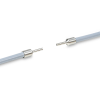
Micro-Epsilon Group Transmission Sensor for Transparent/Translucent Objects optoCONTROL CFS3-M12-600

Description
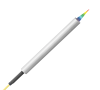
With the transmission sensor, the infrared light emitted by the controller is guided via the optical fiber to the transmitter and from there to the detecting object. There, the light beam is either interrupted or transmitted, depending on the target. The receiving unit of the sensor receives the remaining light and sends it back to the controller via the optical fiber. The remaining light component consists of either the unshielded light component or light transmitted from the object. By illuminating the transmitter through the object, it is possible to detect levels of liquids in jars as well as transparent objects. In addition to detecting transparent and semi-transparent objects, the sensor arrangement of the transmission sensor in transmitted light is ideally suited for area detection, as a light barrier, for distinguishing sizes and diameters, for tolerance inspection and for web edge detection. The CFS3 sensors, in combination with the performance of the CLS1000 series, provide reliable results. Here, the distance variation between the test specimen and receiver or illumination has no noticeable influence on the result. The transmission sensor can be universally used but is also suitable for special solutions (customer-specific adaptions). The sensors are available with different operating ranges, temperature ranges and lengths. This enables a wide range of applications. The fiber optic cable has a sensor head, which is available in different versions: With external thread: For example, threaded sensors can be easily fixed on a mounting bracket. Without external thread: Cylindrical sensor heads are suitable for space-saving mounting. This is achieved by simply setting a grub screw. 90° deflection: If the installation depth and the mounting space are very limited, sensors with integrated 90° deflection are the optimal solution. Flat sensor head: Thanks to the light band, flat sensor heads are ideal for distinguishing sizes and diameters, monitoring web edges, and area detection.
Request a Quote Datasheet
Description
With the transmission sensor, the infrared light emitted by the controller is guided via the optical fiber to the transmitter and from there to the detecting object. There, the light beam is either interrupted or transmitted, depending on the target. The receiving unit of the sensor receives the remaining light and sends it back to the controller via the optical fiber. The remaining light component consists of either the unshielded light component or light transmitted from the object. By illuminating the transmitter through the object, it is possible to detect levels of liquids in jars as well as transparent objects. In addition to detecting transparent and semi-transparent objects, the sensor arrangement of the transmission sensor in transmitted light is ideally suited for area detection, as a light barrier, for distinguishing sizes and diameters, for tolerance inspection and for web edge detection. The CFS3 sensors, in combination with the performance of the CLS1000 series, provide reliable results. Here, the distance variation between the test specimen and receiver or illumination has no noticeable influence on the result. The transmission sensor can be universally used but is also suitable for special solutions (customer-specific adaptions). The sensors are available with different operating ranges, temperature ranges and lengths. This enables a wide range of applications. The fiber optic cable has a sensor head, which is available in different versions: With external thread: For example, threaded sensors can be easily fixed on a mounting bracket. Without external thread: Cylindrical sensor heads are suitable for space-saving mounting. This is achieved by simply setting a grub screw. 90° deflection: If the installation depth and the mounting space are very limited, sensors with integrated 90° deflection are the optimal solution. Flat sensor head: Thanks to the light band, flat sensor heads are ideal for distinguishing sizes and diameters, monitoring web edges, and area detection.
Request a Quote Datasheet

Suppliers

Company
Product
Description
Supplier Links
Transmission Sensor for Transparent/Translucent Objects - optoCONTROL CFS3-M12-600 - Micro-Epsilon Group
Ortenburg, Germany
Transmission Sensor for Transparent/Translucent Objects
optoCONTROL CFS3-M12-600
Transmission Sensor for Transparent/Translucent Objects optoCONTROL CFS3-M12-600
With the transmission sensor, the infrared light emitted by the controller is guided via the optical fiber to the transmitter and from there to the detecting object. There, the light beam is either interrupted or transmitted, depending on the target. The receiving unit of the sensor receives the remaining light and sends it back to the controller via the optical fiber. The remaining light component consists of either the unshielded light component or light transmitted from the object. By illuminating the transmitter through the object, it is possible to detect levels of liquids in jars as well as transparent objects. In addition to detecting transparent and semi-transparent objects, the sensor arrangement of the transmission sensor in transmitted light is ideally suited for area detection, as a light barrier, for distinguishing sizes and diameters, for tolerance inspection and for web edge detection. The CFS3 sensors, in combination with the performance of the CLS1000 series, provide reliable results. Here, the distance variation between the test specimen and receiver or illumination has no noticeable influence on the result. The transmission sensor can be universally used but is also suitable for special solutions (customer-specific adaptions). The sensors are available with different operating ranges, temperature ranges and lengths. This enables a wide range of applications. The fiber optic cable has a sensor head, which is available in different versions: With external thread: For example, threaded sensors can be easily fixed on a mounting bracket. Without external thread: Cylindrical sensor heads are suitable for space-saving mounting. This is achieved by simply setting a grub screw. 90° deflection: If the installation depth and the mounting space are very limited, sensors with integrated 90° deflection are the optimal solution. Flat sensor head: Thanks to the light band, flat sensor heads are ideal for distinguishing sizes and diameters, monitoring web edges, and area detection.

With the transmission sensor, the infrared light emitted by the controller is guided via the optical fiber to the transmitter and from there to the detecting object. There, the light beam is either interrupted or transmitted, depending on the target. The receiving unit of the sensor receives the remaining light and sends it back to the controller via the optical fiber. The remaining light component consists of either the unshielded light component or light transmitted from the object. By illuminating the transmitter through the object, it is possible to detect levels of liquids in jars as well as transparent objects. In addition to detecting transparent and semi-transparent objects, the sensor arrangement of the transmission sensor in transmitted light is ideally suited for area detection, as a light barrier, for distinguishing sizes and diameters, for tolerance inspection and for web edge detection. The CFS3 sensors, in combination with the performance of the CLS1000 series, provide reliable results. Here, the distance variation between the test specimen and receiver or illumination has no noticeable influence on the result. The transmission sensor can be universally used but is also suitable for special solutions (customer-specific adaptions). The sensors are available with different operating ranges, temperature ranges and lengths. This enables a wide range of applications. The fiber optic cable has a sensor head, which is available in different versions: With external thread: For example, threaded sensors can be easily fixed on a mounting bracket. Without external thread: Cylindrical sensor heads are suitable for space-saving mounting. This is achieved by simply setting a grub screw. 90° deflection: If the installation depth and the mounting space are very limited, sensors with integrated 90° deflection are the optimal solution. Flat sensor head: Thanks to the light band, flat sensor heads are ideal for distinguishing sizes and diameters, monitoring web edges, and area detection.

Supplier's Site Datasheet

Technical Specifications

  Micro-Epsilon Group
Product Category Fiber Optic Proximity Sensors
Product Number optoCONTROL CFS3-M12-600
Product Name Transmission Sensor for Transparent/Translucent Objects
Operation Distance 0.0394 to 3.54 inch (1 to 90 mm)
Unlock Full Specs
to access all available technical data

Similar Products

Precise universal confocal sensor - confocalDT IFS2405-10 - Micro-Epsilon Group
Specs
Body Shape Cylindrical
Operation Distance 1.97 to 2.36 inch (50 to 60 mm)
Operating Temperature 41 to 158 F (5 to 70 C)
View Details
Confocal sensor for series applications - confocalDT IFS2404-3 - Micro-Epsilon Group
Specs
Body Shape Cylindrical
Operation Distance 0.9843 to 1.1 inch (25 to 28 mm)
Operating Temperature 41 to 158 F (5 to 70 C)
View Details
Confocal sensor for special requirements - confocalDT IFS2406-2.5/VAC(003) - Micro-Epsilon Group
Specs
Body Shape Cylindrical
Operation Distance 0.6772 to 0.7756 inch (17.2 to 19.7 mm)
Operating Temperature 41 to 158 F (5 to 70 C)
View Details
Confocal miniature sensor - confocalDT IFS2402-0.5 - Micro-Epsilon Group
Specs
Body Shape Cylindrical
Operation Distance 0.0669 to 0.0866 inch (1.7 to 2.2 mm)
Operating Temperature 41 to 158 F (5 to 70 C)
View Details