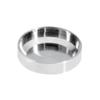
Aluminum Crucibles
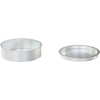
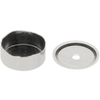
Light aluminum pan with lid Aluminum is the most frequently used pan material for DSC measurements. The light aluminum pan has the shortest signal time constant.
Excellent Thermal Conductivity The pan is particularly suitable for measuring polymer films and powders. This pan type cannot be sealed hermetically.
Lid handling of the pan (I) The lid can also be placed base-down into the pan. In this way, preloaded samples are pressed down towards the base.
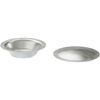
Al 20 μL pan description The crucible has similar outer dimensions as the standard crucble (6.0 mm base; 1.6 mm height). However the mass of the pan (with 14 mg) and lid (9 mg) is clearly reduced.
Plunger/die set for sealing For the light (20 uL) crucibles, a special die/plunger set has to be used (ArtNo: 51140547).
Lid handling of light pan (II) To press substances even more tightly to the base of the pan, the lid is often inverted and sealed with the crucible press.
Lid handling of light pan (III) The narrow space between the pan and the lid leads to the formation of a self-generated atmosphere. Piercing the lid beforehand allows contact with the external atmosphere.
Aluminum background information (I) Aluminum crucibles have a high purity of 99.9%. The maximum usage temperature of the crucibles is 640 °C. At the surface, a thin alumina (Al2O3) layer forms if the crucibles are kept in an ambient atmosphere.
Aluminum background information (II) "... However, this alumina layer is not always perfect; therefore, experts recommend treating crucibles for critical experiments for about 15 min at 400 °C in an air atmosphere. A hazardous substance in combination with aluminum is mercury (poison for Al)."
METTLER TOLEDO Thermal Analysis
Done
Request a Quote
Email Supplier
Description
Aluminum Crucibles
Light aluminum pan with lid Aluminum is the most frequently used pan material for DSC measurements. The light aluminum pan has the shortest signal time constant.
Excellent Thermal Conductivity The pan is particularly suitable for measuring polymer films and powders. This pan type cannot be sealed hermetically.
Lid handling of the pan (I) The lid can also be placed base-down into the pan. In this way, preloaded samples are pressed down towards the base.
Al 20 μL pan description The crucible has similar outer dimensions as the standard crucble (6.0 mm base; 1.6 mm height). However the mass of the pan (with 14 mg) and lid (9 mg) is clearly reduced.
Plunger/die set for sealing For the light (20 uL) crucibles, a special die/plunger set has to be used (ArtNo: 51140547).
Lid handling of light pan (II) To press substances even more tightly to the base of the pan, the lid is often inverted and sealed with the crucible press.
Lid handling of light pan (III) The narrow space between the pan and the lid leads to the formation of a self-generated atmosphere. Piercing the lid beforehand allows contact with the external atmosphere.
Aluminum background information (I) Aluminum crucibles have a high purity of 99.9%. The maximum usage temperature of the crucibles is 640 °C. At the surface, a thin alumina (Al2O3) layer forms if the crucibles are kept in an ambient atmosphere.
Aluminum background information (II) "... However, this alumina layer is not always perfect; therefore, experts recommend treating crucibles for critical experiments for about 15 min at 400 °C in an air atmosphere. A hazardous substance in combination with aluminum is mercury (poison for Al)."