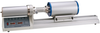
Linseis Inc. Laser Time Domain Thermoreflectance Analyzer TF-LFA

Description
Information of the thermo physical properties of materials and heat transfer optimization of final products is becoming more and more vital for industrial applications. Over the past few decades, the flash method has been developed into the most commonly used technique for the measurement of the thermal diffusivity and thermal conductivity of various kinds of solids, powders and liquids. Thermophysical properties from thin-films are becoming more and more important in industries for products such as, phase-change optical disk media, thermoelectric materials, light emitting diodes (LEDs), phase change memories, flat panel displays and of curse all kinds of semiconductors. In all these cases, a thin film gets deposit on a substrate in order to give a device a particular function. Since the physical properties of these films differ from bulk material, these data are required for accurate thermal management predictions. Based on the well established Laser Flash technique, the Linseis Laserflash for thin films (TF-LFA) now offers a whole range of new possibilities to analyze thermophysical properties of thin films from 80nm up to 20 μm thickness.
Description
Information of the thermo physical properties of materials and heat transfer optimization of final products is becoming more and more vital for industrial applications. Over the past few decades, the flash method has been developed into the most commonly used technique for the measurement of the thermal diffusivity and thermal conductivity of various kinds of solids, powders and liquids. Thermophysical properties from thin-films are becoming more and more important in industries for products such as, phase-change optical disk media, thermoelectric materials, light emitting diodes (LEDs), phase change memories, flat panel displays and of curse all kinds of semiconductors. In all these cases, a thin film gets deposit on a substrate in order to give a device a particular function. Since the physical properties of these films differ from bulk material, these data are required for accurate thermal management predictions. Based on the well established Laser Flash technique, the Linseis Laserflash for thin films (TF-LFA) now offers a whole range of new possibilities to analyze thermophysical properties of thin films from 80nm up to 20 μm thickness.

Suppliers

Company
Product
Description
Supplier Links
Laser Time Domain Thermoreflectance Analyzer - TF-LFA - Linseis Inc.
Robbinsville, NJ, USA
Laser Time Domain Thermoreflectance Analyzer
TF-LFA
Laser Time Domain Thermoreflectance Analyzer TF-LFA
Information of the thermo physical properties of materials and heat transfer optimization of final products is becoming more and more vital for industrial applications. Over the past few decades, the flash method has been developed into the most commonly used technique for the measurement of the thermal diffusivity and thermal conductivity of various kinds of solids, powders and liquids. Thermophysical properties from thin-films are becoming more and more important in industries for products such as, phase-change optical disk media, thermoelectric materials, light emitting diodes (LEDs), phase change memories, flat panel displays and of curse all kinds of semiconductors. In all these cases, a thin film gets deposit on a substrate in order to give a device a particular function. Since the physical properties of these films differ from bulk material, these data are required for accurate thermal management predictions. Based on the well established Laser Flash technique, the Linseis Laserflash for thin films (TF-LFA) now offers a whole range of new possibilities to analyze thermophysical properties of thin films from 80nm up to 20 μm thickness.

Information of the thermo physical properties of materials and heat transfer optimization of final products is becoming more and more vital for industrial applications.

Over the past few decades, the flash method has been developed into the most commonly used technique for the measurement of the thermal diffusivity and thermal conductivity of various kinds of solids, powders and liquids.

Thermophysical properties from thin-films are becoming more and more important in industries for products such as, phase-change optical disk media, thermoelectric materials, light emitting diodes (LEDs), phase change memories, flat panel displays and of curse all kinds of semiconductors. In all these cases, a thin film gets deposit on a substrate in order to give a device a particular function. Since the physical properties of these films differ from bulk material, these data are required for accurate thermal management predictions.

Based on the well established Laser Flash technique, the Linseis Laserflash for thin films (TF-LFA) now offers a whole range of new possibilities to analyze thermophysical properties of thin films from 80nm up to 20 μm thickness.

Supplier's Site

Technical Specifications

  Linseis Inc.
Product Category Calorimeters and Thermal Analyzers
Product Number TF-LFA
Product Name Laser Time Domain Thermoreflectance Analyzer
Thermal Analyzer Type Thermal Conductivity
Properties Measured Thermal Conductivity And Diffusivity
Thermal Analyzer Performance Specs 0.01 mm2/s - 1000 mm2/s, Round or Square Samples
Unlock Full Specs
to access all available technical data

Similar Products

Differential Scanning Calorimeter - NEXTA DSC600 - Hitachi High-Tech America
Specs
Calorimeter Type Differential Scanning Calorimeter
Display Digital
Temperature Range 150 to 725 C (302 to 1337 F)
View Details
COSA 9610™ Wobbe Index, BTU, & CARI Calorimeter -  - COSA Xentaur Corporation
Specs
Calorimeter Type Combustion
Features Cooling (optional feature)
Certifications Ex, FM
View Details
Simultaneous Thermal Analysis Toploading Thermobalance - L81-I - Linseis Inc.
Specs
Thermal Analyzer Type Differential Thermal Analysis; Thermal Gravimetric Analyzer
Calorimeter Type Differential Scanning Calorimeter
Features Programmable Heating; Atmosphere Control; Temperature Control; Coupled with a Mass Spectrometer (optional feature); Coupled with a FTIR Spectrometer (optional feature)
View Details