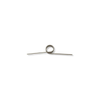
Lee Spring Company Torsion Spring LTL017C 01 M

Description
TORSION SPRINGS are helical springs that exert a torque or rotary force. The ends of torsion springs are attached to other components, and when those components rotate around the center of the spring, the spring tries to push them back to their original position. Although the name implies otherwise, torsion springs are subjected to bending stress rather than torsional stress. They can store and release angular energy or statically hold a mechanism in place by deflecting the legs about the body centerline axis. This type of torsion spring is normally close wound but can have pitch to reduce friction between the coils. They offer resistance to twist or rotationally applied force. Depending on the application, torsion springs can be designed to work in a clockwise or counter-clockwise rotation, thus determining the direction of the wind. Applications: Common torsion springs are used in clothes pins, clipboards, swing-down tailgates and garage doors,. Torsion springs are used for hinges, counterbalances and lever return applications. Sizes range from miniature, used in electronic devices, to large torsion springs used in chair control units. Load should be applied in the direction of wind; unwinding from the free position is not recommended. As they wind up, torsion springs reduce in diameter and their body length becomes longer. This should be considered when design space is limited. Torsion Springs perform best when supported by a rod or tube. The designer should consider the effects of friction and arm deflection on the torque. Configurations: Torsion springs are designed and wound to be actuated rotationally, and to provide an angular return force. There are many options for leg configuration so the spring can be attached in different ways. Leg specifications to consider for torsion springs include leg angle, equal leg length, and leg end style. Springs that are straight or parallel on the same side are considered to have a 0º leg angle the increasing angle is in the unwinding direction. Leg end style choices include straight torsion, straight offset, hinged, short hook ends, and hook ends. Torsion spring ends can be bent, twisted, hooked or looped to suit your project needs. Lee Torsion Stock Springs are offered in a choice of 90 degree, 180 degree, 270 degree and 360 degree free leg position The double torsion spring consists of one set of coils coiled right hand and one set of coils coiled left hand. These coils are connected, usually with an unwound section between the winds and work in parallel. The sections are designed separately with the total torque being the sum of the two.
Description
TORSION SPRINGS are helical springs that exert a torque or rotary force. The ends of torsion springs are attached to other components, and when those components rotate around the center of the spring, the spring tries to push them back to their original position. Although the name implies otherwise, torsion springs are subjected to bending stress rather than torsional stress. They can store and release angular energy or statically hold a mechanism in place by deflecting the legs about the body centerline axis. This type of torsion spring is normally close wound but can have pitch to reduce friction between the coils. They offer resistance to twist or rotationally applied force. Depending on the application, torsion springs can be designed to work in a clockwise or counter-clockwise rotation, thus determining the direction of the wind. Applications: Common torsion springs are used in clothes pins, clipboards, swing-down tailgates and garage doors,. Torsion springs are used for hinges, counterbalances and lever return applications. Sizes range from miniature, used in electronic devices, to large torsion springs used in chair control units. Load should be applied in the direction of wind; unwinding from the free position is not recommended. As they wind up, torsion springs reduce in diameter and their body length becomes longer. This should be considered when design space is limited. Torsion Springs perform best when supported by a rod or tube. The designer should consider the effects of friction and arm deflection on the torque. Configurations: Torsion springs are designed and wound to be actuated rotationally, and to provide an angular return force. There are many options for leg configuration so the spring can be attached in different ways. Leg specifications to consider for torsion springs include leg angle, equal leg length, and leg end style. Springs that are straight or parallel on the same side are considered to have a 0º leg angle the increasing angle is in the unwinding direction. Leg end style choices include straight torsion, straight offset, hinged, short hook ends, and hook ends. Torsion spring ends can be bent, twisted, hooked or looped to suit your project needs. Lee Torsion Stock Springs are offered in a choice of 90 degree, 180 degree, 270 degree and 360 degree free leg position The double torsion spring consists of one set of coils coiled right hand and one set of coils coiled left hand. These coils are connected, usually with an unwound section between the winds and work in parallel. The sections are designed separately with the total torque being the sum of the two.

Suppliers

Company
Product
Description
Supplier Links
Torsion Spring - LTL017C 01 M - Lee Spring Company
Brooklyn, NY, USA
Torsion Spring
LTL017C 01 M
Torsion Spring LTL017C 01 M
TORSION SPRINGS are helical springs that exert a torque or rotary force. The ends of torsion springs are attached to other components, and when those components rotate around the center of the spring, the spring tries to push them back to their original position. Although the name implies otherwise, torsion springs are subjected to bending stress rather than torsional stress. They can store and release angular energy or statically hold a mechanism in place by deflecting the legs about the body centerline axis. This type of torsion spring is normally close wound but can have pitch to reduce friction between the coils. They offer resistance to twist or rotationally applied force. Depending on the application, torsion springs can be designed to work in a clockwise or counter-clockwise rotation, thus determining the direction of the wind. Applications: Common torsion springs are used in clothes pins, clipboards, swing-down tailgates and garage doors,. Torsion springs are used for hinges, counterbalances and lever return applications. Sizes range from miniature, used in electronic devices, to large torsion springs used in chair control units. Load should be applied in the direction of wind; unwinding from the free position is not recommended. As they wind up, torsion springs reduce in diameter and their body length becomes longer. This should be considered when design space is limited. Torsion Springs perform best when supported by a rod or tube. The designer should consider the effects of friction and arm deflection on the torque. Configurations: Torsion springs are designed and wound to be actuated rotationally, and to provide an angular return force. There are many options for leg configuration so the spring can be attached in different ways. Leg specifications to consider for torsion springs include leg angle, equal leg length, and leg end style. Springs that are straight or parallel on the same side are considered to have a 0º leg angle the increasing angle is in the unwinding direction. Leg end style choices include straight torsion, straight offset, hinged, short hook ends, and hook ends. Torsion spring ends can be bent, twisted, hooked or looped to suit your project needs. Lee Torsion Stock Springs are offered in a choice of 90 degree, 180 degree, 270 degree and 360 degree free leg position The double torsion spring consists of one set of coils coiled right hand and one set of coils coiled left hand. These coils are connected, usually with an unwound section between the winds and work in parallel. The sections are designed separately with the total torque being the sum of the two.

TORSION SPRINGS are helical springs that exert a torque or rotary force. The ends of torsion springs are attached to other components, and when those components rotate around the center of the spring, the spring tries to push them back to their original position. Although the name implies otherwise, torsion springs are subjected to bending stress rather than torsional stress. They can store and release angular energy or statically hold a mechanism in place by deflecting the legs about the body centerline axis.
This type of torsion spring is normally close wound but can have pitch to reduce friction between the coils. They offer resistance to twist or rotationally applied force. Depending on the application, torsion springs can be designed to work in a clockwise or counter-clockwise rotation, thus determining the direction of the wind.
Applications: Common torsion springs are used in clothes pins, clipboards, swing-down tailgates and garage doors,. Torsion springs are used for hinges, counterbalances and lever return applications. Sizes range from miniature, used in electronic devices, to large torsion springs used in chair control units. Load should be applied in the direction of wind; unwinding from the free position is not recommended. As they wind up, torsion springs reduce in diameter and their body length becomes longer. This should be considered when design space is limited. Torsion Springs perform best when supported by a rod or tube. The designer should consider the effects of friction and arm deflection on the torque.
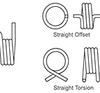
Configurations: Torsion springs are designed and wound to be actuated rotationally, and to provide an angular return force. There are many options for leg configuration so the spring can be attached in different ways. Leg specifications to consider for torsion springs include leg angle, equal leg length, and leg end style. Springs that are straight or parallel on the same side are considered to have a 0º leg angle the increasing angle is in the unwinding direction. Leg end style choices include straight torsion, straight offset, hinged, short hook ends, and hook ends. Torsion spring ends can be bent, twisted, hooked or looped to suit your project needs. Lee Torsion Stock Springs are offered in a choice of 90 degree, 180 degree, 270 degree and 360 degree free leg position
The double torsion spring consists of one set of coils coiled right hand and one set of coils coiled left hand. These coils are connected, usually with an unwound section between the winds and work in parallel. The sections are designed separately with the total torque being the sum of the two.

Supplier's Site

Technical Specifications

  Lee Spring Company
Product Category Torsion Springs
Product Number LTL017C 01 M
Product Name Torsion Spring
Units English
I.D. 0.2500 inch (6.35 mm)
O.D. 0.1600 inch (4.06 mm)
Wire Diameter 0.0170 inch (0.4318 mm)
Spring Length 0.0770 inch (1.96 mm)
Unlock Full Specs
to access all available technical data

Similar Products

Torsional Spring: 180 Deg. Deflection, 2.77mm Minimum Axial Space for Operation - S78TSYM046180035 - Stock Drive Products & Sterling Instrument - SDP/SI
Specs
O.D. 0.2169 inch (5.51 mm)
Wire Diameter 0.0181 inch (0.4600 mm)
Maximum Deflection 180 degrees
View Details
Custom Torsion Springs -  - Coiling Technologies, Inc.
Coiling Technologies, Inc.
Specs
End Style Straight Torsion; Straight Offset; Hinged; Short Hook Ends; Hook Ends; Double Torsion
View Details
Torsion Spring - LTL059K 05 M - Lee Spring Company
Specs
Units English
I.D. 1 inch (25.4 mm)
O.D. 0.6990 inch (17.75 mm)
View Details