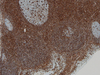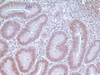
Ventana Medical Systems, Inc. PMS2 760-4531

Description
Microsatellite instability (MSI) is characterised by genome-wide alterations in short, repetitive DNA sequences. It is caused by defects in the nucleotide mismatch repair (MMR) system. Biologically, defective MMR results in a general increase in the mutation rate and the development of a “mutator phenotype.” In colorectal cancer (CRC), high-level MSI was first described in tumors from patients with hereditary non-polyposis colorectal cancer (HNPCC). PMS2 is a useful diagnostic and prognostic marker for hereditary non-polyposis colorectal cancer (HNPCC).
Description
Microsatellite instability (MSI) is characterised by genome-wide alterations in short, repetitive DNA sequences. It is caused by defects in the nucleotide mismatch repair (MMR) system. Biologically, defective MMR results in a general increase in the mutation rate and the development of a “mutator phenotype.” In colorectal cancer (CRC), high-level MSI was first described in tumors from patients with hereditary non-polyposis colorectal cancer (HNPCC). PMS2 is a useful diagnostic and prognostic marker for hereditary non-polyposis colorectal cancer (HNPCC).

Suppliers

Company
Product
Description
Supplier Links
Microsatellite instability (MSI) is characterised by genome-wide alterations in short, repetitive DNA sequences. It is caused by defects in the nucleotide mismatch repair (MMR) system. Biologically, defective MMR results in a general increase in the mutation rate and the development of a “mutator phenotype.” In colorectal cancer (CRC), high-level MSI was first described in tumors from patients with hereditary non-polyposis colorectal cancer (HNPCC). PMS2 is a useful diagnostic and prognostic marker for hereditary non-polyposis colorectal cancer (HNPCC).

Microsatellite instability (MSI) is characterised by genome-wide alterations in short, repetitive DNA sequences. It is caused by defects in the nucleotide mismatch repair (MMR) system. Biologically, defective MMR results in a general increase in the mutation rate and the development of a “mutator phenotype.” In colorectal cancer (CRC), high-level MSI was first described in tumors from patients with hereditary non-polyposis colorectal cancer (HNPCC). PMS2 is a useful diagnostic and prognostic marker for hereditary non-polyposis colorectal cancer (HNPCC).

Supplier's Site

Technical Specifications

  Ventana Medical Systems, Inc.
Product Category Organic Chemicals
Product Number 760-4531
Product Name PMS2
Unlock Full Specs
to access all available technical data

Similar Products

Intermediates and Ingredients for Pharmaceuticals and Agrochemical Compounds -  - AGC Chemicals Americas, Inc.
Specs
Chemical Family All Halogenated
Chemical Name Trifluoroacetic Acid, Trifluoroacetic Anhydride, Ethyl Trifluoroacetate, Sodium Trifluoroacetate, 2,3,4-Trifluoro aniline, Trifluoroacetamide, & More
CAS Number 76-05-1, 407-25-0, 383-63-1, 2923-18-4, 3862-73-5, 354-38-1, 148043-73-6, 30071-93-3, 677-69-0, 122665-97-8, 118612-00-3, 136040-19-2, and More
View Details
DMI 1,3 Dimethyl-2-Imidazolidinone -  - Mitsui Chemicals America, Inc.
Mitsui Chemicals America, Inc.
Specs
Trigger Solvent
Chemical Name DMI 1,3 Dimethyl-2-Imidazolidinone
State of Matter Liquid / Solution
View Details
Solvents -  - Esprix Technologies
Esprix Technologies
Specs
Trigger Solvent
Chemical Name DMSO, NMP, TMAH, MEA, N-aminopropylmorpholine, Butyldiglycol
View Details