Ventana Medical Systems, Inc. CD25 760-4439

Description
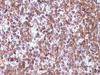
According to the World Health Organization classification system, the major diagnostic criterion for bone marrow involvement by systemicmastocytosis (SM) is the presence of dense aggregates (>15 cells) of mast cells. Expression of CD25, a low-affinity receptorfor interleukin-2 (IL-2), is a reliable diagnostic tool for distinguishing neoplastic mast cell aggregates from reactive proliferations, and has therefore recently become a minor criterion for the diagnosis of SM. Hahn et al. demonstrated that aberrant staining of mast cell clusters by anti-CD25 antibody in GI biopsies was essentially diagnostic of SM. Anti-CD25 antibody has also been useful in identifying mast cells in skin biopsies in the setting of urticaria pigmentosa, which is predictive of systemic mastocytosis. Quantitation of regulatory T cells (Treg) in the setting of hepatocellular carcinoma (HCC) has been used as an independent predictive factor of tumor recurrence after hepatic resection for HCC. Also, the percentage of tumor infiltrating CD25+FOXP3+ regulatory T cells among tumor cells, inside tumor parenchyma and at its periphery, is significantly higher in recurrent cutaneous melanoma than in non-recurrent melanoma.
Description
According to the World Health Organization classification system, the major diagnostic criterion for bone marrow involvement by systemicmastocytosis (SM) is the presence of dense aggregates (>15 cells) of mast cells. Expression of CD25, a low-affinity receptorfor interleukin-2 (IL-2), is a reliable diagnostic tool for distinguishing neoplastic mast cell aggregates from reactive proliferations, and has therefore recently become a minor criterion for the diagnosis of SM. Hahn et al. demonstrated that aberrant staining of mast cell clusters by anti-CD25 antibody in GI biopsies was essentially diagnostic of SM. Anti-CD25 antibody has also been useful in identifying mast cells in skin biopsies in the setting of urticaria pigmentosa, which is predictive of systemic mastocytosis. Quantitation of regulatory T cells (Treg) in the setting of hepatocellular carcinoma (HCC) has been used as an independent predictive factor of tumor recurrence after hepatic resection for HCC. Also, the percentage of tumor infiltrating CD25+FOXP3+ regulatory T cells among tumor cells, inside tumor parenchyma and at its periphery, is significantly higher in recurrent cutaneous melanoma than in non-recurrent melanoma.

Suppliers

Company
Product
Description
Supplier Links
According to the World Health Organization classification system, the major diagnostic criterion for bone marrow involvement by systemicmastocytosis (SM) is the presence of dense aggregates (>15 cells) of mast cells. Expression of CD25, a low-affinity receptorfor interleukin-2 (IL-2), is a reliable diagnostic tool for distinguishing neoplastic mast cell aggregates from reactive proliferations, and has therefore recently become a minor criterion for the diagnosis of SM. Hahn et al. demonstrated that aberrant staining of mast cell clusters by anti-CD25 antibody in GI biopsies was essentially diagnostic of SM. Anti-CD25 antibody has also been useful in identifying mast cells in skin biopsies in the setting of urticaria pigmentosa, which is predictive of systemic mastocytosis. Quantitation of regulatory T cells (Treg) in the setting of hepatocellular carcinoma (HCC) has been used as an independent predictive factor of tumor recurrence after hepatic resection for HCC. Also, the percentage of tumor infiltrating CD25+FOXP3+ regulatory T cells among tumor cells, inside tumor parenchyma and at its periphery, is significantly higher in recurrent cutaneous melanoma than in non-recurrent melanoma.

According to the World Health Organization classification system, the major diagnostic criterion for bone marrow involvement by systemicmastocytosis (SM) is the presence of dense aggregates (>15 cells) of mast cells. Expression of CD25, a low-affinity receptorfor interleukin-2 (IL-2), is a reliable diagnostic tool for distinguishing neoplastic mast cell aggregates from reactive proliferations, and has therefore recently become a minor criterion for the diagnosis of SM. Hahn et al. demonstrated that aberrant staining of mast cell clusters by anti-CD25 antibody in GI biopsies was essentially diagnostic of SM. Anti-CD25 antibody has also been useful in identifying mast cells in skin biopsies in the setting of urticaria pigmentosa, which is predictive of systemic mastocytosis. Quantitation of regulatory T cells (Treg) in the setting of hepatocellular carcinoma (HCC) has been used as an independent predictive factor of tumor recurrence after hepatic resection for HCC. Also, the percentage of tumor infiltrating CD25+FOXP3+ regulatory T cells among tumor cells, inside tumor parenchyma and at its periphery, is significantly higher in recurrent cutaneous melanoma than in non-recurrent melanoma.

Supplier's Site

Technical Specifications

  Ventana Medical Systems, Inc.
Product Category Organic Chemicals
Product Number 760-4439
Product Name CD25
Unlock Full Specs
to access all available technical data

Similar Products

DMI 1,3 Dimethyl-2-Imidazolidinone -  - Mitsui Chemicals America, Inc.
Mitsui Chemicals America, Inc.
Specs
Trigger Solvent
Chemical Name DMI 1,3 Dimethyl-2-Imidazolidinone
State of Matter Liquid / Solution
View Details
AsahiKlin Precision Cleaning Solvent - AE3000AT - AGC Chemicals Americas, Inc.
Specs
Trigger Solvent
Chemical Family All Alkenes; All Halogenated; All Ethers
Chemical Name Trans-1,2 Dichloroethylene
View Details
METHYLCELLULOSE GEL (1 %) -  - Medisca Inc.
Specs
Trigger Base
View Details
Acid Alcohol Trichrome Stain - s2031 - Poly Scientific
Specs
Trigger Acid
Chemical Family All Alcohols
Chemical Name Acid Alcohol Trichrome Stain
View Details