Ventana Medical Systems, Inc. NGFR 760-4391

Description
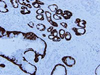
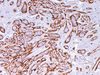
NGFR, a 75 kd glycoprotein (also known as P-75NTR), is the first of neurotrophin receptors to be isolated and is a member of the tumor necrosis factor (TNF) receptor family. It is expressed not only in sympathetic and sensory neurons, but also in various neural crest cell or tumor derivatives such as melanocytes, melanomas, neuroblastomas, pheochromocytomas, neurofibromas, and neurotized nevi (type C melanocytes). NGFR has been shown to be a reliable marker for desmoplastic and neurotropic melanoma by several groups. Although the sensitivity of NGFR staining in desmoplastic melanomas has not been systematically analyzed, all reported cases stain with NGFR. A review of 9 cases of desmoplastic melanomas diagnosed in the Dermatopathology Section of the Department of Dermatology at Boston University School of Medicine between 2001 and 2004 disclosed that all 9 cases of desmoplastic melanomas tested stained positively with NGFR. These findings are in contrast to a study reported by Huttenbach et al in which only 33% of their desmoplastic melanomas stained with NGFR. This difference emphasizes the importance of the choice of monoclonal antibody to obtain consistent results. This staining property of desmoplastic melanoma cells can be useful in diagnosing challenging cases, namely early lesions, suspected cases with negative or weak S-100 staining, and those that must be distinguished from a scar. It is now apparent that expression of NGFR is ubiquitous and not limited to the nervous system, being expressed in mature nonneural cells such as perivascular cells, dental pulp cells, lymphoidal follicular dendritic cells, basal epithelium of oral mucosa and hair follicles, prostate basal cells and myoepithelial cells. Unlike the high-affinity nerve growth factor tyrosine kinase receptors (TrkA, TrkB and TrkC), NGFR has no intrinsic tyrosine kinase activity. Studies in prostate and urothelial cancer suggest that NGFR may act as a tumor suppressor, negatively regulating cell growth and proliferation. Anti-NGFR labels the myoepithelial cells of breast ducts and intralobular fibroblasts of breast ducts and thus aides in the diagnosis of malignancy in the breast.
Description
NGFR, a 75 kd glycoprotein (also known as P-75NTR), is the first of neurotrophin receptors to be isolated and is a member of the tumor necrosis factor (TNF) receptor family. It is expressed not only in sympathetic and sensory neurons, but also in various neural crest cell or tumor derivatives such as melanocytes, melanomas, neuroblastomas, pheochromocytomas, neurofibromas, and neurotized nevi (type C melanocytes). NGFR has been shown to be a reliable marker for desmoplastic and neurotropic melanoma by several groups. Although the sensitivity of NGFR staining in desmoplastic melanomas has not been systematically analyzed, all reported cases stain with NGFR. A review of 9 cases of desmoplastic melanomas diagnosed in the Dermatopathology Section of the Department of Dermatology at Boston University School of Medicine between 2001 and 2004 disclosed that all 9 cases of desmoplastic melanomas tested stained positively with NGFR. These findings are in contrast to a study reported by Huttenbach et al in which only 33% of their desmoplastic melanomas stained with NGFR. This difference emphasizes the importance of the choice of monoclonal antibody to obtain consistent results. This staining property of desmoplastic melanoma cells can be useful in diagnosing challenging cases, namely early lesions, suspected cases with negative or weak S-100 staining, and those that must be distinguished from a scar. It is now apparent that expression of NGFR is ubiquitous and not limited to the nervous system, being expressed in mature nonneural cells such as perivascular cells, dental pulp cells, lymphoidal follicular dendritic cells, basal epithelium of oral mucosa and hair follicles, prostate basal cells and myoepithelial cells. Unlike the high-affinity nerve growth factor tyrosine kinase receptors (TrkA, TrkB and TrkC), NGFR has no intrinsic tyrosine kinase activity. Studies in prostate and urothelial cancer suggest that NGFR may act as a tumor suppressor, negatively regulating cell growth and proliferation. Anti-NGFR labels the myoepithelial cells of breast ducts and intralobular fibroblasts of breast ducts and thus aides in the diagnosis of malignancy in the breast.

Suppliers

Company
Product
Description
Supplier Links
NGFR, a 75 kd glycoprotein (also known as P-75NTR), is the first of neurotrophin receptors to be isolated and is a member of the tumor necrosis factor (TNF) receptor family. It is expressed not only in sympathetic and sensory neurons, but also in various neural crest cell or tumor derivatives such as melanocytes, melanomas, neuroblastomas, pheochromocytomas, neurofibromas, and neurotized nevi (type C melanocytes). NGFR has been shown to be a reliable marker for desmoplastic and neurotropic melanoma by several groups. Although the sensitivity of NGFR staining in desmoplastic melanomas has not been systematically analyzed, all reported cases stain with NGFR. A review of 9 cases of desmoplastic melanomas diagnosed in the Dermatopathology Section of the Department of Dermatology at Boston University School of Medicine between 2001 and 2004 disclosed that all 9 cases of desmoplastic melanomas tested stained positively with NGFR. These findings are in contrast to a study reported by Huttenbach et al in which only 33% of their desmoplastic melanomas stained with NGFR. This difference emphasizes the importance of the choice of monoclonal antibody to obtain consistent results. This staining property of desmoplastic melanoma cells can be useful in diagnosing challenging cases, namely early lesions, suspected cases with negative or weak S-100 staining, and those that must be distinguished from a scar. It is now apparent that expression of NGFR is ubiquitous and not limited to the nervous system, being expressed in mature nonneural cells such as perivascular cells, dental pulp cells, lymphoidal follicular dendritic cells, basal epithelium of oral mucosa and hair follicles, prostate basal cells and myoepithelial cells. Unlike the high-affinity nerve growth factor tyrosine kinase receptors (TrkA, TrkB and TrkC), NGFR has no intrinsic tyrosine kinase activity. Studies in prostate and urothelial cancer suggest that NGFR may act as a tumor suppressor, negatively regulating cell growth and proliferation. Anti-NGFR labels the myoepithelial cells of breast ducts and intralobular fibroblasts of breast ducts and thus aides in the diagnosis of malignancy in the breast.

NGFR, a 75 kd glycoprotein (also known as P-75NTR), is the first of neurotrophin receptors to be isolated and is a member of the tumor necrosis factor (TNF) receptor family. It is expressed not only in sympathetic and sensory neurons, but also in various neural crest cell or tumor derivatives such as melanocytes, melanomas, neuroblastomas, pheochromocytomas, neurofibromas, and neurotized nevi (type C melanocytes). NGFR has been shown to be a reliable marker for desmoplastic and neurotropic melanoma by several groups. Although the sensitivity of NGFR staining in desmoplastic melanomas has not been systematically analyzed, all reported cases stain with NGFR. A review of 9 cases of desmoplastic melanomas diagnosed in the Dermatopathology Section of the Department of Dermatology at Boston University School of Medicine between 2001 and 2004 disclosed that all 9 cases of desmoplastic melanomas tested stained positively with NGFR. These findings are in contrast to a study reported by Huttenbach et al in which only 33% of their desmoplastic melanomas stained with NGFR. This difference emphasizes the importance of the choice of monoclonal antibody to obtain consistent results. This staining property of desmoplastic melanoma cells can be useful in diagnosing challenging cases, namely early lesions, suspected cases with negative or weak S-100 staining, and those that must be distinguished from a scar.
It is now apparent that expression of NGFR is ubiquitous and not limited to the nervous system, being expressed in mature nonneural cells such as perivascular cells, dental pulp cells, lymphoidal follicular dendritic cells, basal epithelium of oral mucosa and hair follicles, prostate basal cells and myoepithelial cells. Unlike the high-affinity nerve growth factor tyrosine kinase receptors (TrkA, TrkB and TrkC), NGFR has no intrinsic tyrosine kinase activity. Studies in prostate and urothelial cancer suggest that NGFR may act as a tumor suppressor, negatively regulating cell growth and proliferation. Anti-NGFR labels the myoepithelial cells of breast ducts and intralobular fibroblasts of breast ducts and thus aides in the diagnosis of malignancy in the breast.

Supplier's Site

Technical Specifications

  Ventana Medical Systems, Inc.
Product Category Organic Chemicals
Product Number 760-4391
Product Name NGFR
Unlock Full Specs
to access all available technical data

Similar Products

AsahiKlin Precision Cleaning Solvent - AE3100E - AGC Chemicals Americas, Inc.
Specs
Trigger Solvent
Chemical Family All Halogenated; All Ethers; Ethanol
Chemical Name 1,1,2,2- tetra fluoroethyl-2,2,2- trifluoro ethyl ether
View Details
DMI 1,3 Dimethyl-2-Imidazolidinone -  - Mitsui Chemicals America, Inc.
Mitsui Chemicals America, Inc.
Specs
Trigger Solvent
Chemical Name DMI 1,3 Dimethyl-2-Imidazolidinone
State of Matter Liquid / Solution
View Details
CONFIRM Kappa - 760-2514 - Ventana Medical Systems, Inc.
Ventana Medical Systems, Inc.
View Details