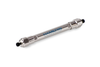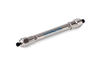
Hamilton Company PRP-h5 5 µm 2.1 x 100 mm 79270

Description
The PRP-h5 utilizes the PRP-3 as its base with a pentafluorinated modification, making it more hydrophobic in nature. The PRP-h5, with its functionality derived from a pentafluorinated polymer bead, delivers a selectivity difference from standard silica C18 stationary phases. This gives chromatographers the desired retention characteristics necessary for certain sample types. This difference is especially pronounced for halogenated solutes. Unlike silica-based C8 or C18 columns, PRP-h5 has no stationary phase coating. Since there is no stationary phase to hydrolyze, the column maintains its performance characteristics longer than many silica-based C8 or C18 columns. Applications Organic compounds: macromolecules (> 2,000 mw), pharmaceuticals, protein digests, tryptic digests, proteomics
Request a Quote
Datasheet
Datasheet Summary
Powered by GS/AI

The PRP-h5 HPLC column is a polymeric reversed-phase column designed for oligonucleotide purification and general analyte separations under extreme conditions. It features a 2.1 mm internal diameter and 100 mm length, constructed from cross-linked poly(styrene-co-divinylbenzene) with 5 µm particle size and 300 Å pore size. The column operates stably across a full pH range of 1 to 13, resists degradation from harsh solvents including 1 M sodium hydroxide, and enables lower system pressures than traditional polymer columns due to minimized swelling. It offers enhanced sample recovery and reduced carry-over contamination. Multiple lengths and diameters are available in the PRP-h5 series.

Suppliers

Company
Product
Description
Supplier Links
PRP-h5 5 µm 2.1 x 100 mm - 79270 - Hamilton Company
Reno, NV, United States
PRP-h5 5 µm 2.1 x 100 mm
79270
PRP-h5 5 µm 2.1 x 100 mm 79270
The PRP-h5 utilizes the PRP-3 as its base with a pentafluorinated modification, making it more hydrophobic in nature. The PRP-h5, with its functionality derived from a pentafluorinated polymer bead, delivers a selectivity difference from standard silica C18 stationary phases. This gives chromatographers the desired retention characteristics necessary for certain sample types. This difference is especially pronounced for halogenated solutes. Unlike silica-based C8 or C18 columns, PRP-h5 has no stationary phase coating. Since there is no stationary phase to hydrolyze, the column maintains its performance characteristics longer than many silica-based C8 or C18 columns. Applications Organic compounds: macromolecules (> 2,000 mw), pharmaceuticals, protein digests, tryptic digests, proteomics

The PRP-h5 utilizes the PRP-3 as its base with a pentafluorinated modification, making it more hydrophobic in nature. The PRP-h5, with its functionality derived from a pentafluorinated polymer bead, delivers a selectivity difference from standard silica C18 stationary phases. This gives chromatographers the desired retention characteristics necessary for certain sample types. This difference is especially pronounced for halogenated solutes.

Unlike silica-based C8 or C18 columns, PRP-h5 has no stationary phase coating. Since there is no stationary phase to hydrolyze, the column maintains its performance characteristics longer than many silica-based C8 or C18 columns.

Applications

Organic compounds: macromolecules (> 2,000 mw), pharmaceuticals, protein digests, tryptic digests, proteomics

Supplier's Site Datasheet

Technical Specifications

  Hamilton Company
Product Category HPLC Columns
Product Number 79270
Product Name PRP-h5 5 µm 2.1 x 100 mm
Column Type Analytical
Stationary Phase/Separation Process Reversed Phase
Construction Material Stainless Steel
Packing Diameter 5 µm (0.1969 mils)
Pore Diameter 0.0300 µm (0.0012 mils)
Unlock Full Specs
to access all available technical data

Similar Products

PRP-X100 5 µm 2.1 x 250 mm - 79190 - Hamilton Company
Specs
Column Type Analytical
Stationary Phase/Separation Process Ion Exchange
Construction Material Stainless Steel
View Details
PRP-1 7 µm 10 x 250 mm - 79531 - Hamilton Company
Specs
Column Type Analytical
Stationary Phase/Separation Process Reversed Phase
Construction Material Stainless Steel
View Details
PRP-X100 10 µm 4.6 x 150 mm PEEK - 79354 - Hamilton Company
Specs
Column Type Analytical
Stationary Phase/Separation Process Ion Exchange
Construction Material polymer
View Details
PRP-1 10 µm 7 x 100 mm - 79495 - Hamilton Company
Specs
Column Type Analytical
Stationary Phase/Separation Process Reversed Phase
Construction Material Stainless Steel
View Details