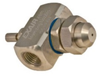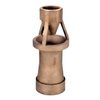
EXAIR Tank Mixing Nozzle

Description
It is necessary to keep tank contents mixed or agitated in many applications. Conventional mixing in a tank requires mechanical mixing components, such as a large, motor-driven impeller. However, many applications in which immiscible liquids need to be kept mixed or solids kept suspended may be done so with only a pump and submerged spray nozzles, greatly reducing system complexity, capital cost, and maintenance requirements. Eductor mixing nozzles (BETE TurboMix) are completely submerged below the liquid in the tank and operate based on the simple premise that when velocity increases, pressure decreases. They are designed to take the velocity of the fluid pumped into the nozzle and convert it into a low-pressure zone that induces surrounding liquid in the tank to enter into the nozzle. In this fashion, the pumped fluid is effectively mixed with the tank contents, and the amount of fluid that exits the nozzle is three to five times the amount of fluid pumped. This multiplier effect allows greater mixing efficiency while using a smaller pumping capacity.
Request a Quote
Description
It is necessary to keep tank contents mixed or agitated in many applications. Conventional mixing in a tank requires mechanical mixing components, such as a large, motor-driven impeller. However, many applications in which immiscible liquids need to be kept mixed or solids kept suspended may be done so with only a pump and submerged spray nozzles, greatly reducing system complexity, capital cost, and maintenance requirements. Eductor mixing nozzles (BETE TurboMix) are completely submerged below the liquid in the tank and operate based on the simple premise that when velocity increases, pressure decreases. They are designed to take the velocity of the fluid pumped into the nozzle and convert it into a low-pressure zone that induces surrounding liquid in the tank to enter into the nozzle. In this fashion, the pumped fluid is effectively mixed with the tank contents, and the amount of fluid that exits the nozzle is three to five times the amount of fluid pumped. This multiplier effect allows greater mixing efficiency while using a smaller pumping capacity.
Request a Quote

Suppliers

Company
Product
Description
Supplier Links
Tank Mixing Nozzle -  - EXAIR
Cincinnati, OH, United States
Tank Mixing Nozzle
Tank Mixing Nozzle
It is necessary to keep tank contents mixed or agitated in many applications. Conventional mixing in a tank requires mechanical mixing components, such as a large, motor-driven impeller. However, many applications in which immiscible liquids need to be kept mixed or solids kept suspended may be done so with only a pump and submerged spray nozzles, greatly reducing system complexity, capital cost, and maintenance requirements. Eductor mixing nozzles (BETE TurboMix) are completely submerged below the liquid in the tank and operate based on the simple premise that when velocity increases, pressure decreases. They are designed to take the velocity of the fluid pumped into the nozzle and convert it into a low-pressure zone that induces surrounding liquid in the tank to enter into the nozzle. In this fashion, the pumped fluid is effectively mixed with the tank contents, and the amount of fluid that exits the nozzle is three to five times the amount of fluid pumped. This multiplier effect allows greater mixing efficiency while using a smaller pumping capacity.

It is necessary to keep tank contents mixed or agitated in many applications. Conventional mixing in a tank requires mechanical mixing components, such as a large, motor-driven impeller. However, many applications in which immiscible liquids need to be kept mixed or solids kept suspended may be done so with only a pump and submerged spray nozzles, greatly reducing system complexity, capital cost, and maintenance requirements. Eductor mixing nozzles (BETE TurboMix) are completely submerged below the liquid in the tank and operate based on the simple premise that when velocity increases, pressure decreases. They are designed to take the velocity of the fluid pumped into the nozzle and convert it into a low-pressure zone that induces surrounding liquid in the tank to enter into the nozzle. In this fashion, the pumped fluid is effectively mixed with the tank contents, and the amount of fluid that exits the nozzle is three to five times the amount of fluid pumped. This multiplier effect allows greater mixing efficiency while using a smaller pumping capacity.

Supplier's Site

Technical Specifications

  EXAIR
Product Category Nozzles
Product Name Tank Mixing Nozzle
Media Water
Unlock Full Specs
to access all available technical data

Similar Products

Super Air Nozzles -  - EXAIR
Specs
Media Air
Application Cleaning; Spray Drying; Cooling
Pattern Solid Cone
View Details
High Power Safety Air Nozzle -  - EXAIR
Specs
Media Air
Application Cleaning; Spray Drying; Cooling
Pattern Solid Cone
View Details
HydroWhirl® Poseidon (HWP) Corrosion-Resistant PTFE Tank Cleaning Nozzle -  - EXAIR
Specs
Media Water
Application Cleaning
Flow 538 to 1290 GPH (565 to 1356 ml/sec)
View Details
WL Series Low Flow Full Cone Nozzle, 1/8 NPT -  - EXAIR
Specs
Media Water
Application Cleaning
Pattern Hollow Cone
View Details