CeNing Optics Co., Ltd. CaF2 Crystals

Description
Calcium fluoride CaF2 is commonly used as a window material for both infrared and ultraviolet wavelengths, since it is transparent in these regions (about 0.15mm to 9mm) and exhibits extremely weak birefringence. Furthermore, the material is fairly inert chemically, so that these windows are not attacked. Nevertheless, at wavelengths as low as 157nm, which are appealing to semiconductor manufacturers, the birefringence of calcium fluoride exceeds tolerable limits. Fluorides are toxic to humans, however CaF2 is considered relatively harmless due to its extreme insolubility. CeNing Optics provides artificially-crystal lized calcium fluoride components available in IR grade and UV Grade. Note: The cost of UV grade crystals is much more expensive than IR grade crystals.
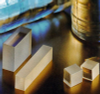
Request a Quote Datasheet
Description
Calcium fluoride CaF2 is commonly used as a window material for both infrared and ultraviolet wavelengths, since it is transparent in these regions (about 0.15mm to 9mm) and exhibits extremely weak birefringence. Furthermore, the material is fairly inert chemically, so that these windows are not attacked. Nevertheless, at wavelengths as low as 157nm, which are appealing to semiconductor manufacturers, the birefringence of calcium fluoride exceeds tolerable limits. Fluorides are toxic to humans, however CaF2 is considered relatively harmless due to its extreme insolubility. CeNing Optics provides artificially-crystal lized calcium fluoride components available in IR grade and UV Grade. Note: The cost of UV grade crystals is much more expensive than IR grade crystals.
Request a Quote Datasheet

Suppliers

Company
Product
Description
Supplier Links
CaF<sub>2</sub> Crystals -  - CeNing Optics Co., Ltd.
Fuzhou, China
CaF2 Crystals
CaF2 Crystals
Calcium fluoride CaF2 is commonly used as a window material for both infrared and ultraviolet wavelengths, since it is transparent in these regions (about 0.15mm to 9mm) and exhibits extremely weak birefringence. Furthermore, the material is fairly inert chemically, so that these windows are not attacked. Nevertheless, at wavelengths as low as 157nm, which are appealing to semiconductor manufacturers, the birefringence of calcium fluoride exceeds tolerable limits. Fluorides are toxic to humans, however CaF2 is considered relatively harmless due to its extreme insolubility. CeNing Optics provides artificially-crystal lized calcium fluoride components available in IR grade and UV Grade. Note: The cost of UV grade crystals is much more expensive than IR grade crystals.

Calcium fluoride CaF2 is commonly used as a window material for both infrared and ultraviolet wavelengths, since it is transparent in these regions (about 0.15mm to 9mm) and exhibits extremely weak birefringence. Furthermore, the material is fairly inert chemically, so that these windows are not attacked. Nevertheless, at wavelengths as low as 157nm, which are appealing to semiconductor manufacturers, the birefringence of calcium fluoride exceeds tolerable limits.

Fluorides are toxic to humans, however CaF2 is considered relatively harmless due to its extreme insolubility.

CeNing Optics provides artificially-crystallized calcium fluoride components available in IR grade and UV Grade. Note: The cost of UV grade crystals is much more expensive than IR grade crystals.

Supplier's Site Datasheet

Technical Specifications

  CeNing Optics Co., Ltd.
Product Category Optical Crystals
Product Name CaF2 Crystals
Material CaF2 Crystals
Unlock Full Specs
to access all available technical data

Similar Products

BBO Crystals -  - CeNing Optics Co., Ltd.
CeNing Optics Co., Ltd.
Specs
Type Q-Switch
Material BBO
Azimuthal Angle 0.0 to 30 degrees
View Details
Un-doped YAG Crystals -  - CeNing Optics Co., Ltd.
CeNing Optics Co., Ltd.
Specs
Material Un-doped YAG Crystals
Surface Quality 20-10 Scratch / Dig
Surface Flatness λ/8
View Details
Nd:YAG Crystals -  - CeNing Optics Co., Ltd.
CeNing Optics Co., Ltd.
Specs
Material Nd:YAG Crystals
Surface Quality 20-10 Scratch / Dig
Surface Flatness λ/8
View Details