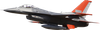
The QF-16 Full Scale Aerial Target will provide the next generation of combat training and testing for U.S. warfighters. Retired F-16 aircraft are converted into QF-16 aerial targets for the purpose of testing newly developed weapons and tactics. The QF-16 will replace the existing QF-4 fleet, and provide a higher capability, fourth generation aerial target that is more representative of today’s targets and threats.
QF-16 Quick Facts
The Boeing team leverages the capabilities of the entire Boeing Company for execution of the QF-16 aerial target program.
The QF-16 has Peculiar Support Equipment with improved test and fault isolation.
All eight wing stations are active, pre-wired spare payload discrete, and have a modular payload design for easy programmability.
Boeing and the U.S. Air Force completed the first unmanned flight of the QF-16 Full Scale Aerial Target on Sept. 23, 2013, at Tyndall Air Force Base, Fla.
The QF-16 mission profile included auto takeoff, a series of simulated maneuvers, supersonic flight and an auto land all without a pilot in the cockpit.
Testing on the six aircraft continues at Holloman Air Force Base, N.M.
Technical Specifications
Primary Function
Full-scale aerial target
Contractor
The Boeing Company
Power Plant
F-16A/C: one Pratt and Whitney F100-PW-200/220/229 or General Electric F110-GE-100/129
F-16 Maneuverability
Fully maintained, including supersonic speeds and 9g turns
Radar Cross Section
4 to 4.5 generation capability
Countermeasures
F-16 chaff & flares; EA pods, ALQ-188 & ALQ-167
120nm GRDCS datalink
Improved TVI clock/position, data latency, and frequency stability
Weapon Accuracy Scoring
Improved Doppler system
Range Safety
Flight termination qualified to RCC-319
The QF-16 Full Scale Aerial Target will provide the next generation of combat training and testing for U.S. warfighters. Retired F-16 aircraft are converted into QF-16 aerial targets for the purpose of testing newly developed weapons and tactics. The QF-16 will replace the existing QF-4 fleet, and provide a higher capability, fourth generation aerial target that is more representative of today’s targets and threats.
QF-16 Quick Facts
- The Boeing team leverages the capabilities of the entire Boeing Company for execution of the QF-16 aerial target program.
- The QF-16 has Peculiar Support Equipment with improved test and fault isolation.
- All eight wing stations are active, pre-wired spare payload discrete, and have a modular payload design for easy programmability.
- Boeing and the U.S. Air Force completed the first unmanned flight of the QF-16 Full Scale Aerial Target on Sept. 23, 2013, at Tyndall Air Force Base, Fla.
- The QF-16 mission profile included auto takeoff, a series of simulated maneuvers, supersonic flight and an auto land all without a pilot in the cockpit.
- Testing on the six aircraft continues at Holloman Air Force Base, N.M.
Technical Specifications
|
Primary Function | Full-scale aerial target |
|
Contractor | The Boeing Company |
|
Power Plant | F-16A/C: one Pratt and Whitney F100-PW-200/220/229 or General Electric F110-GE-100/129 |
|
F-16 Maneuverability | Fully maintained, including supersonic speeds and 9g turns |
|
Radar Cross Section | 4 to 4.5 generation capability |
|
Countermeasures | F-16 chaff & flares; EA pods, ALQ-188 & ALQ-167 |
|
120nm GRDCS datalink | Improved TVI clock/position, data latency, and frequency stability |
|
Weapon Accuracy Scoring | Improved Doppler system |
|
Range Safety | Flight termination qualified to RCC-319 |