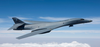
Boeing Company (The) Long-range Multi-role Heavy Bomber B-1B Lancer

Description
Nicknamed “The Bone,” the B-1B Lancer is a long-range, multi-mission conventional bomber, which has served the United States Air Force since 1985. Originally designed for nuclear capabilities, the B-1 switched to an exclusively conventional combat role in the mid 1990’s. In 1999, during Operation Allied Force, six B-1s flew 2 percent of the strike missions, yet dropped 20 percent of the ordnance. The B-1 has been nearly continuously deployed in combat operations over Afghanistan and Iraq since 2001. B-1B Lancer Technical Specifications Function Long-range, multi-role, heavy bomber Power plant Four General Electric F101-GE-102 turbofan engine with afterburner Thrust 30,000-plus pounds with afterburner, per engine Wingspan 137 ft (41.8 m) extended forward, 79 ft (24.1 m) swept aft Length 146 ft (44.5 meters) Height 34 ft (10.4 meters) Weight Approximately 190,000 lbs (86,183 kg) Max Takeoff Weight 477,000 lbs (216,634 kg) Fuel Capacity 265,274 lbs (120,326 kg) Payload 75,000 lbs internal (34,019 kg), 50,000 lbs (22,679 kg) Speed 900-plus mph (Mach 1.2 at sea level) Range Intercontinental Ceiling More than 30,000 ft (9,144 m) Crew 4 (aircraft commander, copilot, and two weapon systems officers) Inventory 66
Description
Nicknamed “The Bone,” the B-1B Lancer is a long-range, multi-mission conventional bomber, which has served the United States Air Force since 1985. Originally designed for nuclear capabilities, the B-1 switched to an exclusively conventional combat role in the mid 1990’s. In 1999, during Operation Allied Force, six B-1s flew 2 percent of the strike missions, yet dropped 20 percent of the ordnance. The B-1 has been nearly continuously deployed in combat operations over Afghanistan and Iraq since 2001. B-1B Lancer Technical Specifications Function Long-range, multi-role, heavy bomber Power plant Four General Electric F101-GE-102 turbofan engine with afterburner Thrust 30,000-plus pounds with afterburner, per engine Wingspan 137 ft (41.8 m) extended forward, 79 ft (24.1 m) swept aft Length 146 ft (44.5 meters) Height 34 ft (10.4 meters) Weight Approximately 190,000 lbs (86,183 kg) Max Takeoff Weight 477,000 lbs (216,634 kg) Fuel Capacity 265,274 lbs (120,326 kg) Payload 75,000 lbs internal (34,019 kg), 50,000 lbs (22,679 kg) Speed 900-plus mph (Mach 1.2 at sea level) Range Intercontinental Ceiling More than 30,000 ft (9,144 m) Crew 4 (aircraft commander, copilot, and two weapon systems officers) Inventory 66

Suppliers

Company
Product
Description
Supplier Links
Long-range Multi-role Heavy Bomber - B-1B Lancer - Boeing Company (The)
Chicago, IL, USA
Long-range Multi-role Heavy Bomber
B-1B Lancer
Long-range Multi-role Heavy Bomber B-1B Lancer
Nicknamed “The Bone,” the B-1B Lancer is a long-range, multi-mission conventional bomber, which has served the United States Air Force since 1985. Originally designed for nuclear capabilities, the B-1 switched to an exclusively conventional combat role in the mid 1990’s. In 1999, during Operation Allied Force, six B-1s flew 2 percent of the strike missions, yet dropped 20 percent of the ordnance. The B-1 has been nearly continuously deployed in combat operations over Afghanistan and Iraq since 2001. B-1B Lancer Technical Specifications Function Long-range, multi-role, heavy bomber Power plant Four General Electric F101-GE-102 turbofan engine with afterburner Thrust 30,000-plus pounds with afterburner, per engine Wingspan 137 ft (41.8 m) extended forward, 79 ft (24.1 m) swept aft Length 146 ft (44.5 meters) Height 34 ft (10.4 meters) Weight Approximately 190,000 lbs (86,183 kg) Max Takeoff Weight 477,000 lbs (216,634 kg) Fuel Capacity 265,274 lbs (120,326 kg) Payload 75,000 lbs internal (34,019 kg), 50,000 lbs (22,679 kg) Speed 900-plus mph (Mach 1.2 at sea level) Range Intercontinental Ceiling More than 30,000 ft (9,144 m) Crew 4 (aircraft commander, copilot, and two weapon systems officers) Inventory 66

Nicknamed “The Bone,” the B-1B Lancer is a long-range, multi-mission conventional bomber, which has served the United States Air Force since 1985. Originally designed for nuclear capabilities, the B-1 switched to an exclusively conventional combat role in the mid 1990’s. In 1999, during Operation Allied Force, six B-1s flew 2 percent of the strike missions, yet dropped 20 percent of the ordnance. The B-1 has been nearly continuously deployed in combat operations over Afghanistan and Iraq since 2001.

B-1B Lancer Technical Specifications

Function

Long-range, multi-role, heavy bomber

Power plant

Four General Electric F101-GE-102 turbofan engine with afterburner

Thrust

30,000-plus pounds with afterburner, per engine

Wingspan

137 ft (41.8 m) extended forward, 79 ft (24.1 m) swept aft

Length

146 ft (44.5 meters)

Height

34 ft (10.4 meters)

Weight

Approximately 190,000 lbs (86,183 kg)

Max Takeoff Weight

477,000 lbs (216,634 kg)

Fuel Capacity

265,274 lbs (120,326 kg)

Payload

75,000 lbs internal (34,019 kg), 50,000 lbs (22,679 kg)

Speed

900-plus mph (Mach 1.2 at sea level)

Range

Intercontinental

Ceiling

More than 30,000 ft (9,144 m)

Crew

4 (aircraft commander, copilot, and two weapon systems officers)

Inventory

66
Supplier's Site

Technical Specifications

  Boeing Company (The)
Product Category Aircraft
Product Number B-1B Lancer
Product Name Long-range Multi-role Heavy Bomber
Unlock Full Specs
to access all available technical data

Similar Products
