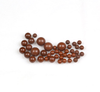
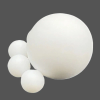
Vespel is a trademark for the part where the aromatic Polyimide (PI) resin powder of Dupont is molded into parts. It has very few foreign substances, low out-gassing, and plasma resistance.
Production Range 1mm ~ 25.4 mm
Applications Semiconductor, display, automotive parts, secondary battery, ball caster (ball transfer), aviation, electronics, and bearing
Polyimide (Pl)
Vespel has the highest thermal and wear resistance among high-functional resins. It was commercialized in 1962 and is widely used by the aviation, space, and defense industries to OA devices, electronics, science equipment, industrial machinery, and production equipment. Lineup : SP-1, MELDIN, PLAVIS, etc.
Features
Ultra-thermal Resistance : Continuous working temperature at 288 °C , short term at 480°C (even for ultralow temperature)
Wear Resistance : Without lubrication, the PV threshold is 10 times or more higher than most engineering plastics.
Creep : It doesn’t soften at a high temperature but endures high load. (Creep at 0.6% at 260°C, 186 kg/cm for 1,000 hr)
Chemical Resistance : Resistance to grease and oil solvent
Electrical Insulation : Dielectric strength of 220 KV/mm
Excellent machinability
Plasma and radiation resistance
Vespel is a trademark for the part where the aromatic Polyimide (PI) resin powder of Dupont is molded into parts.
It has very few foreign substances, low out-gassing, and plasma resistance.
- Production Range 1mm ~ 25.4 mm
- Applications Semiconductor, display, automotive parts, secondary battery, ball caster (ball transfer), aviation, electronics, and bearing
Polyimide (Pl)
Vespel has the highest thermal and wear resistance among high-functional resins.
It was commercialized in 1962 and is widely used by the aviation, space,
and defense industries to OA devices, electronics, science equipment,
industrial machinery, and production equipment.
Lineup : SP-1, MELDIN, PLAVIS, etc.
Features
Ultra-thermal Resistance : Continuous working temperature at 288 °C , short term at 480°C (even for ultralow temperature)
Wear Resistance : Without lubrication, the PV threshold is 10 times or more higher than most engineering plastics.
Creep : It doesn’t soften at a high temperature but endures high load. (Creep at 0.6% at 260°C, 186 kg/cm for 1,000 hr)
Chemical Resistance : Resistance to grease and oil solvent
Electrical Insulation : Dielectric strength of 220 KV/mm
Excellent machinability
Plasma and radiation resistance