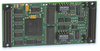
Two CAN bus channels with optional isolation
NXP SJA1000 CAN controller with TJA1041 transceiver
IP560 modules provide two independent CAN bus interface channels. Each channel has a NXP SJA1000 CAN controller with a TJA1041 transceiver. The advantage of this design is that it allows reporting of bus fault conditions directly from the TJA1041 transceivers. It also has the ability to transmit, receive and perform message filtering on extended and standard messages.
Using CAN to network controllers, actuators, sensors, and transducers provides many benefits to system developers. First, the ready availability of multi-sourced components and tools can significantly reduce design time. Next, the small, light cables used by CAN help lower connection costs. Additionally, CAN has fewer connections which improves reliability.
CAN is ideal for the following applications:
Marine control and navigation systems
Elevator control systems
Defense vehicles
Production line control systems
Machine tools
Large optical telescopes
Medical systems
Paper and textile production machinery
Packaging machinery
Features
Two complete CAN bus interfaces
NXP SJA1000 CAN bus controller with high-speed TJA1043 CAN transceiver
1000V isolation, channel-to-channel and channel-to-host (IP560-i models)
ISO 11898 compliance for Part A (11-bit) and Part B extended (29-bit) arbitration IDs
CAN 2.0B protocol compatibility (extended frame passive in PCA82C200 compatibility mode)
Data rates of up to 1Mb/s
Supports both 8MHz and 32MHz IP operation
0 to 70°C or -40 to 85°C operating temperature range
TXD dominant clamping handler with diagnosis
RXD recessive clamping handler with diagnosis
TXD-to-RXD short-circuit handler with diagnosis
Bus line short-circuit diagnosis
Bus dominant clamping diagnosis
PCA82C200 mode (BasicCAN mode is default)
Extended receive buffer (64-byte FIFO)
24 MHz clock frequency
PeliCAN mode extensions: – Error counters with read/write access – Programmable error warning limit – Last error code register – Error interrupt for each CAN-bus error – Arbitration lost interrupt with detailed bit position – Single-shot transmission (no re-transmission) – Listen only mode (no acknowledge, no active error flags) – Hot plugging support (software driven bit rate detection) – Acceptance filter extension (4-byte code, 4-byte mask) – Reception of ‘own’ messages (self reception request)
Undervoltage detection on VBAT
Listen-only mode for node diagnosis and failure containment
- Two CAN bus channels with optional isolation
- NXP SJA1000 CAN controller with TJA1041 transceiver
IP560 modules provide two independent CAN bus interface channels. Each channel has a NXP SJA1000 CAN controller with a TJA1041 transceiver. The advantage of this design is that it allows reporting of bus fault conditions directly from the TJA1041 transceivers. It also has the ability to transmit, receive and perform message filtering on extended and standard messages.
Using CAN to network controllers, actuators, sensors, and transducers provides many benefits to system developers. First, the ready availability of multi-sourced components and tools can significantly reduce design time. Next, the small, light cables used by CAN help lower connection costs. Additionally, CAN has fewer connections which improves reliability.
CAN is ideal for the following applications:
- Marine control and navigation systems
- Elevator control systems
- Defense vehicles
- Production line control systems
- Machine tools
- Large optical telescopes
- Medical systems
- Paper and textile production machinery
- Packaging machinery
Features
- Two complete CAN bus interfaces
- NXP SJA1000 CAN bus controller with high-speed TJA1043 CAN transceiver
- 1000V isolation, channel-to-channel and channel-to-host (IP560-i models)
- ISO 11898 compliance for Part A (11-bit) and Part B extended (29-bit) arbitration IDs
- CAN 2.0B protocol compatibility (extended frame passive in PCA82C200 compatibility mode)
- Data rates of up to 1Mb/s
- Supports both 8MHz and 32MHz IP operation
- 0 to 70°C or -40 to 85°C operating temperature range
- TXD dominant clamping handler with diagnosis
- RXD recessive clamping handler with diagnosis
- TXD-to-RXD short-circuit handler with diagnosis
- Bus line short-circuit diagnosis
- Bus dominant clamping diagnosis
- PCA82C200 mode (BasicCAN mode is default)
- Extended receive buffer (64-byte FIFO)
- 24 MHz clock frequency
- PeliCAN mode extensions:
– Error counters with read/write access
– Programmable error warning limit
– Last error code register
– Error interrupt for each CAN-bus error
– Arbitration lost interrupt with detailed bit position
– Single-shot transmission (no re-transmission)
– Listen only mode (no acknowledge, no active error flags)
– Hot plugging support (software driven bit rate detection)
– Acceptance filter extension (4-byte code, 4-byte mask)
– Reception of ‘own’ messages (self reception request)
- Undervoltage detection on VBAT
- Listen-only mode for node diagnosis and failure containment