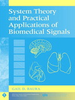
IEEE - Institute of Electrical and Electronics Engineers, Inc. System Theory and Practical Applications of Biomedical Signals

Description
System theory is becoming increasingly important to medical applications. Yet, biomedical and digital signal processing researchers rarely have expertise in practical medical applications, and medical instrumentation designers usually are unfamiliar with system theory. System Theory and Practical Applications for Biomedical Signals bridges those gaps in a practical manner, showing how various aspects of system theory are put into practice by industry. The chapters are intentionally organized in groups of two chapters, with the first chapter describing a system theory technology, and the second chapter describing an industrial application of this technology. Each theory chapter contains a general overview of a system theory technology, which is intended as background material for the application chapter. Each application chapter contains a history of a highlighted medical instrument, summary of appropriate physiology, discussion of the problem of interest and previous empirical solutions, and review of a solution that utilizes the theory in the previous chapter. Biomedical and DSP academic researchers pursuing grants and industry funding will find its real-world approach extremely valuable. Its in-depth discussion of the theoretical issues will clarify for medical instrumentation managers how system theory can compensate for less-than-ideal sensors. With application MATLAB?? exercises and suggestions for system theory course work included, the text also fills the need for detailed information for students or practicing engineers interested in instrument design. An Instructor Support FTP site is available from the Wiley editorial department: ftp://ftp.ieee.org/u ploads/press/baura
Request a Quote
Description
System theory is becoming increasingly important to medical applications. Yet, biomedical and digital signal processing researchers rarely have expertise in practical medical applications, and medical instrumentation designers usually are unfamiliar with system theory. System Theory and Practical Applications for Biomedical Signals bridges those gaps in a practical manner, showing how various aspects of system theory are put into practice by industry. The chapters are intentionally organized in groups of two chapters, with the first chapter describing a system theory technology, and the second chapter describing an industrial application of this technology. Each theory chapter contains a general overview of a system theory technology, which is intended as background material for the application chapter. Each application chapter contains a history of a highlighted medical instrument, summary of appropriate physiology, discussion of the problem of interest and previous empirical solutions, and review of a solution that utilizes the theory in the previous chapter. Biomedical and DSP academic researchers pursuing grants and industry funding will find its real-world approach extremely valuable. Its in-depth discussion of the theoretical issues will clarify for medical instrumentation managers how system theory can compensate for less-than-ideal sensors. With application MATLAB?? exercises and suggestions for system theory course work included, the text also fills the need for detailed information for students or practicing engineers interested in instrument design. An Instructor Support FTP site is available from the Wiley editorial department: ftp://ftp.ieee.org/u ploads/press/baura
Request a Quote

Suppliers

Company
Product
Description
Supplier Links
System Theory and Practical Applications of Biomedical Signals -  - IEEE -  Institute of Electrical and Electronics Engineers, Inc.
Piscataway, NJ, USA
System Theory and Practical Applications of Biomedical Signals
System theory is becoming increasingly important to medical applications. Yet, biomedical and digital signal processing researchers rarely have expertise in practical medical applications, and medical instrumentation designers usually are unfamiliar with system theory. System Theory and Practical Applications for Biomedical Signals bridges those gaps in a practical manner, showing how various aspects of system theory are put into practice by industry. The chapters are intentionally organized in groups of two chapters, with the first chapter describing a system theory technology, and the second chapter describing an industrial application of this technology. Each theory chapter contains a general overview of a system theory technology, which is intended as background material for the application chapter. Each application chapter contains a history of a highlighted medical instrument, summary of appropriate physiology, discussion of the problem of interest and previous empirical solutions, and review of a solution that utilizes the theory in the previous chapter. Biomedical and DSP academic researchers pursuing grants and industry funding will find its real-world approach extremely valuable. Its in-depth discussion of the theoretical issues will clarify for medical instrumentation managers how system theory can compensate for less-than-ideal sensors. With application MATLAB?? exercises and suggestions for system theory course work included, the text also fills the need for detailed information for students or practicing engineers interested in instrument design. An Instructor Support FTP site is available from the Wiley editorial department: ftp://ftp.ieee.org/u ploads/press/baura

System theory is becoming increasingly important to medical applications. Yet, biomedical and digital signal processing researchers rarely have expertise in practical medical applications, and medical instrumentation designers usually are unfamiliar with system theory. System Theory and Practical Applications for Biomedical Signals bridges those gaps in a practical manner, showing how various aspects of system theory are put into practice by industry. The chapters are intentionally organized in groups of two chapters, with the first chapter describing a system theory technology, and the second chapter describing an industrial application of this technology. Each theory chapter contains a general overview of a system theory technology, which is intended as background material for the application chapter. Each application chapter contains a history of a highlighted medical instrument, summary of appropriate physiology, discussion of the problem of interest and previous empirical solutions, and review of a solution that utilizes the theory in the previous chapter. Biomedical and DSP academic researchers pursuing grants and industry funding will find its real-world approach extremely valuable. Its in-depth discussion of the theoretical issues will clarify for medical instrumentation managers how system theory can compensate for less-than-ideal sensors. With application MATLAB?? exercises and suggestions for system theory course work included, the text also fills the need for detailed information for students or practicing engineers interested in instrument design. An Instructor Support FTP site is available from the Wiley editorial department: ftp://ftp.ieee.org/uploads/press/baura

Supplier's Site

Technical Specifications

  IEEE - Institute of Electrical and Electronics Engineers, Inc.
Product Category Technical Books
Product Name System Theory and Practical Applications of Biomedical Signals
Unlock Full Specs
to access all available technical data

Similar Products

Antenna Theory & Design -  - IEEE -  Institute of Electrical and Electronics Engineers, Inc.
IEEE - Institute of Electrical and Electronics Engineers, Inc.
View Details
Ada: A Life And A Legacy -  - IEEE -  Institute of Electrical and Electronics Engineers, Inc.
IEEE - Institute of Electrical and Electronics Engineers, Inc.
View Details