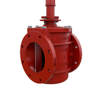
Watson McDaniel Company Air Pilot-Operated Regulating Valve 1 1/2" HDA6

Description
The HD or D Regulator with the “A” Air Pilot is used for reducing steam pressure on steam mains and process equipment. The “A” Air Pilot can also be used in conjunction with the PTR and PTL Pneumatic Controller for controlling temperature in process applications. The significant advantage of the “A” Air Pilot over standard spring-loaded pilots is that pressure adjustments to the regulator can be made from a remote location. A regulator placed in a difficult to reach or inaccessible location can now be adjusted by a control panel board placed in a convenient location. When air pressure is applied to the upper chamber of the air pilot it exerts a downward force on the air pilot’s diaphragm. The lower chamber of the air pilot is connected to the outlet side of the regulator using a sensing line. The purpose of the sensing line is to sense the pressure on the outlet side of the regulator. When the intended set pressure is reached the pilot valve closes which then closes off the flow path of steam to the underside of the diaphragm chamber in the regulator body. The regulator modulates maintaining the desired downstream pressure regardless of the amount of steam being used.
Datasheet
Description
The HD or D Regulator with the “A” Air Pilot is used for reducing steam pressure on steam mains and process equipment. The “A” Air Pilot can also be used in conjunction with the PTR and PTL Pneumatic Controller for controlling temperature in process applications. The significant advantage of the “A” Air Pilot over standard spring-loaded pilots is that pressure adjustments to the regulator can be made from a remote location. A regulator placed in a difficult to reach or inaccessible location can now be adjusted by a control panel board placed in a convenient location. When air pressure is applied to the upper chamber of the air pilot it exerts a downward force on the air pilot’s diaphragm. The lower chamber of the air pilot is connected to the outlet side of the regulator using a sensing line. The purpose of the sensing line is to sense the pressure on the outlet side of the regulator. When the intended set pressure is reached the pilot valve closes which then closes off the flow path of steam to the underside of the diaphragm chamber in the regulator body. The regulator modulates maintaining the desired downstream pressure regardless of the amount of steam being used.
Datasheet

Suppliers

Company
Product
Description
Supplier Links
Pottstown, PA, USA
Air Pilot-Operated Regulating Valve
1 1/2" HDA6
Air Pilot-Operated Regulating Valve 1 1/2" HDA6
The HD or D Regulator with the “A” Air Pilot is used for reducing steam pressure on steam mains and process equipment. The “A” Air Pilot can also be used in conjunction with the PTR and PTL Pneumatic Controller for controlling temperature in process applications. The significant advantage of the “A” Air Pilot over standard spring-loaded pilots is that pressure adjustments to the regulator can be made from a remote location. A regulator placed in a difficult to reach or inaccessible location can now be adjusted by a control panel board placed in a convenient location. When air pressure is applied to the upper chamber of the air pilot it exerts a downward force on the air pilot’s diaphragm. The lower chamber of the air pilot is connected to the outlet side of the regulator using a sensing line. The purpose of the sensing line is to sense the pressure on the outlet side of the regulator. When the intended set pressure is reached the pilot valve closes which then closes off the flow path of steam to the underside of the diaphragm chamber in the regulator body. The regulator modulates maintaining the desired downstream pressure regardless of the amount of steam being used.

The HD or D Regulator with the “A” Air Pilot is used for reducing steam pressure on steam mains and process equipment. The “A” Air Pilot can also be used in conjunction with the PTR and PTL Pneumatic Controller for controlling temperature in process applications. The significant advantage of the “A” Air Pilot over standard spring-loaded pilots is that pressure adjustments to the regulator can be made from a remote location. A regulator placed in a difficult to reach or inaccessible location can now be adjusted by a control panel board placed in a convenient location. When air pressure is applied to the upper chamber of the air pilot it exerts a downward force on the air pilot’s diaphragm. The lower chamber of the air pilot is connected to the outlet side of the regulator using a sensing line. The purpose of the sensing line is to sense the pressure on the outlet side of the regulator. When the intended set pressure is reached the pilot valve closes which then closes off the flow path of steam to the underside of the diaphragm chamber in the regulator body. The regulator modulates maintaining the desired downstream pressure regardless of the amount of steam being used.

Datasheet

Technical Specifications

  Watson McDaniel Company
Product Category Industrial Valves
Product Number 1 1/2" HDA6
Product Name Air Pilot-Operated Regulating Valve
Valve Type Metal Seated
Primary Material Ductile Iron
Media Steam; Air
Valve Size 1.50 inch (38.10 mm)
Unlock Full Specs
to access all available technical data

Similar Products

Pressure Relief Valves -  - Technetics Group
Specs
Valve Type Relief
Primary Material Aluminum; Stainless Steel; Exotic Metal; PTFE
Media Jet & Rocket Fuels, Oxidizers, other Harsh Fluids
View Details
VALVES - BP-050-PVC-T-SW - Blacoh Fluid Control, Inc.
Blacoh Fluid Control, Inc.
Specs
Valve Type Back Flow
Primary Material PVC
Valve Size 0.50 inch (12.70 mm)
View Details
Check Valves - Double Disc Swing Check Valves - McWane Plant and Industrial
Specs
Valve Type Check
Primary Material Ductile Iron; Ductile Iron, ASTM A536 - GR 70-50-05
Valve Size 2.00 to 24.00 inch (50.80 to 609.60 mm)
View Details
Actuated Plastic Butterfly Valves, Electric Series 92 on Type-57P Butterfly Valve -  - Asahi/America, Inc.
Specs
Valve Type Butterfly
Media Temperature 150 F (66 C)
Actuation Electric
View Details