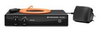
Visual Sound, Inc. Optical Microphone Set MO 2000 Set

Description
Sennheiser Electronic Corp. Operating Principle In the optical microphone, light from an LED is directed onto a reflective diaphragm via an optical-fibre cable (transmitter optical waveguide). The membrane reflects part of the light into a receiver optical waveguide. If the diaphragm is moved by sound signals, a displacement of the reflected light beam occurs, with the result that more or less light is coupled into the receiver waveguide. At the end of the receiver waveguide, a photodiode converts the light intensity variations into electric signals. Advantages The optical principle is the only microphone principle in which the microphone head and the electronics can be located far away from each other. The component parts of the MO 2000 H acoustic-optical microphone head (external diameter 1/2") are made of a plastic material that is suitable for use in areas with aggressive substances (gases, salts, humidity) and radiation. All components of the microphone head, including the optical waveguides, are free of metal; no electric current flows. Applications These advantages make it possible to use the optical microphone in areas in which other microphones are not suitable. For example, the optical microphone can be used in potentially explosive atmospheres, such as for the acoustic monitoring of gas drying plants in natural gas production (IAS MO 2000 SET). In this case, the microphone can "hear" slow leaks, which, due to their small size, cause neither a pressure loss nor an alarm message in the other monitoring systems. In medical applications, the microphone is ideal for use in magnetic resonance imaging (MRI), for example to maintain communication with the patient during MRI scans or to achieve active noise cancellation in MRI. The optical microphone does not disturb the imaging process and is itself not influenced by the strong fields inside magnetic resonance imaging equipment. In measuring technology, the microphone is ideal for use in EMI/EMC laboratories, as it does not influence the electric field. In this case, for example, it functions like an "ear on a mobile phone". A further application possibility is in the field of undetectable acoustic monitoring. Delivery Includes 1 optical microphone with MO 2000 H optical cable (3 m) 1 MO 2000 CU central unit 1 power supply with various adapters (EU, UK, US) 1 carrying case 1 operating instructions
Description
Sennheiser Electronic Corp. Operating Principle In the optical microphone, light from an LED is directed onto a reflective diaphragm via an optical-fibre cable (transmitter optical waveguide). The membrane reflects part of the light into a receiver optical waveguide. If the diaphragm is moved by sound signals, a displacement of the reflected light beam occurs, with the result that more or less light is coupled into the receiver waveguide. At the end of the receiver waveguide, a photodiode converts the light intensity variations into electric signals. Advantages The optical principle is the only microphone principle in which the microphone head and the electronics can be located far away from each other. The component parts of the MO 2000 H acoustic-optical microphone head (external diameter 1/2") are made of a plastic material that is suitable for use in areas with aggressive substances (gases, salts, humidity) and radiation. All components of the microphone head, including the optical waveguides, are free of metal; no electric current flows. Applications These advantages make it possible to use the optical microphone in areas in which other microphones are not suitable. For example, the optical microphone can be used in potentially explosive atmospheres, such as for the acoustic monitoring of gas drying plants in natural gas production (IAS MO 2000 SET). In this case, the microphone can "hear" slow leaks, which, due to their small size, cause neither a pressure loss nor an alarm message in the other monitoring systems. In medical applications, the microphone is ideal for use in magnetic resonance imaging (MRI), for example to maintain communication with the patient during MRI scans or to achieve active noise cancellation in MRI. The optical microphone does not disturb the imaging process and is itself not influenced by the strong fields inside magnetic resonance imaging equipment. In measuring technology, the microphone is ideal for use in EMI/EMC laboratories, as it does not influence the electric field. In this case, for example, it functions like an "ear on a mobile phone". A further application possibility is in the field of undetectable acoustic monitoring. Delivery Includes 1 optical microphone with MO 2000 H optical cable (3 m) 1 MO 2000 CU central unit 1 power supply with various adapters (EU, UK, US) 1 carrying case 1 operating instructions

Suppliers

Company
Product
Description
Supplier Links
Optical Microphone Set - MO 2000 Set - Visual Sound, Inc.
Broomall, PA, USA
Optical Microphone Set
MO 2000 Set
Optical Microphone Set MO 2000 Set
Sennheiser Electronic Corp. Operating Principle In the optical microphone, light from an LED is directed onto a reflective diaphragm via an optical-fibre cable (transmitter optical waveguide). The membrane reflects part of the light into a receiver optical waveguide. If the diaphragm is moved by sound signals, a displacement of the reflected light beam occurs, with the result that more or less light is coupled into the receiver waveguide. At the end of the receiver waveguide, a photodiode converts the light intensity variations into electric signals. Advantages The optical principle is the only microphone principle in which the microphone head and the electronics can be located far away from each other. The component parts of the MO 2000 H acoustic-optical microphone head (external diameter 1/2") are made of a plastic material that is suitable for use in areas with aggressive substances (gases, salts, humidity) and radiation. All components of the microphone head, including the optical waveguides, are free of metal; no electric current flows. Applications These advantages make it possible to use the optical microphone in areas in which other microphones are not suitable. For example, the optical microphone can be used in potentially explosive atmospheres, such as for the acoustic monitoring of gas drying plants in natural gas production (IAS MO 2000 SET). In this case, the microphone can "hear" slow leaks, which, due to their small size, cause neither a pressure loss nor an alarm message in the other monitoring systems. In medical applications, the microphone is ideal for use in magnetic resonance imaging (MRI), for example to maintain communication with the patient during MRI scans or to achieve active noise cancellation in MRI. The optical microphone does not disturb the imaging process and is itself not influenced by the strong fields inside magnetic resonance imaging equipment. In measuring technology, the microphone is ideal for use in EMI/EMC laboratories, as it does not influence the electric field. In this case, for example, it functions like an "ear on a mobile phone". A further application possibility is in the field of undetectable acoustic monitoring. Delivery Includes 1 optical microphone with MO 2000 H optical cable (3 m) 1 MO 2000 CU central unit 1 power supply with various adapters (EU, UK, US) 1 carrying case 1 operating instructions

Sennheiser Electronic Corp.

Operating Principle
In the optical microphone, light from an LED is directed onto a reflective diaphragm via an optical-fibre cable (transmitter optical waveguide). The membrane reflects part of the light into a receiver optical waveguide. If the diaphragm is moved by sound signals, a displacement of the reflected light beam occurs, with the result that more or less light is coupled into the receiver waveguide. At the end of the receiver waveguide, a photodiode converts the light intensity variations into electric signals.
Advantages
The optical principle is the only microphone principle in which the microphone head and the electronics can be located far away from each other.
The component parts of the MO 2000 H acoustic-optical microphone head (external diameter 1/2") are made of a plastic material that is suitable for use in areas with aggressive substances (gases, salts, humidity) and radiation. All components of the microphone head, including the optical waveguides, are free of metal; no electric current flows.
Applications
These advantages make it possible to use the optical microphone in areas in which other microphones are not suitable.
For example, the optical microphone can be used in potentially explosive atmospheres, such as for the acoustic monitoring of gas drying plants in natural gas production (IAS MO 2000 SET). In this case, the microphone can "hear" slow leaks, which, due to their small size, cause neither a pressure loss nor an alarm message in the other monitoring systems.
In medical applications, the microphone is ideal for use in magnetic resonance imaging (MRI), for example to maintain communication with the patient during MRI scans or to achieve active noise cancellation in MRI. The optical microphone does not disturb the imaging process and is itself not influenced by the strong fields inside magnetic resonance imaging equipment.
In measuring technology, the microphone is ideal for use in EMI/EMC laboratories, as it does not influence the electric field. In this case, for example, it functions like an "ear on a mobile phone".
A further application possibility is in the field of undetectable acoustic monitoring.

  • Delivery Includes
  • 1 optical microphone with MO 2000 H optical cable (3 m)
  • 1 MO 2000 CU central unit
  • 1 power supply with various adapters (EU, UK, US)
  • 1 carrying case
  • 1 operating instructions
Supplier's Site

Technical Specifications

  Visual Sound, Inc.
Product Category Audio Microphones
Product Number MO 2000 Set
Product Name Optical Microphone Set
Unlock Full Specs
to access all available technical data

Similar Products

Microphones - 3522698 - RS Components, Ltd.
RS Components, Ltd.
Specs
Frequency Response 70 to 14000 Hz
Application Hand Held Microphone
View Details
Microphones - 448-IM66D132HV01XTMA1DKR-ND - DigiKey
Infineon Technologies AG
Specs
Directivity Omnidirectional
Thickness / Height 0.1043 inch (2.65 mm)
Sensitivity 14.13 mV/Pa (97390 mV/psi)
View Details
Condenser Instrument Microphone - ADX20iP Condenser Instrument Microphone - AUDIX Corporation
Specs
Directivity Directional; Cardioid; Hypercardioid
Frequency Response 40 to 20000 Hz
Sensitivity 6 mV/Pa (41368 mV/psi)
View Details
Microphone Elements - PMOF-9767NS-40DQ - Mallory Sonalert Products, Inc.
Mallory Sonalert Products, Inc.
Specs
Frequency Response 50 to 20000 Hz
Dynamic Range 115 dB re 20µPa
Actual Size 0.3819 inch (9.7 mm)
View Details
4 suppliers