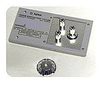
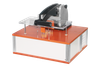
The 16093A is a fixture from Agilent. A fixture is a kind of electronic test equipment that continuously runs tests on a piece of equipment. Fixtures test electronic components, circuits, chips, and software. Engineers use fixtures to hold the equipment under test (EUT) in place and run tests using controlled electronic signals.
Additional Features:
Frequency: DC to 250 MHz
Terminal Connector: 7 mm
DUT Connection: 2-Terminal
Electrical Length: 3.4 mm
Dimensions (approx.): 150(W) x 70(H) x 80(D) [mm]
Weight (approx.): 135 g
Maximum Voltage: ±40 V peak max (AC+DC)
Operating Temperature: 0°C to 55°C
Applicable Instrument: 4287A, 4294A + 42942A, 4395A with Opt.4395A-010 + 43961A, 4396B with Opt.4396B-010 + 43961A, E4991A, (4195A + 41951A, 4286A, 4291A, 4396A)
When used with 16085B: 4263B, 4268A, 4279A, 4284A, 4285A, 4288A, (4192A, 4194A, 4263A, 4278A)
The Agilent 16093A test fixture is designed for impedance evaluation of axial/radial lead type devices. Two binding posts separated by an interval of 7 mm ensure optimum contact of lead components.
The 16093A is a fixture from Agilent. A fixture is a kind of electronic test equipment that continuously runs tests on a piece of equipment. Fixtures test electronic components, circuits, chips, and software. Engineers use fixtures to hold the equipment under test (EUT) in place and run tests using controlled electronic signals.
Additional Features:
- Frequency: DC to 250 MHz
- Terminal Connector: 7 mm
- DUT Connection: 2-Terminal
- Electrical Length: 3.4 mm
- Dimensions (approx.): 150(W) x 70(H) x 80(D) [mm]
- Weight (approx.): 135 g
- Maximum Voltage: ±40 V peak max (AC+DC)
- Operating Temperature: 0°C to 55°C
- Applicable Instrument: 4287A, 4294A + 42942A, 4395A with Opt.4395A-010 + 43961A, 4396B with Opt.4396B-010 + 43961A, E4991A, (4195A + 41951A, 4286A, 4291A, 4396A)
- When used with 16085B: 4263B, 4268A, 4279A, 4284A, 4285A, 4288A, (4192A, 4194A, 4263A, 4278A)
The Agilent 16093A test fixture is designed for impedance evaluation of axial/radial lead type devices. Two binding posts separated by an interval of 7 mm ensure optimum contact of lead components.