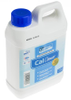
TCI America Tris(hydroxymethyl)aminomethane [for Electrophoresis] T2516

Description
Tris(hydroxymethyl)a minomethane [for Electrophoresis] / 2-Amino-2-(hydroxyme thyl)-1,3-propanedio l In the field of biochemical research, buffering agents perform a very important function. The Tris buffers widely used today have a primary amino group and they are known to frequently cause inhibition problems in biological systems. Furthermore sufficient buffering power cannot be obtained under pH7.5. Good and co-workers have developed buffers to overcome the above-noted defects and their superiority has been indicated by the Hill reactions. These buffers are referred to as Good's Buffers being named after the inventor. [Characteristics] 1) Acid dissociation constant pKa is between 6~8. 2) High water solubility. 3) Low penetration through biomembranes. 4) Low base effect toward biological systems. 5) pKa is less affected by concentration, temperature and ion composition. 6) Low complexation ability with metal ions. 7) Chemically stable. 8) Low in absorption of visible and ultra-violet rays. Composition and pH range
Description
Tris(hydroxymethyl)a minomethane [for Electrophoresis] / 2-Amino-2-(hydroxyme thyl)-1,3-propanedio l In the field of biochemical research, buffering agents perform a very important function. The Tris buffers widely used today have a primary amino group and they are known to frequently cause inhibition problems in biological systems. Furthermore sufficient buffering power cannot be obtained under pH7.5. Good and co-workers have developed buffers to overcome the above-noted defects and their superiority has been indicated by the Hill reactions. These buffers are referred to as Good's Buffers being named after the inventor. [Characteristics] 1) Acid dissociation constant pKa is between 6~8. 2) High water solubility. 3) Low penetration through biomembranes. 4) Low base effect toward biological systems. 5) pKa is less affected by concentration, temperature and ion composition. 6) Low complexation ability with metal ions. 7) Chemically stable. 8) Low in absorption of visible and ultra-violet rays. Composition and pH range

Suppliers

Company
Product
Description
Supplier Links
Tris(hydroxymethyl)aminomethane [for Electrophoresis] - T2516 - TCI America
Portland, OR, USA
Tris(hydroxymethyl)aminomethane [for Electrophoresis]
T2516
Tris(hydroxymethyl)aminomethane [for Electrophoresis] T2516
Tris(hydroxymethyl)a minomethane [for Electrophoresis] / 2-Amino-2-(hydroxyme thyl)-1,3-propanedio l In the field of biochemical research, buffering agents perform a very important function. The Tris buffers widely used today have a primary amino group and they are known to frequently cause inhibition problems in biological systems. Furthermore sufficient buffering power cannot be obtained under pH7.5. Good and co-workers have developed buffers to overcome the above-noted defects and their superiority has been indicated by the Hill reactions. These buffers are referred to as Good's Buffers being named after the inventor. [Characteristics] 1) Acid dissociation constant pKa is between 6~8. 2) High water solubility. 3) Low penetration through biomembranes. 4) Low base effect toward biological systems. 5) pKa is less affected by concentration, temperature and ion composition. 6) Low complexation ability with metal ions. 7) Chemically stable. 8) Low in absorption of visible and ultra-violet rays. Composition and pH range

Tris(hydroxymethyl)aminomethane [for Electrophoresis] / 2-Amino-2-(hydroxymethyl)-1,3-propanediol
In the field of biochemical research, buffering agents perform a very important function. The Tris buffers widely used today have a primary amino group and they are known to frequently cause inhibition problems in biological systems. Furthermore sufficient buffering power cannot be obtained under pH7.5.
Good and co-workers have developed buffers to overcome the above-noted defects and their superiority has been indicated by the Hill reactions. These buffers are referred to as Good's Buffers being named after the inventor.
[Characteristics]
1) Acid dissociation constant pKa is between 6~8.
2) High water solubility.
3) Low penetration through biomembranes.
4) Low base effect toward biological systems.
5) pKa is less affected by concentration, temperature and ion composition.
6) Low complexation ability with metal ions.
7) Chemically stable.
8) Low in absorption of visible and ultra-violet rays.
Composition and pH range

Supplier's Site
Tris(hydroxymethyl)aminomethane [for Electrophoresis] - T2516 - TCI America
Portland, OR, USA
Tris(hydroxymethyl)aminomethane [for Electrophoresis]
T2516
Tris(hydroxymethyl)aminomethane [for Electrophoresis] T2516
Tris(hydroxymethyl)a minomethane [for Electrophoresis] / 2-Amino-2-(hydroxyme thyl)-1,3-propanedio l Electrophoresis is a technique which separates charged biomolecules based on the rate at which they migrate in an applied electrical field. In many cases, electrophoresis of proteins are performed using polyacrylamide gel electrophoresis (PAGE).1) For molecular weight estimation and purity determination of proteins, sodium dodecyl sulfate (SDS)-PAGE is frequently employed. SDS is a strong denaturant of proteins and is added to samples, gels, and buffer solutions for electrodes when proteins are separated with electrophoresis. As SDS not only denatures protein but also binds to the protein, when SDS is used in conjunction with a reducing reagent such as 2-mercaptoethanol to cleave disulfide bonds in the protein, and the protein is completely denatured, the amount of SDS bound is almost always proportional to the molecular weight of the protein. Resultantly, the protein is negatively charged. Therefore, the denatured protein can be separated by molecular weight independently of its structure and biological properties. Laemmli's method is the most widely used system of SDS-PAGE.2) In this method, the separation and the stacking gel contain Tris-HCl and the upper and lower buffer reservoirs contain Tris-glycine. All components of the system contain SDS. The advantage of Laemmli's method is that it gives sharper bands in the final plate.1)

Tris(hydroxymethyl)aminomethane [for Electrophoresis] / 2-Amino-2-(hydroxymethyl)-1,3-propanediol
Electrophoresis is a technique which separates charged biomolecules based on the rate at which they migrate in an applied electrical field. In many cases, electrophoresis of proteins are performed using polyacrylamide gel electrophoresis (PAGE).1) For molecular weight estimation and purity determination of proteins, sodium dodecyl sulfate (SDS)-PAGE is frequently employed. SDS is a strong denaturant of proteins and is added to samples, gels, and buffer solutions for electrodes when proteins are separated with electrophoresis. As SDS not only denatures protein but also binds to the protein, when SDS is used in conjunction with a reducing reagent such as 2-mercaptoethanol to cleave disulfide bonds in the protein, and the protein is completely denatured, the amount of SDS bound is almost always proportional to the molecular weight of the protein. Resultantly, the protein is negatively charged. Therefore, the denatured protein can be separated by molecular weight independently of its structure and biological properties.
Laemmli's method is the most widely used system of SDS-PAGE.2) In this method, the separation and the stacking gel contain Tris-HCl and the upper and lower buffer reservoirs contain Tris-glycine. All components of the system contain SDS. The advantage of Laemmli's method is that it gives sharper bands in the final plate.1)

Supplier's Site

Technical Specifications

  TCI America
Product Category Chemical Additives and Agents
Product Number T2516
Product Name Tris(hydroxymethyl)aminomethane [for Electrophoresis]
Unlock Full Specs
to access all available technical data

Similar Products

ExxonMobil™ HDPE Product Grades - ExxonMobil™ HDPE HYA 600 - ExxonMobil - Polyethylene Products
Specs
Applications Molding
View Details
Buffered Carbonate Solution - pH10 -  - Myron L Company
Specs
Function Buffer / Buffering Agent
Form & Features Liquids
View Details
Formulations - Applications - Activators - 41383PT - 34138347 - Hernon Manufacturing, Inc.
Specs
Function Deactivator / Passivator
View Details
Photoresist Raw Materials -  - Mitsui Chemicals America, Inc.
Mitsui Chemicals America, Inc.
View Details