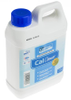
TCI America Dansyl Chloride (10% in Acetone) D0005

Description
Dansyl Chloride (10% in Acetone) / 5-(Dimethylamino)nap hthalene-1-sulfonyl Chloride HPLC is used extensively as a means of detecting and determining trace components. In particular, it is effective in the case of non-volatile trace components in complex matrices such as biological substances. Labeling objective substances for analysis with labeling reagents appropriate for detection methods has been performed to obtain higher sensitivity and selectivity. A great number of labeling reagents have been reported for this purpose. NBD- and DBD-derivatives developed by Imai, Toyo'oka and co-workers are excellent fluorescent labeling reagents with strong and long wave-length fluorescence resulting from their benzoxadiazole skeleton and they are used for analysis of various biological substances. NBD-Cl was the earliest fluorescence reagent which was applied to HPLC and its effectiveness for the secondary amines, such as proline, was reported. Imai and co-workers developed NBD-F1), in which the chlorine was replaced with fluorine, for HPLC analysis and obtained good results. Also, they developed DBD-F2) where a dimethylsulfamoyl group was introduced into the benzoxadiazole skeleton and used it for the analysis of amino acids by reversed phase HPLC. Because DBD-F itself is non-fluorescent, DBD-labeled amino acids can be detected and analyzed with high sensitivity. DBD-COCl3) reacts with a hydroxy group as well as amines and thiols, and forms a stable fluorescence adduct. In addition, NBD- and DBD-H4), in which a hydrazino group is introduced into the NBD-, DBD- skeleton, are used for analysis of carbonyl groups. NBD- and DBD-PZ5), in which a piperazino group is introduced, are used for analysis of carboxyl groups.
Description
Dansyl Chloride (10% in Acetone) / 5-(Dimethylamino)nap hthalene-1-sulfonyl Chloride HPLC is used extensively as a means of detecting and determining trace components. In particular, it is effective in the case of non-volatile trace components in complex matrices such as biological substances. Labeling objective substances for analysis with labeling reagents appropriate for detection methods has been performed to obtain higher sensitivity and selectivity. A great number of labeling reagents have been reported for this purpose. NBD- and DBD-derivatives developed by Imai, Toyo'oka and co-workers are excellent fluorescent labeling reagents with strong and long wave-length fluorescence resulting from their benzoxadiazole skeleton and they are used for analysis of various biological substances. NBD-Cl was the earliest fluorescence reagent which was applied to HPLC and its effectiveness for the secondary amines, such as proline, was reported. Imai and co-workers developed NBD-F1), in which the chlorine was replaced with fluorine, for HPLC analysis and obtained good results. Also, they developed DBD-F2) where a dimethylsulfamoyl group was introduced into the benzoxadiazole skeleton and used it for the analysis of amino acids by reversed phase HPLC. Because DBD-F itself is non-fluorescent, DBD-labeled amino acids can be detected and analyzed with high sensitivity. DBD-COCl3) reacts with a hydroxy group as well as amines and thiols, and forms a stable fluorescence adduct. In addition, NBD- and DBD-H4), in which a hydrazino group is introduced into the NBD-, DBD- skeleton, are used for analysis of carbonyl groups. NBD- and DBD-PZ5), in which a piperazino group is introduced, are used for analysis of carboxyl groups.

Suppliers

Company
Product
Description
Supplier Links
Dansyl Chloride (10% in Acetone) - D0005 - TCI America
Portland, OR, USA
Dansyl Chloride (10% in Acetone)
D0005
Dansyl Chloride (10% in Acetone) D0005
Dansyl Chloride (10% in Acetone) / 5-(Dimethylamino)nap hthalene-1-sulfonyl Chloride HPLC is used extensively as a means of detecting and determining trace components. In particular, it is effective in the case of non-volatile trace components in complex matrices such as biological substances. Labeling objective substances for analysis with labeling reagents appropriate for detection methods has been performed to obtain higher sensitivity and selectivity. A great number of labeling reagents have been reported for this purpose. NBD- and DBD-derivatives developed by Imai, Toyo'oka and co-workers are excellent fluorescent labeling reagents with strong and long wave-length fluorescence resulting from their benzoxadiazole skeleton and they are used for analysis of various biological substances. NBD-Cl was the earliest fluorescence reagent which was applied to HPLC and its effectiveness for the secondary amines, such as proline, was reported. Imai and co-workers developed NBD-F1), in which the chlorine was replaced with fluorine, for HPLC analysis and obtained good results. Also, they developed DBD-F2) where a dimethylsulfamoyl group was introduced into the benzoxadiazole skeleton and used it for the analysis of amino acids by reversed phase HPLC. Because DBD-F itself is non-fluorescent, DBD-labeled amino acids can be detected and analyzed with high sensitivity. DBD-COCl3) reacts with a hydroxy group as well as amines and thiols, and forms a stable fluorescence adduct. In addition, NBD- and DBD-H4), in which a hydrazino group is introduced into the NBD-, DBD- skeleton, are used for analysis of carbonyl groups. NBD- and DBD-PZ5), in which a piperazino group is introduced, are used for analysis of carboxyl groups.

Dansyl Chloride (10% in Acetone) / 5-(Dimethylamino)naphthalene-1-sulfonyl Chloride
HPLC is used extensively as a means of detecting and determining trace components. In particular, it is effective in the case of non-volatile trace components in complex matrices such as biological substances. Labeling objective substances for analysis with labeling reagents appropriate for detection methods has been performed to obtain higher sensitivity and selectivity. A great number of labeling reagents have been reported for this purpose.
NBD- and DBD-derivatives developed by Imai, Toyo'oka and co-workers are excellent fluorescent labeling reagents with strong and long wave-length fluorescence resulting from their benzoxadiazole skeleton and they are used for analysis of various biological substances. NBD-Cl was the earliest fluorescence reagent which was applied to HPLC and its effectiveness for the secondary amines, such as proline, was reported. Imai and co-workers developed NBD-F1), in which the chlorine was replaced with fluorine, for HPLC analysis and obtained good results. Also, they developed DBD-F2) where a dimethylsulfamoyl group was introduced into the benzoxadiazole skeleton and used it for the analysis of amino acids by reversed phase HPLC. Because DBD-F itself is non-fluorescent, DBD-labeled amino acids can be detected and analyzed with high sensitivity. DBD-COCl3) reacts with a hydroxy group as well as amines and thiols, and forms a stable fluorescence adduct. In addition, NBD- and DBD-H4), in which a hydrazino group is introduced into the NBD-, DBD- skeleton, are used for analysis of carbonyl groups. NBD- and DBD-PZ5), in which a piperazino group is introduced, are used for analysis of carboxyl groups.

Supplier's Site
Dansyl Chloride (10% in Acetone) - D0005 - TCI America
Portland, OR, USA
Dansyl Chloride (10% in Acetone)
D0005
Dansyl Chloride (10% in Acetone) D0005
Dansyl Chloride (10% in Acetone) / 5-(Dimethylamino)nap hthalene-1-sulfonyl Chloride Mass spectrometry (MS) is the method for determining the mass-to-charge ratio (m/z) of a molecule or an atom and obtaining information such as a molecular weight. To determine m/z, first it is necessary to ionize target analytes. Electron impact (EI) is known as the easiest ionization method. However, the mass spectrum obtained by EI is complicated because of easy fragmentation which sometimes makes it hard to analyze. So softer ionization methods which cause less fragmentation have been developed. They include fast atom bombardment ionization (FAB), electron spray ionization (ESI) and matrix-assisted laser desorption ionization (MALDI). These softer ionization methods can provide high-quality spectra without unnecessary fragmentation. One of the main reasons of today's successful proteome analysis is the development of the mass spectrometry technique using soft ionization methods. The speed of protein analysis has been significantly improved for the two following reasons; 1) establishment of the soft ionization method of proteins using ESI and MALDI, 2) enhancement of precision, sensitivity and speed of time-of-flight mass spectrometry (TOF-MS). In 1993, the peptide mass fingerprinting (PMF) method was developed, which enabled rapid proteome analysis. Now, MS is used as an important analytical tool not only in the field of chemistry but also in the field of biological science. MS is also used for the analysis of trace amounts of biologically active small molecules in living bodies. For analysis of biologically active small molecules in a complicated biological matrix, LC-MS is commonly used. In these cases the sample is separated by HPLC and the quantity is determined by MS. FAB and ESI are used as ionization methods for LC-MS, in which vaporization of the sample is not required. Especially, ESI is the most used ionization method for LC-MS because it causes less fragmentation and has a wide range of applicable compounds and high operability. However, in today's advanced research, sometimes we can not get sufficient detection for trace amounts of components even using highly-sensitive LC-ESI-MS. In that case, derivatization reagents for MS are used to increase detection sensitivity for ESI-MS. The derivatization reagents have functional groups in the molecule that stabilize positive or negative charge.

Dansyl Chloride (10% in Acetone) / 5-(Dimethylamino)naphthalene-1-sulfonyl Chloride
Mass spectrometry (MS) is the method for determining the mass-to-charge ratio (m/z) of a molecule or an atom and obtaining information such as a molecular weight. To determine m/z, first it is necessary to ionize target analytes. Electron impact (EI) is known as the easiest ionization method. However, the mass spectrum obtained by EI is complicated because of easy fragmentation which sometimes makes it hard to analyze. So softer ionization methods which cause less fragmentation have been developed. They include fast atom bombardment ionization (FAB), electron spray ionization (ESI) and matrix-assisted laser desorption ionization (MALDI). These softer ionization methods can provide high-quality spectra without unnecessary fragmentation.
One of the main reasons of today's successful proteome analysis is the development of the mass spectrometry technique using soft ionization methods. The speed of protein analysis has been significantly improved for the two following reasons; 1) establishment of the soft ionization method of proteins using ESI and MALDI, 2) enhancement of precision, sensitivity and speed of time-of-flight mass spectrometry (TOF-MS). In 1993, the peptide mass fingerprinting (PMF) method was developed, which enabled rapid proteome analysis. Now, MS is used as an important analytical tool not only in the field of chemistry but also in the field of biological science.
MS is also used for the analysis of trace amounts of biologically active small molecules in living bodies. For analysis of biologically active small molecules in a complicated biological matrix, LC-MS is commonly used. In these cases the sample is separated by HPLC and the quantity is determined by MS. FAB and ESI are used as ionization methods for LC-MS, in which vaporization of the sample is not required. Especially, ESI is the most used ionization method for LC-MS because it causes less fragmentation and has a wide range of applicable compounds and high operability. However, in today's advanced research, sometimes we can not get sufficient detection for trace amounts of components even using highly-sensitive LC-ESI-MS. In that case, derivatization reagents for MS are used to increase detection sensitivity for ESI-MS. The derivatization reagents have functional groups in the molecule that stabilize positive or negative charge.

Supplier's Site

Technical Specifications

  TCI America
Product Category Chemical Additives and Agents
Product Number D0005
Product Name Dansyl Chloride (10% in Acetone)
Unlock Full Specs
to access all available technical data

Similar Products

Light-Curable Materials, Activators, 501-E-REV-A -  - Dymax
Specs
Applications Adhesives or Sealants
View Details
Formulations - Applications - Activators - Adhesion Promoter 42 - 304207 - Hernon Manufacturing, Inc.
Specs
Function Tackifer / Adhesion Promoter
View Details
pH/ORP Sensor Storage Solution -  - Myron L Company
Specs
Function Unlisted, Proprietary or Specialized Function; Storage Solution
Form & Features Liquids
View Details
ExxonMobil™ HDPE Product Grades - ExxonMobil™ HDPE HPA 020 Wire & Cable - ExxonMobil - Polyethylene Products
Specs
Applications Molding
View Details