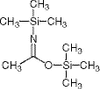
TCI America BSA B0510

Description
N,O-Bis(trimethylsil yl)acetamide (25% in Acetonitrile) [Trimethylsilylating Reagent, for NH2 compounds] / BSA For GC analysis, the substance to be analyzed must be in the gaseous form. Because of this, the analysis of many organic compounds requires that injections, columns, and detectors are kept at relatively high temperatures. However, many organic compounds are thermally unstable. In such cases, it is necessary to convert the substance to be analyzed to a more volatile derivative appropriate for GC analysis. GC derivatizing reagents such as silylating, acylating, and alkylating reagents are used for this conversion. Meanwhile, GC has been used for the analysis of biogenic substances. This generally requires the use of various derivatizing reagents. As an example, trimethylsulfonium hydroxide 1 can easily convert fatty acids, fatty acid esters, and glycerides into their methyl esters in a single step through the pyrolysis of the corresponding sulfonium salts 2.1) The low-boiling by-product, dimethyl sulfide, does not disturb the chromatographic separation of the samples. Therefore, the method using 1 is suitable for detection not only of longer chain fatty acids but also of relatively short chain fatty acids. 1 has been successfully applied for sample preparation in the analysis of fatty acids in microorganisms and human blood serum.2)
Description
N,O-Bis(trimethylsil yl)acetamide (25% in Acetonitrile) [Trimethylsilylating Reagent, for NH2 compounds] / BSA For GC analysis, the substance to be analyzed must be in the gaseous form. Because of this, the analysis of many organic compounds requires that injections, columns, and detectors are kept at relatively high temperatures. However, many organic compounds are thermally unstable. In such cases, it is necessary to convert the substance to be analyzed to a more volatile derivative appropriate for GC analysis. GC derivatizing reagents such as silylating, acylating, and alkylating reagents are used for this conversion. Meanwhile, GC has been used for the analysis of biogenic substances. This generally requires the use of various derivatizing reagents. As an example, trimethylsulfonium hydroxide 1 can easily convert fatty acids, fatty acid esters, and glycerides into their methyl esters in a single step through the pyrolysis of the corresponding sulfonium salts 2.1) The low-boiling by-product, dimethyl sulfide, does not disturb the chromatographic separation of the samples. Therefore, the method using 1 is suitable for detection not only of longer chain fatty acids but also of relatively short chain fatty acids. 1 has been successfully applied for sample preparation in the analysis of fatty acids in microorganisms and human blood serum.2)

Suppliers

Company
Product
Description
Supplier Links
BSA - B0510 - TCI America
Portland, OR, USA
N,O-Bis(trimethylsil yl)acetamide (25% in Acetonitrile) [Trimethylsilylating Reagent, for NH2 compounds] / BSA For GC analysis, the substance to be analyzed must be in the gaseous form. Because of this, the analysis of many organic compounds requires that injections, columns, and detectors are kept at relatively high temperatures. However, many organic compounds are thermally unstable. In such cases, it is necessary to convert the substance to be analyzed to a more volatile derivative appropriate for GC analysis. GC derivatizing reagents such as silylating, acylating, and alkylating reagents are used for this conversion. Meanwhile, GC has been used for the analysis of biogenic substances. This generally requires the use of various derivatizing reagents. As an example, trimethylsulfonium hydroxide 1 can easily convert fatty acids, fatty acid esters, and glycerides into their methyl esters in a single step through the pyrolysis of the corresponding sulfonium salts 2.1) The low-boiling by-product, dimethyl sulfide, does not disturb the chromatographic separation of the samples. Therefore, the method using 1 is suitable for detection not only of longer chain fatty acids but also of relatively short chain fatty acids. 1 has been successfully applied for sample preparation in the analysis of fatty acids in microorganisms and human blood serum.2)

N,O-Bis(trimethylsilyl)acetamide (25% in Acetonitrile) [Trimethylsilylating Reagent, for NH2 compounds] / BSA
For GC analysis, the substance to be analyzed must be in the gaseous form. Because of this, the analysis of many organic compounds requires that injections, columns, and detectors are kept at relatively high temperatures. However, many organic compounds are thermally unstable. In such cases, it is necessary to convert the substance to be analyzed to a more volatile derivative appropriate for GC analysis. GC derivatizing reagents such as silylating, acylating, and alkylating reagents are used for this conversion.
Meanwhile, GC has been used for the analysis of biogenic substances. This generally requires the use of various derivatizing reagents. As an example, trimethylsulfonium hydroxide 1 can easily convert fatty acids, fatty acid esters, and glycerides into their methyl esters in a single step through the pyrolysis of the corresponding sulfonium salts 2.1) The low-boiling by-product, dimethyl sulfide, does not disturb the chromatographic separation of the samples. Therefore, the method using 1 is suitable for detection not only of longer chain fatty acids but also of relatively short chain fatty acids. 1 has been successfully applied for sample preparation in the analysis of fatty acids in microorganisms and human blood serum.2)

Supplier's Site

Technical Specifications

  TCI America
Product Category Chemical Additives and Agents
Product Number B0510
Product Name BSA
Unlock Full Specs
to access all available technical data

Similar Products

Stain Preventor Gel -  - MacDermid Alpha Electronics Solutions
MacDermid Alpha Electronics Solutions
Specs
Function Surface Active Agent
View Details
Low Viscosity Polyaphaolefin (PAO) Base Stock - SpectraSyn™ 4 - ExxonMobil Chemical Company - Synthetic Base Stocks
ExxonMobil Chemical Company - Synthetic Base Stocks
Specs
Applications Oils & Fuels
Form & Features Liquids
View Details
Descalers - 8946941 - RS Components, Ltd.
RS Components, Ltd.
Specs
Function Scale Inhibitor
View Details
Formulations - Applications - Activators - Adhesion Promoter 42 - 304207 - Hernon Manufacturing, Inc.
Specs
Function Tackifer / Adhesion Promoter
View Details
