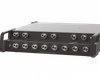
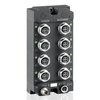
steute Access Point RF RxT-NET

Description
The Access Points together form the underlying infrastructure of the wireless network. They are responsible for communication with the sensors, bundling all information and directing it towards the Sensor Bridge, which then in turn communicates with the application software. Highlights Small, robust, vibration-resistant Simple set-up Unlimited spatial expandability Long radio range (700 m outdoors, approx. 50 m indoors) Minimal configuration due to dynamic self-organization The Access Points are installed throughout the transmission zone in order to guarantee reliable communication with every wireless sensor. One Access Point can receive signals from approx. 100 sensors. An Access Point is responsible for certain sensors, determined automatically by the Sensor Bridge depending on the field strength measured. When a sensor transmits a signal, it communicates with the responsible Access Points in a predetermined order. If transmission to the first Access Point should fail, the second is automatically addressed, and so on. With an increasing number of Access Points, this procedure achieves maximum transmission reliability. Power can be supplied via an external power supply or via PoE (Power over Ethernet) using an additional module. The power consumption of an Access Point is < 2 watts. The robust and dustproof housing of the Access Points (protection class IP 20) also makes them suitable for use in rough industrial environments.
Description
The Access Points together form the underlying infrastructure of the wireless network. They are responsible for communication with the sensors, bundling all information and directing it towards the Sensor Bridge, which then in turn communicates with the application software. Highlights Small, robust, vibration-resistant Simple set-up Unlimited spatial expandability Long radio range (700 m outdoors, approx. 50 m indoors) Minimal configuration due to dynamic self-organization The Access Points are installed throughout the transmission zone in order to guarantee reliable communication with every wireless sensor. One Access Point can receive signals from approx. 100 sensors. An Access Point is responsible for certain sensors, determined automatically by the Sensor Bridge depending on the field strength measured. When a sensor transmits a signal, it communicates with the responsible Access Points in a predetermined order. If transmission to the first Access Point should fail, the second is automatically addressed, and so on. With an increasing number of Access Points, this procedure achieves maximum transmission reliability. Power can be supplied via an external power supply or via PoE (Power over Ethernet) using an additional module. The power consumption of an Access Point is < 2 watts. The robust and dustproof housing of the Access Points (protection class IP 20) also makes them suitable for use in rough industrial environments.

Suppliers

Company
Product
Description
Supplier Links
Access Point - RF RxT-NET - steute
Ridgefield, CT, USA
Access Point
RF RxT-NET
Access Point RF RxT-NET
The Access Points together form the underlying infrastructure of the wireless network. They are responsible for communication with the sensors, bundling all information and directing it towards the Sensor Bridge, which then in turn communicates with the application software. Highlights Small, robust, vibration-resistant Simple set-up Unlimited spatial expandability Long radio range (700 m outdoors, approx. 50 m indoors) Minimal configuration due to dynamic self-organization The Access Points are installed throughout the transmission zone in order to guarantee reliable communication with every wireless sensor. One Access Point can receive signals from approx. 100 sensors. An Access Point is responsible for certain sensors, determined automatically by the Sensor Bridge depending on the field strength measured. When a sensor transmits a signal, it communicates with the responsible Access Points in a predetermined order. If transmission to the first Access Point should fail, the second is automatically addressed, and so on. With an increasing number of Access Points, this procedure achieves maximum transmission reliability. Power can be supplied via an external power supply or via PoE (Power over Ethernet) using an additional module. The power consumption of an Access Point is < 2 watts. The robust and dustproof housing of the Access Points (protection class IP 20) also makes them suitable for use in rough industrial environments.

The Access Points together form the underlying infrastructure of the wireless network. They are responsible for communication with the sensors, bundling all information and directing it towards the Sensor Bridge, which then in turn communicates with the application software.

Highlights

  • Small, robust, vibration-resistant
  • Simple set-up
  • Unlimited spatial expandability
  • Long radio range (700 m outdoors, approx. 50 m indoors)
  • Minimal configuration due to dynamic self-organization

The Access Points are installed throughout the transmission zone in order to guarantee reliable communication with every wireless sensor. One Access Point can receive signals from approx. 100 sensors.

An Access Point is responsible for certain sensors, determined automatically by the Sensor Bridge depending on the field strength measured. When a sensor transmits a signal, it communicates with the responsible Access Points in a predetermined order. If transmission to the first Access Point should fail, the second is automatically addressed, and so on. With an increasing number of Access Points, this procedure achieves maximum transmission reliability.

Power can be supplied via an external power supply or via PoE (Power over Ethernet) using an additional module. The power consumption of an Access Point is < 2 watts. The robust and dustproof housing of the Access Points (protection class IP 20) also makes them suitable for use in rough industrial environments.

Supplier's Site

Technical Specifications

  steute
Product Category Network Equipment
Product Number RF RxT-NET
Product Name Access Point
Network Equipment Access Points
Area Network Type WLAN (optional feature)
Form Factor Chassis Mount
Network Media Wireless
Unlock Full Specs
to access all available technical data

Similar Products

IoT Gateways - 162168 - RS Components, Ltd.
RS Components, Ltd.
Specs
Network Equipment Gateway
Features Internet of Things (IoT) Capable
View Details
Electrical interface - CPX-CTEL-4-M12-5POL - Festo Corporation
Specs
Network Equipment Gateway
View Details
Unmanaged Industrial PoE+ Switches - HNS-8415P - Volktek Corporation
Specs
Network Equipment Switch
Area Network Type LAN Capable
Protocol / Network Nway Auto-negotiation
View Details
RAD Data Communications Short Range Async Modem - SRM-5D/M/TB - Classic Automation LLC
Specs
Network Equipment Modem
View Details