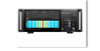
The SR770 is a 100 kHz Spectrum Analyzer from Stanford Research. A spectrum analyzer measures the power of spectrums of known and unknown signals. Spectrum analyzers collect information such as the magnitude of an input signal compared to its frequency. As a frequency analyzer, spectrum analyzers’ main use is to document and analyze electrical input signals as well as spectral compositions of other signals.
Additional Features:
DC to 100 kHz Bandwidth
90 dB Dynamic Range
Low-distortion source
Harmonic, band & sideband analysis
100 kHz real-time bandwidth
Hardcopy output to printers & plotters
3.5" DOS compatible disk drive
GPIB and RS-232 interfaces
The SR770 is a single-channel 100 kHz FFT spectrum analyzer with a dynamic range of 90 dB and a real-time bandwidth of 100 kHz. Additionally, the SR770 includes a low-distortion source which allows you to measure the transfer functions of electronic and mechanical systems.
The speed and dynamic range of these instruments, coupled with their flexibility and many analysis modes, makes them the ideal choice for a variety of applications including acoustics, vibration, noise measurement, and general electronic use.
The SR770 is a 100 kHz Spectrum Analyzer from Stanford Research. A spectrum analyzer measures the power of spectrums of known and unknown signals. Spectrum analyzers collect information such as the magnitude of an input signal compared to its frequency. As a frequency analyzer, spectrum analyzers’ main use is to document and analyze electrical input signals as well as spectral compositions of other signals.
Additional Features:
- DC to 100 kHz Bandwidth
- 90 dB Dynamic Range
- Low-distortion source
- Harmonic, band & sideband analysis
- 100 kHz real-time bandwidth
- Hardcopy output to printers & plotters
- 3.5" DOS compatible disk drive
- GPIB and RS-232 interfaces
The SR770 is a single-channel 100 kHz FFT spectrum analyzer with a dynamic range of 90 dB and a real-time bandwidth of 100 kHz. Additionally, the SR770 includes a low-distortion source which allows you to measure the transfer functions of electronic and mechanical systems.
The speed and dynamic range of these instruments, coupled with their flexibility and many analysis modes, makes them the ideal choice for a variety of applications including acoustics, vibration, noise measurement, and general electronic use.