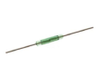
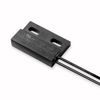
SMC Corporation of America Sensor, reed switch, direct mount, grommet connection D-97

Description
One type of proximity switch is an enclosed reed switch that is activated by a permanent magnet mounted to the piston. As the piston approaches, the magnetic field closes the switch, completing an electric circuit and producing an electric signal. Others prefer to use Hall-effect (Solid-State) sensors in combination with a piston-mounted magnet. The main difference between these two devices is that a reed switch is a mechanical device, while a Hall-effect (Solid-State) switch is electronic, with no moving parts to wear out. Reed switches have the advantage of operating on AC or DC current; Hall-effect (Solid-State) switches are limited to DC only. Also, reed switches are about half the price of their electronic counterpart, although the price differential is decreasing. On the other hand, Hall-effect (Solid-State) devices react much faster than reed switches, on the order of 100,000 versus 500 Hz. It is a waste of money to install microprocessor-based logic, and then be hampered by a slow switch. Overall, the trend seems to be towards these solid-state devices. Both switches have a repeatability of 0.005" or less. But often rod velocity, not switch accuracy, determines the overall repeatability of rod position. Because air is a compressible fluid, precise positioning of the cylinder rod -- especially in midstroke -- is difficult, regardless of the switch used. In many applications, even if the switch is very fast and accurate, getting the valves to react fast enough may be the real problem. In such cases, mounting fast-acting valves as close to the cylinder as possible is important. This eliminates excess compressible air in the lines between cylinder and flow control, giving more precise control. Note: Switch mounting hardware sold separately.
Description
One type of proximity switch is an enclosed reed switch that is activated by a permanent magnet mounted to the piston. As the piston approaches, the magnetic field closes the switch, completing an electric circuit and producing an electric signal. Others prefer to use Hall-effect (Solid-State) sensors in combination with a piston-mounted magnet. The main difference between these two devices is that a reed switch is a mechanical device, while a Hall-effect (Solid-State) switch is electronic, with no moving parts to wear out. Reed switches have the advantage of operating on AC or DC current; Hall-effect (Solid-State) switches are limited to DC only. Also, reed switches are about half the price of their electronic counterpart, although the price differential is decreasing. On the other hand, Hall-effect (Solid-State) devices react much faster than reed switches, on the order of 100,000 versus 500 Hz. It is a waste of money to install microprocessor-based logic, and then be hampered by a slow switch. Overall, the trend seems to be towards these solid-state devices. Both switches have a repeatability of 0.005" or less. But often rod velocity, not switch accuracy, determines the overall repeatability of rod position. Because air is a compressible fluid, precise positioning of the cylinder rod -- especially in midstroke -- is difficult, regardless of the switch used. In many applications, even if the switch is very fast and accurate, getting the valves to react fast enough may be the real problem. In such cases, mounting fast-acting valves as close to the cylinder as possible is important. This eliminates excess compressible air in the lines between cylinder and flow control, giving more precise control. Note: Switch mounting hardware sold separately.

Suppliers

Company
Product
Description
Supplier Links
Sensor, reed switch, direct mount, grommet connection - 70071193 - Allied Electronics, Inc.
Fort Worth, TX, USA
Sensor, reed switch, direct mount, grommet connection
70071193
Sensor, reed switch, direct mount, grommet connection 70071193
One type of proximity switch is an enclosed reed switch that is activated by a permanent magnet mounted to the piston. As the piston approaches, the magnetic field closes the switch, completing an electric circuit and producing an electric signal. Others prefer to use Hall-effect (Solid-State) sensors in combination with a piston-mounted magnet. The main difference between these two devices is that a reed switch is a mechanical device, while a Hall-effect (Solid-State) switch is electronic, with no moving parts to wear out. Reed switches have the advantage of operating on AC or DC current; Hall-effect (Solid-State) switches are limited to DC only. Also, reed switches are about half the price of their electronic counterpart, although the price differential is decreasing. On the other hand, Hall-effect (Solid-State) devices react much faster than reed switches, on the order of 100,000 versus 500 Hz. It is a waste of money to install microprocessor-based logic, and then be hampered by a slow switch. Overall, the trend seems to be towards these solid-state devices. Both switches have a repeatability of 0.005" or less. But often rod velocity, not switch accuracy, determines the overall repeatability of rod position. Because air is a compressible fluid, precise positioning of the cylinder rod -- especially in midstroke -- is difficult, regardless of the switch used. In many applications, even if the switch is very fast and accurate, getting the valves to react fast enough may be the real problem. In such cases, mounting fast-acting valves as close to the cylinder as possible is important. This eliminates excess compressible air in the lines between cylinder and flow control, giving more precise control. Note: Switch mounting hardware sold separately.

One type of proximity switch is an enclosed reed switch that is activated by a permanent magnet mounted to the piston. As the piston approaches, the magnetic field closes the switch, completing an electric circuit and producing an electric signal. Others prefer to use Hall-effect (Solid-State) sensors in combination with a piston-mounted magnet. The main difference between these two devices is that a reed switch is a mechanical device, while a Hall-effect (Solid-State) switch is electronic, with no moving parts to wear out. Reed switches have the advantage of operating on AC or DC current; Hall-effect (Solid-State) switches are limited to DC only. Also, reed switches are about half the price of their electronic counterpart, although the price differential is decreasing. On the other hand, Hall-effect (Solid-State) devices react much faster than reed switches, on the order of 100,000 versus 500 Hz. It is a waste of money to install microprocessor-based logic, and then be hampered by a slow switch. Overall, the trend seems to be towards these solid-state devices.
Both switches have a repeatability of 0.005" or less. But often rod velocity, not switch accuracy, determines the overall repeatability of rod position. Because air is a compressible fluid, precise positioning of the cylinder rod -- especially in midstroke -- is difficult, regardless of the switch used. In many applications, even if the switch is very fast and accurate, getting the valves to react fast enough may be the real problem. In such cases, mounting fast-acting valves as close to the cylinder as possible is important. This eliminates excess compressible air in the lines between cylinder and flow control, giving more precise control. Note: Switch mounting hardware sold separately.

Supplier's Site

Technical Specifications

  Allied Electronics, Inc.
Product Category Reed Switches
Product Number 70071193
Product Name Sensor, reed switch, direct mount, grommet connection
Unlock Full Specs
to access all available technical data

Similar Products

Reed Switches - 2652231 - RS Components, Ltd.
RS Components, Ltd.
Specs
Pole and Throw Specifications Other Type (Special Application)
Other Pole and Throw Specifications SPCO
Contact Material Iridium
View Details
Magnetic reed switch - BN 31/310 - BN 310-10Z 15,0M -  - Schmersal Inc.
Specs
Switch Type Other
Configuration Normally Open (NO)
Current Rating 3 amps
View Details
Reed Switches - 9092613 - RS Components, Ltd.
Comus International
Specs
Pole and Throw Specifications Other Type (Special Application)
Other Pole and Throw Specifications Spst-no
Contact Material Ruthenium on gold
View Details
Reed Switch - 1900 - Reed Switch Developments Corp.
Reed Switch Developments Corp.
Specs
Switch Type Dry Reed Switch
Pole and Throw Specifications Single Pole, Double Throw (SPDT)
Configuration Normally Closed (NC)
View Details