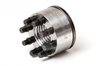
SKF/Global Hydraulic Bolt Tensioner - HYDROCAM - HTS2 Series HTS2 55

Description
A standard Hydrocam tensioner has a hydraulic body which, using a hydraulic fluid, exerts a strong tension load on the bolt through the brace screwed on that bolt. In some tensioner types (HTC R), the body is screwed directly on the bolt to be tightened. The body also rests on the skirt in order to apply the reaction force on the assembly to be tightened. Prior to screwing the body-brace-skirt unit on the protruding end of the bolt, a socket has to be placed on the nut of the bolt. This nut can then be “turned down” (screwed until the lower surface of the nut comes into contact with the assembly bearing surface), by a tommy bar, while the tensioner applies the tension load. Brace The brace is screwed on the protruding end of the bolt, above the nut. It supplies the tension load exerted by the hydraulic body on the bolt. Hydraulic body Using the fluid under pressure, the hydraulic body creates the tension load on the brace by pushing on the skirt. Skirt The skirt is placed around the nut on the assembly to be tightened. It transmits the compression force to the assembly by reaction to the tension load applied on the bolt by the hydraulic body. Socket for standard nut (optional) In the case of assemblies with standard nuts, a socket is placed around the nut to effortlessly bring the nut into contact with the assembly. For this purpose, the outer surface of the socket is drilled with radial axis holes to hold the push rods. Turning down occurs while the tension load is applied by the hydraulic body.
Datasheet
Description
A standard Hydrocam tensioner has a hydraulic body which, using a hydraulic fluid, exerts a strong tension load on the bolt through the brace screwed on that bolt. In some tensioner types (HTC R), the body is screwed directly on the bolt to be tightened. The body also rests on the skirt in order to apply the reaction force on the assembly to be tightened. Prior to screwing the body-brace-skirt unit on the protruding end of the bolt, a socket has to be placed on the nut of the bolt. This nut can then be “turned down” (screwed until the lower surface of the nut comes into contact with the assembly bearing surface), by a tommy bar, while the tensioner applies the tension load. Brace The brace is screwed on the protruding end of the bolt, above the nut. It supplies the tension load exerted by the hydraulic body on the bolt. Hydraulic body Using the fluid under pressure, the hydraulic body creates the tension load on the brace by pushing on the skirt. Skirt The skirt is placed around the nut on the assembly to be tightened. It transmits the compression force to the assembly by reaction to the tension load applied on the bolt by the hydraulic body. Socket for standard nut (optional) In the case of assemblies with standard nuts, a socket is placed around the nut to effortlessly bring the nut into contact with the assembly. For this purpose, the outer surface of the socket is drilled with radial axis holes to hold the push rods. Turning down occurs while the tension load is applied by the hydraulic body.
Datasheet

Suppliers

Company
Product
Description
Supplier Links
Hydraulic Bolt Tensioner - HYDROCAM - HTS2 Series - HTS2 55 - SKF/Global
Lansdale, PA, USA
Hydraulic Bolt Tensioner - HYDROCAM - HTS2 Series
HTS2 55
Hydraulic Bolt Tensioner - HYDROCAM - HTS2 Series HTS2 55
A standard Hydrocam tensioner has a hydraulic body which, using a hydraulic fluid, exerts a strong tension load on the bolt through the brace screwed on that bolt. In some tensioner types (HTC R), the body is screwed directly on the bolt to be tightened. The body also rests on the skirt in order to apply the reaction force on the assembly to be tightened. Prior to screwing the body-brace-skirt unit on the protruding end of the bolt, a socket has to be placed on the nut of the bolt. This nut can then be “turned down” (screwed until the lower surface of the nut comes into contact with the assembly bearing surface), by a tommy bar, while the tensioner applies the tension load. Brace The brace is screwed on the protruding end of the bolt, above the nut. It supplies the tension load exerted by the hydraulic body on the bolt. Hydraulic body Using the fluid under pressure, the hydraulic body creates the tension load on the brace by pushing on the skirt. Skirt The skirt is placed around the nut on the assembly to be tightened. It transmits the compression force to the assembly by reaction to the tension load applied on the bolt by the hydraulic body. Socket for standard nut (optional) In the case of assemblies with standard nuts, a socket is placed around the nut to effortlessly bring the nut into contact with the assembly. For this purpose, the outer surface of the socket is drilled with radial axis holes to hold the push rods. Turning down occurs while the tension load is applied by the hydraulic body.

A standard Hydrocam tensioner has a hydraulic body which, using a hydraulic fluid, exerts a strong tension load on the bolt through the brace screwed on that bolt. In some tensioner types (HTC R), the body is screwed directly on the bolt to be tightened. The body also rests on the skirt in order to apply the reaction force on the assembly to be tightened.

Prior to screwing the body-brace-skirt unit on the protruding end of the bolt, a socket has to be placed on the nut of the bolt. This nut can then be “turned down” (screwed until the lower surface of the nut comes into contact with the assembly bearing surface), by a tommy bar, while the tensioner applies the tension load.

Brace

The brace is screwed on the protruding end of the bolt, above the nut. It supplies the tension load exerted by the hydraulic body on the bolt.

Hydraulic body

Using the fluid under pressure, the hydraulic body creates the tension load on the brace by pushing on the skirt.

Skirt

The skirt is placed around the nut on the assembly to be tightened. It transmits the compression force to the assembly by reaction to the tension load applied on the bolt by the hydraulic body. Socket for standard nut (optional) In the case of assemblies with standard nuts, a socket is placed around the nut to effortlessly bring the nut into contact with the assembly. For this purpose, the outer surface of the socket is drilled with radial axis holes to hold the push rods. Turning down occurs while the tension load is applied by the hydraulic body.

Supplier's Site Datasheet
Hydraulic Bolt Tensioner - HYDROCAM - HTS2 Series - HTS2 55 - SKF/North America
Lansdale, PA, USA
Hydraulic Bolt Tensioner - HYDROCAM - HTS2 Series
HTS2 55
Hydraulic Bolt Tensioner - HYDROCAM - HTS2 Series HTS2 55
A standard Hydrocam tensioner has a hydraulic body which, using a hydraulic fluid, exerts a strong tension load on the bolt through the brace screwed on that bolt. In some tensioner types (HTC R), the body is screwed directly on the bolt to be tightened. The body also rests on the skirt in order to apply the reaction force on the assembly to be tightened. Prior to screwing the body-brace-skirt unit on the protruding end of the bolt, a socket has to be placed on the nut of the bolt. This nut can then be “turned down” (screwed until the lower surface of the nut comes into contact with the assembly bearing surface), by a tommy bar, while the tensioner applies the tension load. Brace The brace is screwed on the protruding end of the bolt, above the nut. It supplies the tension load exerted by the hydraulic body on the bolt. Hydraulic body Using the fluid under pressure, the hydraulic body creates the tension load on the brace by pushing on the skirt. Skirt The skirt is placed around the nut on the assembly to be tightened. It transmits the compression force to the assembly by reaction to the tension load applied on the bolt by the hydraulic body. Socket for standard nut (optional) In the case of assemblies with standard nuts, a socket is placed around the nut to effortlessly bring the nut into contact with the assembly. For this purpose, the outer surface of the socket is drilled with radial axis holes to hold the push rods. Turning down occurs while the tension load is applied by the hydraulic body.

A standard Hydrocam tensioner has a hydraulic body which, using a hydraulic fluid, exerts a strong tension load on the bolt through the brace screwed on that bolt. In some tensioner types (HTC R), the body is screwed directly on the bolt to be tightened. The body also rests on the skirt in order to apply the reaction force on the assembly to be tightened.

Prior to screwing the body-brace-skirt unit on the protruding end of the bolt, a socket has to be placed on the nut of the bolt. This nut can then be “turned down” (screwed until the lower surface of the nut comes into contact with the assembly bearing surface), by a tommy bar, while the tensioner applies the tension load.

Brace

The brace is screwed on the protruding end of the bolt, above the nut. It supplies the tension load exerted by the hydraulic body on the bolt.

Hydraulic body

Using the fluid under pressure, the hydraulic body creates the tension load on the brace by pushing on the skirt.

Skirt

The skirt is placed around the nut on the assembly to be tightened. It transmits the compression force to the assembly by reaction to the tension load applied on the bolt by the hydraulic body. Socket for standard nut (optional) In the case of assemblies with standard nuts, a socket is placed around the nut to effortlessly bring the nut into contact with the assembly. For this purpose, the outer surface of the socket is drilled with radial axis holes to hold the push rods. Turning down occurs while the tension load is applied by the hydraulic body.

Supplier's Site Datasheet

Technical Specifications

  SKF/Global SKF/North America
Product Category Bolt Tensioners Bolt Tensioners
Product Number HTS2 55 HTS2 55
Product Name Hydraulic Bolt Tensioner - HYDROCAM - HTS2 Series Hydraulic Bolt Tensioner - HYDROCAM - HTS2 Series
Type Nut Replacement / Augmentation Nut Replacement / Augmentation
Unlock Full Specs
to access all available technical data

Similar Products

Subsea Tensioner -  - Nord-Lock Group
Nord-Lock Group
Specs
Type Nut Replacement / Augmentation
Power Hydraulically Powered
Threaded Diameter 0.7500 to 3.5 inch (19.05 to 88.9 mm)
View Details
Hydraulic Bolt Tensioner - HYDROCAM - HTA Series - HTA 50 - SKF/Global
Specs
Type Nut Replacement / Augmentation
Power Hydraulically Powered
Threaded Diameter 1.38 to 1.75 inch (34.92 to 44.45 mm)
View Details
2 suppliers
Xtra Load Range Hydraulic Bolt Tensioning Tools - XTRA RANGE - Nord-Lock Group
Specs
Type Bolt Replacement
Power Hydraulically Powered
Threaded Diameter 0.7500 to 4 inch (19.05 to 102 mm)
View Details
Hydraulic Bolt Tensioner - HYDROCAM - HTC R Series - HTH R 223 - SKF/Global
Specs
Type Nut Replacement / Augmentation
Power Hydraulically Powered
Threaded Diameter 3.5 to 3.75 inch (88.9 to 95.25 mm)
View Details
2 suppliers