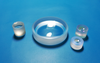
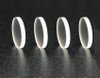
Ross Optical Industries Standard Achromats L-AOC005

Description
These lenses consist of two optical elements, usually of crown and flint glass types, cemented together to form an achromatic doublet. Most often, the crown lens is a biconvex positive lens. Due to the difference in refractive indices, chromatic aberration with respect to two selected wavelengths has been corrected. The lenses have been corrected for on-axis spherical aberration as well. Achromatic doublets are used as telescope objectives, eye loupes, magnifying glasses and eyepieces. Achromatic doublets have also been used to focus and manipulate laser beams because their image quality is superior to single lenses.
Description
These lenses consist of two optical elements, usually of crown and flint glass types, cemented together to form an achromatic doublet. Most often, the crown lens is a biconvex positive lens. Due to the difference in refractive indices, chromatic aberration with respect to two selected wavelengths has been corrected. The lenses have been corrected for on-axis spherical aberration as well. Achromatic doublets are used as telescope objectives, eye loupes, magnifying glasses and eyepieces. Achromatic doublets have also been used to focus and manipulate laser beams because their image quality is superior to single lenses.

Suppliers

Company
Product
Description
Supplier Links
Standard Achromats - L-AOC005 - Ross Optical Industries
El Paso, TX, USA
Standard Achromats
L-AOC005
Standard Achromats L-AOC005
These lenses consist of two optical elements, usually of crown and flint glass types, cemented together to form an achromatic doublet. Most often, the crown lens is a biconvex positive lens. Due to the difference in refractive indices, chromatic aberration with respect to two selected wavelengths has been corrected. The lenses have been corrected for on-axis spherical aberration as well. Achromatic doublets are used as telescope objectives, eye loupes, magnifying glasses and eyepieces. Achromatic doublets have also been used to focus and manipulate laser beams because their image quality is superior to single lenses.

These lenses consist of two optical elements, usually of crown and flint glass types, cemented together to form an achromatic doublet. Most often, the crown lens is a biconvex positive lens. Due to the difference in refractive indices, chromatic aberration with respect to two selected wavelengths has been corrected. The lenses have been corrected for on-axis spherical aberration as well. Achromatic doublets are used as telescope objectives, eye loupes, magnifying glasses and eyepieces. Achromatic doublets have also been used to focus and manipulate laser beams because their image quality is superior to single lenses.

Supplier's Site

Technical Specifications

  Ross Optical Industries
Product Category Optical Lenses
Product Number L-AOC005
Product Name Standard Achromats
Lens Type Achromats; Spherical Lens
Lens Application Infrared (optional feature); Visible; Ultraviolet (optional feature)
Focal Length 20 mm (0.7874 inch)
Center Thickness 3.9 mm (0.1535 inch)
Edge Thickness 2.8 mm (0.1102 inch)
Unlock Full Specs
to access all available technical data

Similar Products

Bi-Concave Lens, N-BK7, 50.8 mm Diameter, -250 mm EFL, 1000-1550nm - KBC073AR.18 - Newport MKS
Specs
Lens Type Spherical Lens
Focal Length -251 mm (-9.87 inch)
Center Thickness 2.5 mm (0.0984 inch)
View Details
Aspheres & Freeforms -  - Zygo Corporation
Zygo Corporation
Specs
Lens Type Aspheric; Spherical Lens; Freeform, Axicon, Kinoform
Diameter / Length 600 mm (23.62 inch)
Materials BK7 Glass; SF11 Glass; Zerodur, Clearceram, ULE, silicon carbide (SiC), Alon, Spinel, calcium fluoride, magnesium fluoride, germanium, silicon, aluminum, nickel
View Details
Precision Aspherical Lenses - G945 - Gurley Precision Instruments
Gurley Precision Instruments
Specs
Lens Type Aspheric; Spherical Lens
Focal Length 23.5 mm (0.9252 inch)
Center Thickness 13.5 mm (0.5315 inch)
View Details
Custom Optical Lenses -  - Insaco, Inc.
Specs
Lens Type Spherical Lens
Materials Sapphire
View Details