RainWise, Inc. Wind Speed and Direction Sensor WSR/WDV

Description
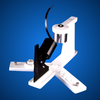
Wind Speed & Direction Sensor The RainWise multivane wind speed and wind direction sensor consists of a multi-vane rotor and wind direction vane mounted on a anodized aluminum support tube. RainWise modeled the multi-vane rotor after a similar design that was used to measure the wind speed of 231 miles per hour on top of Mount Washington. Since it was introduced, some eighteen years ago, we have sold over 15,000 of them. It is the most rugged and reliable mechanical method of measuring wind speed and direction that we know of. The RainWise multi-vane anemometer has been wind tunnel tested at the Stennis Space Center at speeds of 140 MPH. The accuracy is traceable to NIST. The WSR operates with an optical switch. The pulses generated each revolution are counted over a known period of time and this output is the wind speed. Heaters are an available option for the WSR. For battery/solar powered systems the WSR is also available with a dry reed switch output. The WDV consists of two magnets positioned on the vane at an angle of 140 degrees. These magnets actuate 9 dry reed switches mounted below them, producing 36 discreet nine-bit binary outputs. This information is placed into a shift register and sent down the connecting cable in a serial string. The direction sensor is programmed to indicate “630” if there is any malfunction in the system. Both the WSR and the WDV are available separately. A heated version of the WSR is also available. Product Features NIST traceable. Designed to measure high wind speeds. Low power consumption.
Datasheet
Description
Wind Speed & Direction Sensor The RainWise multivane wind speed and wind direction sensor consists of a multi-vane rotor and wind direction vane mounted on a anodized aluminum support tube. RainWise modeled the multi-vane rotor after a similar design that was used to measure the wind speed of 231 miles per hour on top of Mount Washington. Since it was introduced, some eighteen years ago, we have sold over 15,000 of them. It is the most rugged and reliable mechanical method of measuring wind speed and direction that we know of. The RainWise multi-vane anemometer has been wind tunnel tested at the Stennis Space Center at speeds of 140 MPH. The accuracy is traceable to NIST. The WSR operates with an optical switch. The pulses generated each revolution are counted over a known period of time and this output is the wind speed. Heaters are an available option for the WSR. For battery/solar powered systems the WSR is also available with a dry reed switch output. The WDV consists of two magnets positioned on the vane at an angle of 140 degrees. These magnets actuate 9 dry reed switches mounted below them, producing 36 discreet nine-bit binary outputs. This information is placed into a shift register and sent down the connecting cable in a serial string. The direction sensor is programmed to indicate “630” if there is any malfunction in the system. Both the WSR and the WDV are available separately. A heated version of the WSR is also available. Product Features NIST traceable. Designed to measure high wind speeds. Low power consumption.
Datasheet

Suppliers

Company
Product
Description
Supplier Links
Wind Speed and Direction Sensor - WSR/WDV - RainWise, Inc.
Trenton, ME, USA
Wind Speed and Direction Sensor
WSR/WDV
Wind Speed and Direction Sensor WSR/WDV
Wind Speed & Direction Sensor The RainWise multivane wind speed and wind direction sensor consists of a multi-vane rotor and wind direction vane mounted on a anodized aluminum support tube. RainWise modeled the multi-vane rotor after a similar design that was used to measure the wind speed of 231 miles per hour on top of Mount Washington. Since it was introduced, some eighteen years ago, we have sold over 15,000 of them. It is the most rugged and reliable mechanical method of measuring wind speed and direction that we know of. The RainWise multi-vane anemometer has been wind tunnel tested at the Stennis Space Center at speeds of 140 MPH. The accuracy is traceable to NIST. The WSR operates with an optical switch. The pulses generated each revolution are counted over a known period of time and this output is the wind speed. Heaters are an available option for the WSR. For battery/solar powered systems the WSR is also available with a dry reed switch output. The WDV consists of two magnets positioned on the vane at an angle of 140 degrees. These magnets actuate 9 dry reed switches mounted below them, producing 36 discreet nine-bit binary outputs. This information is placed into a shift register and sent down the connecting cable in a serial string. The direction sensor is programmed to indicate “630” if there is any malfunction in the system. Both the WSR and the WDV are available separately. A heated version of the WSR is also available. Product Features NIST traceable. Designed to measure high wind speeds. Low power consumption.

Wind Speed & Direction Sensor

The RainWise multivane wind speed and wind direction sensor consists of a multi-vane rotor and wind direction vane mounted on a anodized aluminum support tube.
RainWise modeled the multi-vane rotor after a similar design that was used to measure the wind speed of 231 miles per hour on top of Mount Washington. Since it was introduced, some eighteen
years ago, we have sold over 15,000 of them. It is the most rugged and reliable mechanical method of measuring wind speed and direction that we know of. The RainWise multi-vane anemometer has been wind tunnel tested at the Stennis Space Center at speeds of 140 MPH. The accuracy is traceable to NIST.
The WSR operates with an optical switch. The
pulses generated each revolution are counted over a known period of time and this output is the wind speed. Heaters are an available option for the WSR.
For battery/solar powered systems the WSR is also available with a dry reed switch output.
The WDV consists of two magnets positioned on the vane at an angle of 140 degrees. These magnets actuate 9 dry reed switches mounted below them, producing 36 discreet nine-bit binary outputs. This information is placed into a shift register and sent down the connecting cable in a serial string. The direction sensor is programmed to indicate “630” if there is any malfunction in the system.
Both the WSR and the WDV are available separately. A heated version of the WSR is also available.

Product Features

  • NIST traceable.
  • Designed to measure high wind speeds.
  • Low power consumption.
Supplier's Site Datasheet

Technical Specifications

  RainWise, Inc.
Product Category Weather Instruments
Product Number WSR/WDV
Product Name Wind Speed and Direction Sensor
Device Classification Sensor Only
Weather Component Sensed Senses Wind Speed
Output Options Switch or Relay Contact
Features Battery Powered (optional feature); Electrical Heater (For winter environments) (optional feature)
Velocity Range Measured 0.0 to 150 mile/hr (0.0 to 241 km/hr)
Unlock Full Specs
to access all available technical data

Similar Products

Anemometer - PCE-A420 - PCE Instruments / PCE Americas Inc.
PCE Instruments / PCE Americas Inc.
Specs
Device Classification Sensor System
Weather Component Sensed Senses Wind Speed
Instrument Display Options Digital Display
View Details
 - 1367874 - RS Components, Ltd.
RS Components, Ltd.
Specs
Weather Component Sensed Senses Wind Speed; Senses Wind Direction; Measures Rain/Snow Fall; Measures Temperature; Measures Barometric Pressure; Measures % Relative Humidity
Features Battery Powered
Velocity Range Measured 125 mile/hr (202 km/hr)
View Details
Traceable® Anemometer/Thermometer - Model 4331 - Traceable® Products
Specs
Device Classification Sensor System
Weather Component Sensed Senses Wind Speed; Measures Temperature
Interface Options Digital Serial
View Details
KANOMAX USA, INC.
Specs
Device Classification Sensor System
Weather Component Sensed Measures Barometric Pressure
Output Options Outputs an analog voltage signal
View Details