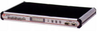
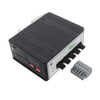
RAD Data Communications, Inc.8 Mbps Inverse MultiplexersIMX-4E1
Description
FEATURES
The IMX-4E1 Inverse Multiplexer enables splitting and transmitting a high speed data channel of up to 7.68 Mbps, over up to four E1 links. IMX-4E1 spans the bandwidth gap between E1 and E3, providing increased bandwidth where services higher than E1 are either not available or are too expensive.
IMX-4E1 can be ordered with either 2 or 4 E1 links. For long range applications, an optional built-in LTU for each of the links is available.
Differential delays of up to 64 msec between the E1 lines are tolerated. IMX-4E1 compensates for such delays, and the original stream is reconstructed. The end-to-end delay of the IMX-4E1 is not more than the maximum differential delay between the links.
The automatic rate fallback feature ensures that the logical channel remains open even if individual E1 links fail, by automatically dropping to the next lower rate. When failed links are recovered, IMX-4E1 automatically returns to original rate.
IMX-4E1 provides immediate connection to installed applications. The user data port is available with the following sync data interfaces: V.35, RS-530, V.36/RS-449, X.21 or HSSI. The data rate can be any multiple of 1.92 Mbps, up to a total of 7.68 Mbps.
An Ethernet Bridge port can be ordered instead of a sync data port interface. The Ethernet bridge port option allows direct connection to LAN and provides self learning and extensive packet filtering. The Ethernet bridge has 10BaseT (UTP) interface, and fully complies with IEEE 802.3.
The Ethernet bridge uses an Enhanced Tinygram compression algorithm, enabling it to utilize bandwidth more efficiently and thus reduce the required number of E1 lines.
Two user-selectable clock modes are available for the sync type data port: - DCE: IMX-4E1 provides both TX and RX clocks to user DTE. - External-DCE: IMX-4E1 provides RX clock to user while receiving TX clock from user.
Note: Ethernet port operates in DCE only
System timing options include: - Internal clock: the internal oscillator is the source for E1 links. - Loopback: the E1 transmit clock is derived from one of the E1 receive clocks. - Station clock: the E1 transmit clock is the source for framed/unframed all "1"s or G.703 compatible.
Setup, control, status, alarms and diagnostic information are provided via the front panel LCD display or an ASCII terminal/Telnet.
Diagnostics capabilities include: - Local/remote data port loopback - Local/remote E1 links loopback - V.52 BERT.
Diagnostics can be executed via the front panel or ASCII terminal (connected to supervisory port).
The supervisory port supports dial-in/dial-out for remote out-of-band configuration and monitoring (dial-in), as well as for alarm reporting (dial-out).
Data Connect Enterprise, Inc.
Done
Description
FEATURES
The IMX-4E1 Inverse Multiplexer enables splitting and transmitting a high speed data channel of up to 7.68 Mbps, over up to four E1 links. IMX-4E1 spans the bandwidth gap between E1 and E3, providing increased bandwidth where services higher than E1 are either not available or are too expensive.
IMX-4E1 can be ordered with either 2 or 4 E1 links. For long range applications, an optional built-in LTU for each of the links is available.
Differential delays of up to 64 msec between the E1 lines are tolerated. IMX-4E1 compensates for such delays, and the original stream is reconstructed. The end-to-end delay of the IMX-4E1 is not more than the maximum differential delay between the links.
The automatic rate fallback feature ensures that the logical channel remains open even if individual E1 links fail, by automatically dropping to the next lower rate. When failed links are recovered, IMX-4E1 automatically returns to original rate.
IMX-4E1 provides immediate connection to installed applications. The user data port is available with the following sync data interfaces: V.35, RS-530, V.36/RS-449, X.21 or HSSI. The data rate can be any multiple of 1.92 Mbps, up to a total of 7.68 Mbps.
An Ethernet Bridge port can be ordered instead of a sync data port interface. The Ethernet bridge port option allows direct connection to LAN and provides self learning and extensive packet filtering. The Ethernet bridge has 10BaseT (UTP) interface, and fully complies with IEEE 802.3.
The Ethernet bridge uses an Enhanced Tinygram compression algorithm, enabling it to utilize bandwidth more efficiently and thus reduce the required number of E1 lines.
Two user-selectable clock modes are available for the sync type data port: - DCE: IMX-4E1 provides both TX and RX clocks to user DTE. - External-DCE: IMX-4E1 provides RX clock to user while receiving TX clock from user.
Note: Ethernet port operates in DCE only
System timing options include: - Internal clock: the internal oscillator is the source for E1 links. - Loopback: the E1 transmit clock is derived from one of the E1 receive clocks. - Station clock: the E1 transmit clock is the source for framed/unframed all "1"s or G.703 compatible.
Setup, control, status, alarms and diagnostic information are provided via the front panel LCD display or an ASCII terminal/Telnet.
Diagnostics capabilities include: - Local/remote data port loopback - Local/remote E1 links loopback - V.52 BERT.
Diagnostics can be executed via the front panel or ASCII terminal (connected to supervisory port).
The supervisory port supports dial-in/dial-out for remote out-of-band configuration and monitoring (dial-in), as well as for alarm reporting (dial-out).
FEATURES
The IMX-4E1 Inverse Multiplexer enables splitting and transmitting a high speed data channel of up to 7.68 Mbps, over up to four E1 links. IMX-4E1 spans the bandwidth gap between E1 and E3, providing increased bandwidth where services higher than E1 are either not available or are too expensive.
IMX-4E1 can be ordered with either 2 or 4 E1 links. For long range applications, an optional built-in LTU for each of the links is available.
Differential delays of up to 64 msec between the E1 lines are tolerated. IMX-4E1 compensates for such delays, and the original stream is reconstructed. The end-to-end delay of the IMX-4E1 is not more than the maximum differential delay between the links.
The automatic rate fallback feature ensures that the logical channel remains open even if individual E1 links fail, by automatically dropping to the next lower rate. When failed links are recovered, IMX-4E1 automatically returns to original rate.
IMX-4E1 provides immediate connection to installed applications. The user data port is available with the following sync data interfaces: V.35, RS-530, V.36/RS-449, X.21 or HSSI. The data rate can be any multiple of 1.92 Mbps, up to a total of 7.68 Mbps.
An Ethernet Bridge port can be ordered instead of a sync data port interface. The Ethernet bridge port option allows direct connection to LAN and provides self learning and extensive packet filtering. The Ethernet bridge has 10BaseT (UTP) interface, and fully complies with IEEE 802.3.
The Ethernet bridge uses an Enhanced Tinygram compression algorithm, enabling it to utilize bandwidth more efficiently and thus reduce the required number of E1 lines.
Two user-selectable clock modes are available for the sync type data port: - DCE: IMX-4E1 provides both TX and RX clocks to user DTE. - External-DCE: IMX-4E1 provides RX clock to user while receiving TX clock from user.
Note: Ethernet port operates in DCE only
System timing options include: - Internal clock: the internal oscillator is the source for E1 links. - Loopback: the E1 transmit clock is derived from one of the E1 receive clocks. - Station clock: the E1 transmit clock is the source for framed/unframed all "1"s or G.703 compatible.
Setup, control, status, alarms and diagnostic information are provided via the front panel LCD display or an ASCII terminal/Telnet.
Diagnostics capabilities include: - Local/remote data port loopback - Local/remote E1 links loopback - V.52 BERT.
Diagnostics can be executed via the front panel or ASCII terminal (connected to supervisory port).
The supervisory port supports dial-in/dial-out for remote out-of-band configuration and monitoring (dial-in), as well as for alarm reporting (dial-out).
FEATURES
The IMX-4E1 Inverse Multiplexer enables splitting and transmitting a high speed data channel of up to 7.68 Mbps, over up to four E1 links. IMX-4E1 spans the bandwidth gap between E1 and E3, providing increased bandwidth where services higher than E1 are either not available or are too expensive.
IMX-4E1 can be ordered with either 2 or 4 E1 links. For long range applications, an optional built-in LTU for each of the links is available.
Differential delays of up to 64 msec between the E1 lines are tolerated. IMX-4E1 compensates for such delays, and the original stream is reconstructed. The end-to-end delay of the IMX-4E1 is not more than the maximum differential delay between the links.
The automatic rate fallback feature ensures that the logical channel remains open even if individual E1 links fail, by automatically dropping to the next lower rate. When failed links are recovered, IMX-4E1 automatically returns to original rate.
IMX-4E1 provides immediate connection to installed applications. The user data port is available with the following sync data interfaces: V.35, RS-530, V.36/RS-449, X.21 or HSSI. The data rate can be any multiple of 1.92 Mbps, up to a total of 7.68 Mbps.
An Ethernet Bridge port can be ordered instead of a sync data port interface. The Ethernet bridge port option allows direct connection to LAN and provides self learning and extensive packet filtering. The Ethernet bridge has 10BaseT (UTP) interface, and fully complies with IEEE 802.3.
The Ethernet bridge uses an Enhanced Tinygram compression algorithm, enabling it to utilize bandwidth more efficiently and thus reduce the required number of E1 lines.
Two user-selectable clock modes are available for the sync type data port:
- DCE: IMX-4E1 provides both TX and RX clocks to user DTE.
- External-DCE: IMX-4E1 provides RX clock to user while receiving TX clock from user.
Note: Ethernet port operates in DCE only
System timing options include:
- Internal clock: the internal oscillator is the source for E1 links.
- Loopback: the E1 transmit clock is derived from one of the E1 receive clocks.
- Station clock: the E1 transmit clock is the source for framed/unframed all "1"s or G.703 compatible.
Setup, control, status, alarms and diagnostic information are provided via the front panel LCD display or an ASCII terminal/Telnet.
Diagnostics capabilities include:
- Local/remote data port loopback
- Local/remote E1 links loopback
- V.52 BERT.
Diagnostics can be executed via the front panel or ASCII terminal (connected to supervisory port).
The supervisory port supports dial-in/dial-out for remote out-of-band configuration and monitoring (dial-in), as well as for alarm reporting (dial-out).