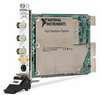
The PXI-5404 is a 100 MHz arbitrary waveform generator from National Instruments. An arbitrary waveform generator (AWG) is a type of electronic test equipment people use to generate repetitive or single-shot electrical waveforms. Single-shot waveforms require a triggering source, either internal or external, while repetitive waveforms do not. Inject the signal the waveform generator creates into a device for analysis during testing, finding problems with the device, or confirming proper operation.
Additional Features:
Outputs: 1 Sine and 1 Clock—both generate same frequency simultaneously
Connector: SMB
Frequency Range: 9 kHz to 105 MHz
Frequency Resolution: 1.07 μHz
Phase Range: 0° to 359.978°
Phase Resolution: 16,384 steps including endpoints (approximately 0.022°)
Output Impedance: 50 ω ±4%
Output Protection: 10 V RMS
Sample Rate: 300 MS/s
The PXI-5404 is a 100 MHz clock generator capable of generating clock and sine wave signals and some other standard functions. This clock generator can generate signals from -1 V to +1 V and uses direct digital synthesis (DDS) to precisely generate waveforms.
The PXI-5404 is a 100 MHz arbitrary waveform generator from National Instruments. An arbitrary waveform generator (AWG) is a type of electronic test equipment people use to generate repetitive or single-shot electrical waveforms. Single-shot waveforms require a triggering source, either internal or external, while repetitive waveforms do not. Inject the signal the waveform generator creates into a device for analysis during testing, finding problems with the device, or confirming proper operation.
Additional Features:
- Outputs: 1 Sine and 1 Clock—both generate same frequency simultaneously
- Connector: SMB
- Frequency Range: 9 kHz to 105 MHz
- Frequency Resolution: 1.07 μHz
- Phase Range: 0° to 359.978°
- Phase Resolution: 16,384 steps including endpoints (approximately 0.022°)
- Output Impedance: 50 Ω ±4%
- Output Protection: 10 V RMS
- Sample Rate: 300 MS/s
The PXI-5404 is a 100 MHz clock generator capable of generating clock and sine wave signals and some other standard functions. This clock generator can generate signals from -1 V to +1 V and uses direct digital synthesis (DDS) to precisely generate waveforms.