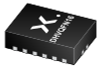
Nexperia B.V. Coin cell battery life booster with adaptive power optimization NBM7100BBQX

Description
The NBM7100A/Bis a battery energy management device designed to maximize usable capacity from non-rechargeable, primary batteries when used in low-voltage, low-power applications requiring burst current loads. The devices overcome voltage drop and battery life limitations associated with extracting high pulse currents (Figure 1) from lithium primary batteries such as 3 V lithium manganese dioxide (LiMnO2) coin cells.which are commonly used in wireless, low-power IoT sensor applications. The NBM7100A/Bcontains two stages of high efficiency DC-DC conversion and an intelligent learning algorithm. The first stage DC-DC conversion transfers energy from the lithium battery at a low constant current to a capacitive storage element. Once charged, a second DC-DC conversion cycle utilizes this stored energy to supply a regulated voltage with high pulse load current capability on the VDH output pin. The battery is never directly subjected to large load pulse currents, resulting in a longer, more predictable battery lifetime. The proprietary learning algorithm monitors the energy used during repetitive load pulse cycles and optimizes first stage DC-DC conversion to minimize the residual charge in the storage capacitor. A serial interface allows a microcontroller to change default configuration settings and read-back system information. Table 1.Related devices Type number - Bus interface - Auto start - Pulse ILOAD NBM7100A I²C Yes ≥ 200 mA NBM7100B SPI No ≥ 200 mA Figure 1.IoT pulsed load profile Features and benefits Programmable constant battery load current: 2 mA to 16 mA Protection against battery voltage dips (Brown-out) Pulse output current: > 200 mA Low ripple regulated programmable output voltage, VDH: 1.8 V to 3.6 V Ultra-low standby current: 20 nA (typ) Peak conversion efficiency up to 93% with adaptive optimization Integrated fuel gauge Small 16 pin lead-free package (SOT763-1/DHVQFN16 ; 2.5 mm × 3.5 mm × 0.85 mm) Specified from -40 °C to +85 °C Applications Battery powered wireless microcontroller applications (IoT): Bluetooth®, LoRaWAN®, Sigfox™, LTE-M, NB-IoT, Zigbee, etc. Industrial: temperature, occupancy, e-metering, electronic shelf label, asset tracking, irrigation monitoring Consumer/wearable: location tags, heart rate monitor, blood glucose meter, remote controls, key fobs Figure 1. Simplified Application
Request a Quote
Datasheet
Datasheet Summary
Powered by GS/AI

The NBM7100B is a coin cell battery life booster designed to maximize usable capacity from primary lithium batteries in low-power, pulsed-load IoT applications. It uses a two-stage DC-DC conversion system to transfer energy from the battery to a storage capacitor and deliver regulated high-current pulses up to 200 mA on the VDH output without exposing the battery to direct pulse loads. The device features programmable battery charge current from 2 mA to 16 mA, a regulated output voltage from 1.8 V to 3.6 V, ultra-low standby current of 20 nA, and peak efficiency up to 93% with adaptive optimization. An integrated fuel gauge monitors energy usage, and an SPI interface enables microcontroller configuration. It is housed in a 16-pin DHVQFN16 package measuring 2.5 mm × 3.5 mm × 0.85 mm and operates across -40 °C to +85 °C.

Suppliers

Company
Product
Description
Supplier Links
Coin cell battery life booster with adaptive power optimization - NBM7100BBQX - Nexperia B.V.
Nijmegen, Netherlands
Coin cell battery life booster with adaptive power optimization
NBM7100BBQX
Coin cell battery life booster with adaptive power optimization NBM7100BBQX
The NBM7100A/Bis a battery energy management device designed to maximize usable capacity from non-rechargeable, primary batteries when used in low-voltage, low-power applications requiring burst current loads. The devices overcome voltage drop and battery life limitations associated with extracting high pulse currents (Figure 1) from lithium primary batteries such as 3 V lithium manganese dioxide (LiMnO2) coin cells.which are commonly used in wireless, low-power IoT sensor applications. The NBM7100A/Bcontains two stages of high efficiency DC-DC conversion and an intelligent learning algorithm. The first stage DC-DC conversion transfers energy from the lithium battery at a low constant current to a capacitive storage element. Once charged, a second DC-DC conversion cycle utilizes this stored energy to supply a regulated voltage with high pulse load current capability on the VDH output pin. The battery is never directly subjected to large load pulse currents, resulting in a longer, more predictable battery lifetime. The proprietary learning algorithm monitors the energy used during repetitive load pulse cycles and optimizes first stage DC-DC conversion to minimize the residual charge in the storage capacitor. A serial interface allows a microcontroller to change default configuration settings and read-back system information. Table 1.Related devices Type number - Bus interface - Auto start - Pulse ILOAD NBM7100A I²C Yes ≥ 200 mA NBM7100B SPI No ≥ 200 mA Figure 1.IoT pulsed load profile Features and benefits Programmable constant battery load current: 2 mA to 16 mA Protection against battery voltage dips (Brown-out) Pulse output current: > 200 mA Low ripple regulated programmable output voltage, VDH: 1.8 V to 3.6 V Ultra-low standby current: 20 nA (typ) Peak conversion efficiency up to 93% with adaptive optimization Integrated fuel gauge Small 16 pin lead-free package (SOT763-1/DHVQFN16 ; 2.5 mm × 3.5 mm × 0.85 mm) Specified from -40 °C to +85 °C Applications Battery powered wireless microcontroller applications (IoT): Bluetooth®, LoRaWAN®, Sigfox™, LTE-M, NB-IoT, Zigbee, etc. Industrial: temperature, occupancy, e-metering, electronic shelf label, asset tracking, irrigation monitoring Consumer/wearable: location tags, heart rate monitor, blood glucose meter, remote controls, key fobs Figure 1. Simplified Application

The NBM7100A/Bis a battery energy management device designed to maximize usable capacity from non-rechargeable, primary batteries when used in low-voltage, low-power applications requiring burst current loads. The devices overcome voltage drop and battery life limitations associated with extracting high pulse currents (Figure 1) from lithium primary batteries such as 3 V lithium manganese dioxide (LiMnO2) coin cells.which are commonly used in wireless, low-power IoT sensor applications.

The NBM7100A/Bcontains two stages of high efficiency DC-DC conversion and an intelligent learning algorithm. The first stage DC-DC conversion transfers energy from the lithium battery at a low constant current to a capacitive storage element. Once charged, a second DC-DC conversion cycle utilizes this stored energy to supply a regulated voltage with high pulse load current capability on the VDH output pin. The battery is never directly subjected to large load pulse currents, resulting in a longer, more predictable battery lifetime.

The proprietary learning algorithm monitors the energy used during repetitive load pulse cycles and optimizes first stage DC-DC conversion to minimize the residual charge in the storage capacitor.

A serial interface allows a microcontroller to change default configuration settings and read-back system information.

Table 1.Related devices

Type number

-

Bus interface

-

Auto

start

-

Pulse

ILOAD

NBM7100A

I²C

Yes

≥ 200 mA

NBM7100B

SPI

No

≥ 200 mA


Figure 1.IoT pulsed load profile

Features and benefits

  • Programmable constant battery load current: 2 mA to 16 mA
  • Protection against battery voltage dips (Brown-out)
  • Pulse output current: > 200 mA
  • Low ripple regulated programmable output voltage, VDH: 1.8 V to 3.6 V
  • Ultra-low standby current: 20 nA (typ)
  • Peak conversion efficiency up to 93% with adaptive optimization
  • Integrated fuel gauge
  • Small 16 pin lead-free package (SOT763-1/DHVQFN16; 2.5 mm × 3.5 mm × 0.85 mm)
  • Specified from -40 °C to +85 °C

Applications

  • Battery powered wireless microcontroller applications (IoT): Bluetooth®, LoRaWAN®, Sigfox™, LTE-M, NB-IoT, Zigbee, etc.
  • Industrial: temperature, occupancy, e-metering, electronic shelf label, asset tracking, irrigation monitoring
  • Consumer/wearable: location tags, heart rate monitor, blood glucose meter, remote controls, key fobs

Figure 1. Simplified Application

Supplier's Site Datasheet

Technical Specifications

  Nexperia B.V.
Product Category Supervisory Circuits and Battery Monitor Chips
Product Number NBM7100BBQX
Product Name Coin cell battery life booster with adaptive power optimization
Type SOT763-1 SOT763-1
Unlock Full Specs
to access all available technical data

Similar Products

Voltage Reference - TL431AMFDT,215 - Quarktwin Technology Ltd.
Specs
Type TO-236-3, SC-59, SOT-23-3
IQ 100000 µA
Operating Temperature -40 to 125 C (-40 to 257 F)
View Details
Voltage Reference - TL431BMFDT,215 - Quarktwin Technology Ltd.
Specs
Type TO-236-3, SC-59, SOT-23-3
IQ 100000 µA
Operating Temperature -40 to 125 C (-40 to 257 F)
View Details