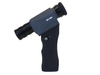
Newport MKS Infrared Viewer, 350-2000 nm Wavelength Range IRV3-2000

Description
The IRV3-2000 Hand-held Infrared Viewer covers the 350-2000 nm wavelength range and is operated by rechargeable battery located in the handle. It includes an IR filter, 1x lens, 2x lens, and a case. 1/4-20 threaded hole for handle attachment, post or tripod mounting. The 1X and the 2X lens assemblies are easily switchable. 350 nm to 2000 nm Wavelength Coverage The Infrared Viewers are offered in various versions with spectral responses that cover anywhere from 350 nm up to 2000 nm. Handheld, Hands-free or Post-Mounted Operation The lightweight, compact device can be used handheld, post mounted with the ¼-20 internal thread, or facemask-mounted for hands-free operation. Wide Variety of Applications Applications for these IR viewers include laser beam alignment, optical fiber alignment, semiconductor inspection, fluorescence, IR luminescence, thermal imaging, night vision, and photo processing. Sensitivity of the IR Viewers in the Long Wavelength Range Typically, the sensitivity of the IR viewer quickly is reduced starting from 1300 nm. However, it is possible to observe low intensity IR beam with proper viewing conditions, such as the spectral filtration, reduced external background noise, short distance of observation, the use of a metallic surface for viewing the IR reflective radiation (instead of a paper material, which has high absorption in IR). The approximate minimal power densities, required for the viewing of infrared laser beam at one meter distance, are as follows: 3 mW/cm² for 1.5 µm 50 mW/cm² for 1.7 µm 180mW/cm² for 1.8 µm 1 W/cm² for 1.9 µm 2 W/cm² for 2.0 µm Maximize Performance: Usage and Testing Tips Each IRV3 unit is tested against our defined black dot pattern and disqualified if it fails to perform its core alignment function. We recommend using these devices in a low-light environment (<50 lux), considering that a typical room is ~200 lux. This technology originates from night vision applications, so it should be tested and used in similar lighting conditions. Furthermore, sensitive photocathode materials degrade faster when exposed to bright light, whether powered on or not.
Request a Quote Datasheet
Description
The IRV3-2000 Hand-held Infrared Viewer covers the 350-2000 nm wavelength range and is operated by rechargeable battery located in the handle. It includes an IR filter, 1x lens, 2x lens, and a case. 1/4-20 threaded hole for handle attachment, post or tripod mounting. The 1X and the 2X lens assemblies are easily switchable. 350 nm to 2000 nm Wavelength Coverage The Infrared Viewers are offered in various versions with spectral responses that cover anywhere from 350 nm up to 2000 nm. Handheld, Hands-free or Post-Mounted Operation The lightweight, compact device can be used handheld, post mounted with the ¼-20 internal thread, or facemask-mounted for hands-free operation. Wide Variety of Applications Applications for these IR viewers include laser beam alignment, optical fiber alignment, semiconductor inspection, fluorescence, IR luminescence, thermal imaging, night vision, and photo processing. Sensitivity of the IR Viewers in the Long Wavelength Range Typically, the sensitivity of the IR viewer quickly is reduced starting from 1300 nm. However, it is possible to observe low intensity IR beam with proper viewing conditions, such as the spectral filtration, reduced external background noise, short distance of observation, the use of a metallic surface for viewing the IR reflective radiation (instead of a paper material, which has high absorption in IR). The approximate minimal power densities, required for the viewing of infrared laser beam at one meter distance, are as follows: 3 mW/cm² for 1.5 µm 50 mW/cm² for 1.7 µm 180mW/cm² for 1.8 µm 1 W/cm² for 1.9 µm 2 W/cm² for 2.0 µm Maximize Performance: Usage and Testing Tips Each IRV3 unit is tested against our defined black dot pattern and disqualified if it fails to perform its core alignment function. We recommend using these devices in a low-light environment (<50 lux), considering that a typical room is ~200 lux. This technology originates from night vision applications, so it should be tested and used in similar lighting conditions. Furthermore, sensitive photocathode materials degrade faster when exposed to bright light, whether powered on or not.
Request a Quote Datasheet

Suppliers

Company
Product
Description
Supplier Links
Infrared Viewer, 350-2000 nm Wavelength Range - IRV3-2000 - Newport MKS
Irvine, CA, United States
Infrared Viewer, 350-2000 nm Wavelength Range
IRV3-2000
Infrared Viewer, 350-2000 nm Wavelength Range IRV3-2000
The IRV3-2000 Hand-held Infrared Viewer covers the 350-2000 nm wavelength range and is operated by rechargeable battery located in the handle. It includes an IR filter, 1x lens, 2x lens, and a case. 1/4-20 threaded hole for handle attachment, post or tripod mounting. The 1X and the 2X lens assemblies are easily switchable. 350 nm to 2000 nm Wavelength Coverage The Infrared Viewers are offered in various versions with spectral responses that cover anywhere from 350 nm up to 2000 nm. Handheld, Hands-free or Post-Mounted Operation The lightweight, compact device can be used handheld, post mounted with the ¼-20 internal thread, or facemask-mounted for hands-free operation. Wide Variety of Applications Applications for these IR viewers include laser beam alignment, optical fiber alignment, semiconductor inspection, fluorescence, IR luminescence, thermal imaging, night vision, and photo processing. Sensitivity of the IR Viewers in the Long Wavelength Range Typically, the sensitivity of the IR viewer quickly is reduced starting from 1300 nm. However, it is possible to observe low intensity IR beam with proper viewing conditions, such as the spectral filtration, reduced external background noise, short distance of observation, the use of a metallic surface for viewing the IR reflective radiation (instead of a paper material, which has high absorption in IR). The approximate minimal power densities, required for the viewing of infrared laser beam at one meter distance, are as follows: 3 mW/cm² for 1.5 µm 50 mW/cm² for 1.7 µm 180mW/cm² for 1.8 µm 1 W/cm² for 1.9 µm 2 W/cm² for 2.0 µm Maximize Performance: Usage and Testing Tips Each IRV3 unit is tested against our defined black dot pattern and disqualified if it fails to perform its core alignment function. We recommend using these devices in a low-light environment (<50 lux), considering that a typical room is ~200 lux. This technology originates from night vision applications, so it should be tested and used in similar lighting conditions. Furthermore, sensitive photocathode materials degrade faster when exposed to bright light, whether powered on or not.

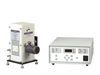
The IRV3-2000 Hand-held Infrared Viewer covers the 350-2000 nm wavelength range and is operated by rechargeable battery located in the handle. It includes an IR filter, 1x lens, 2x lens, and a case. 1/4-20 threaded hole for handle attachment, post or tripod mounting. The 1X and the 2X lens assemblies are easily switchable.

350 nm to 2000 nm Wavelength Coverage

The Infrared Viewers are offered in various versions with spectral responses that cover anywhere from 350 nm up to 2000 nm.

Handheld, Hands-free or Post-Mounted Operation

The lightweight, compact device can be used handheld, post mounted with the ¼-20 internal thread, or facemask-mounted for hands-free operation.

Wide Variety of Applications

Applications for these IR viewers include laser beam alignment, optical fiber alignment, semiconductor inspection, fluorescence, IR luminescence, thermal imaging, night vision, and photo processing.

Sensitivity of the IR Viewers in the Long Wavelength Range


Typically, the sensitivity of the IR viewer quickly is reduced starting from 1300 nm. However, it is possible to observe low intensity IR beam with proper viewing conditions, such as the spectral filtration, reduced external background noise, short distance of observation, the use of a metallic surface for viewing the IR reflective radiation (instead of a paper material, which has high absorption in IR).

The approximate minimal power densities, required for the viewing of infrared laser beam at one meter distance, are as follows:

  • 3 mW/cm² for 1.5 µm
  • 50 mW/cm² for 1.7 µm
  • 180mW/cm² for 1.8 µm
  • 1 W/cm² for 1.9 µm
  • 2 W/cm² for 2.0 µm

Maximize Performance: Usage and Testing Tips


Each IRV3 unit is tested against our defined black dot pattern and disqualified if it fails to perform its core alignment function. We recommend using these devices in a low-light environment (<50 lux), considering that a typical room is ~200 lux. This technology originates from night vision applications, so it should be tested and used in similar lighting conditions. Furthermore, sensitive photocathode materials degrade faster when exposed to bright light, whether powered on or not.

Supplier's Site Datasheet

Technical Specifications

  Newport MKS
Product Category UV Light Systems
Product Number IRV3-2000
Product Name Infrared Viewer, 350-2000 nm Wavelength Range
Unlock Full Specs
to access all available technical data

Similar Products