Newport MKS Zero-Order Waveplate, Half-Wave, Quartz, 25.4 mm Diameter, 441.6 nm 10RP02-10

Description
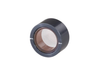
The 10RP02-10 Zero-Order Quartz Half Wave Plate is a temperature insensitive phase retarder for moderate bandwidth 441.6 nm applications. This zero-order waveplate is constructed of two quartz plates, air-spaced to allow for use with high-power lasers. The assembly is held in a 1 inch (25.4 mm) diameter black anodized aluminum housing to protect the optic and permit convenient handling and mounting. The wave plate is antireflection coated to maximize transmission at the 441.6 nm wavelength, and has a λ/2 retardation. Retardation in zero-order wave plates is insensitive to temperature since thermal changes between the multiple-order wave plates tend to cancel. A typical zero-order wave plate has a temperature coefficient of 0.0001 λ/°C compared to 0.0015 λ/°C for a multiple-order wave plate, providing less change in retardation over an extended temperature range. Zero-order wave plates offer several distinct advantages over multiple order wave plates. The primary benefit is a moderate insensitivity to wavelength change, making them ideal for laser diode or tunable laser applications. For example, a zero-order wave plate designed for 780 nm will provide useful retardance from 765–795 nm. By combining two wave plates whose retardations differ by exactly λ/4 or λ/2, a true λ/4 or λ/2 wave plate results. The fast axis of one plate is aligned with the slow axis of the other, so that the net retardation is the difference of the two retardations. Quartz Half-Wave Waveplate Construction These zero-order wave plates are constructed of two quartz plates, air-spaced to allow for use with high-power lasers. By combining the two air spaced waveplates whose retardations differ by exactly λ/2, a true half-wave waveplate results. The fast axis of one plate is aligned with the slow axis of the other, so that the net retardation is the difference of the two retardations. The waveplates are antireflection coated to maximize transmission for major laser wavelengths from 248-1550 nm. The waveplate assembly is mounted in a 12.7 mm or 25.4 mm diameter black anodized aluminum housing to protect the waveplate and permit convenient handling and mounting. Lines on the housing indicate the location of the slow axis. Rotate the Plane of a Plane-Polarized Wave A half-wave plate can rotate the plane of polarization from a polarized laser to any other desired plane. Suppose a plane-polarized wave is normally incident on a wave plate, and the plane of polarization is at an angle θ with respect to the fast axis. To see what happens, resolve the incident field into components polarized along the fast and slow axes, as shown. After passing through the plate, pick a point in the wave where the fast component passes through a maximum. Since the slow component is retarded by one half-wave, it will also be a maximum, but 180° out of phase, or pointing along the negative slow axis. If we follow the wave further, we see that the slow component remains exactly 180° out of phase with the original slow component, relative to the fast component. This describes a plane-polarized wave, but making an angle θ on the opposite side of the fast axis. Our original plane wave has been rotated through an angle 2θ. Retardation is Insensitive to Wavelength Zero-order wave plates offer several distinct advantages over multiple order wave plates. The primary benefit is a moderate insensitivity to wavelength change, making them ideal for laser diode or tunable laser applications. For example, a zero-order wave plate designed for 780 nm will provide useful retardance from 765–795 nm. Retardation is Sensitive to Incidence Angle Quartz waveplates are more sensitive to incidence angle than our Polymer waveplates. Polymer waveplates have excellent angular field of view and the retardation changes by less than 1% over a ±12° incidence angle.
Request a Quote
Description
The 10RP02-10 Zero-Order Quartz Half Wave Plate is a temperature insensitive phase retarder for moderate bandwidth 441.6 nm applications. This zero-order waveplate is constructed of two quartz plates, air-spaced to allow for use with high-power lasers. The assembly is held in a 1 inch (25.4 mm) diameter black anodized aluminum housing to protect the optic and permit convenient handling and mounting. The wave plate is antireflection coated to maximize transmission at the 441.6 nm wavelength, and has a λ/2 retardation. Retardation in zero-order wave plates is insensitive to temperature since thermal changes between the multiple-order wave plates tend to cancel. A typical zero-order wave plate has a temperature coefficient of 0.0001 λ/°C compared to 0.0015 λ/°C for a multiple-order wave plate, providing less change in retardation over an extended temperature range. Zero-order wave plates offer several distinct advantages over multiple order wave plates. The primary benefit is a moderate insensitivity to wavelength change, making them ideal for laser diode or tunable laser applications. For example, a zero-order wave plate designed for 780 nm will provide useful retardance from 765–795 nm. By combining two wave plates whose retardations differ by exactly λ/4 or λ/2, a true λ/4 or λ/2 wave plate results. The fast axis of one plate is aligned with the slow axis of the other, so that the net retardation is the difference of the two retardations. Quartz Half-Wave Waveplate Construction These zero-order wave plates are constructed of two quartz plates, air-spaced to allow for use with high-power lasers. By combining the two air spaced waveplates whose retardations differ by exactly λ/2, a true half-wave waveplate results. The fast axis of one plate is aligned with the slow axis of the other, so that the net retardation is the difference of the two retardations. The waveplates are antireflection coated to maximize transmission for major laser wavelengths from 248-1550 nm. The waveplate assembly is mounted in a 12.7 mm or 25.4 mm diameter black anodized aluminum housing to protect the waveplate and permit convenient handling and mounting. Lines on the housing indicate the location of the slow axis. Rotate the Plane of a Plane-Polarized Wave A half-wave plate can rotate the plane of polarization from a polarized laser to any other desired plane. Suppose a plane-polarized wave is normally incident on a wave plate, and the plane of polarization is at an angle θ with respect to the fast axis. To see what happens, resolve the incident field into components polarized along the fast and slow axes, as shown. After passing through the plate, pick a point in the wave where the fast component passes through a maximum. Since the slow component is retarded by one half-wave, it will also be a maximum, but 180° out of phase, or pointing along the negative slow axis. If we follow the wave further, we see that the slow component remains exactly 180° out of phase with the original slow component, relative to the fast component. This describes a plane-polarized wave, but making an angle θ on the opposite side of the fast axis. Our original plane wave has been rotated through an angle 2θ. Retardation is Insensitive to Wavelength Zero-order wave plates offer several distinct advantages over multiple order wave plates. The primary benefit is a moderate insensitivity to wavelength change, making them ideal for laser diode or tunable laser applications. For example, a zero-order wave plate designed for 780 nm will provide useful retardance from 765–795 nm. Retardation is Sensitive to Incidence Angle Quartz waveplates are more sensitive to incidence angle than our Polymer waveplates. Polymer waveplates have excellent angular field of view and the retardation changes by less than 1% over a ±12° incidence angle.
Request a Quote

Suppliers

Company
Product
Description
Supplier Links
Zero-Order Waveplate, Half-Wave, Quartz, 25.4 mm Diameter, 441.6 nm - 10RP02-10 - Newport MKS
Irvine, CA, United States
Zero-Order Waveplate, Half-Wave, Quartz, 25.4 mm Diameter, 441.6 nm
10RP02-10
Zero-Order Waveplate, Half-Wave, Quartz, 25.4 mm Diameter, 441.6 nm 10RP02-10
The 10RP02-10 Zero-Order Quartz Half Wave Plate is a temperature insensitive phase retarder for moderate bandwidth 441.6 nm applications. This zero-order waveplate is constructed of two quartz plates, air-spaced to allow for use with high-power lasers. The assembly is held in a 1 inch (25.4 mm) diameter black anodized aluminum housing to protect the optic and permit convenient handling and mounting. The wave plate is antireflection coated to maximize transmission at the 441.6 nm wavelength, and has a λ/2 retardation. Retardation in zero-order wave plates is insensitive to temperature since thermal changes between the multiple-order wave plates tend to cancel. A typical zero-order wave plate has a temperature coefficient of 0.0001 λ/°C compared to 0.0015 λ/°C for a multiple-order wave plate, providing less change in retardation over an extended temperature range. Zero-order wave plates offer several distinct advantages over multiple order wave plates. The primary benefit is a moderate insensitivity to wavelength change, making them ideal for laser diode or tunable laser applications. For example, a zero-order wave plate designed for 780 nm will provide useful retardance from 765–795 nm. By combining two wave plates whose retardations differ by exactly λ/4 or λ/2, a true λ/4 or λ/2 wave plate results. The fast axis of one plate is aligned with the slow axis of the other, so that the net retardation is the difference of the two retardations. Quartz Half-Wave Waveplate Construction These zero-order wave plates are constructed of two quartz plates, air-spaced to allow for use with high-power lasers. By combining the two air spaced waveplates whose retardations differ by exactly λ/2, a true half-wave waveplate results. The fast axis of one plate is aligned with the slow axis of the other, so that the net retardation is the difference of the two retardations. The waveplates are antireflection coated to maximize transmission for major laser wavelengths from 248-1550 nm. The waveplate assembly is mounted in a 12.7 mm or 25.4 mm diameter black anodized aluminum housing to protect the waveplate and permit convenient handling and mounting. Lines on the housing indicate the location of the slow axis. Rotate the Plane of a Plane-Polarized Wave A half-wave plate can rotate the plane of polarization from a polarized laser to any other desired plane. Suppose a plane-polarized wave is normally incident on a wave plate, and the plane of polarization is at an angle θ with respect to the fast axis. To see what happens, resolve the incident field into components polarized along the fast and slow axes, as shown. After passing through the plate, pick a point in the wave where the fast component passes through a maximum. Since the slow component is retarded by one half-wave, it will also be a maximum, but 180° out of phase, or pointing along the negative slow axis. If we follow the wave further, we see that the slow component remains exactly 180° out of phase with the original slow component, relative to the fast component. This describes a plane-polarized wave, but making an angle θ on the opposite side of the fast axis. Our original plane wave has been rotated through an angle 2θ. Retardation is Insensitive to Wavelength Zero-order wave plates offer several distinct advantages over multiple order wave plates. The primary benefit is a moderate insensitivity to wavelength change, making them ideal for laser diode or tunable laser applications. For example, a zero-order wave plate designed for 780 nm will provide useful retardance from 765–795 nm. Retardation is Sensitive to Incidence Angle Quartz waveplates are more sensitive to incidence angle than our Polymer waveplates. Polymer waveplates have excellent angular field of view and the retardation changes by less than 1% over a ±12° incidence angle.

The 10RP02-10 Zero-Order Quartz Half Wave Plate is a temperature insensitive phase retarder for moderate bandwidth 441.6 nm applications. This zero-order waveplate is constructed of two quartz plates, air-spaced to allow for use with high-power lasers. The assembly is held in a 1 inch (25.4 mm) diameter black anodized aluminum housing to protect the optic and permit convenient handling and mounting. The wave plate is antireflection coated to maximize transmission at the 441.6 nm wavelength, and has a λ/2 retardation. Retardation in zero-order wave plates is insensitive to temperature since thermal changes between the multiple-order wave plates tend to cancel. A typical zero-order wave plate has a temperature coefficient of 0.0001 λ/°C compared to 0.0015 λ/°C for a multiple-order wave plate, providing less change in retardation over an extended temperature range. Zero-order wave plates offer several distinct advantages over multiple order wave plates. The primary benefit is a moderate insensitivity to wavelength change, making them ideal for laser diode or tunable laser applications. For example, a zero-order wave plate designed for 780 nm will provide useful retardance from 765–795 nm. By combining two wave plates whose retardations differ by exactly λ/4 or λ/2, a true λ/4 or λ/2 wave plate results. The fast axis of one plate is aligned with the slow axis of the other, so that the net retardation is the difference of the two retardations.

Quartz Half-Wave Waveplate Construction

These zero-order wave plates are constructed of two quartz plates, air-spaced to allow for use with high-power lasers. By combining the two air spaced waveplates whose retardations differ by exactly λ/2, a true half-wave waveplate results. The fast axis of one plate is aligned with the slow axis of the other, so that the net retardation is the difference of the two retardations. The waveplates are antireflection coated to maximize transmission for major laser wavelengths from 248-1550 nm. The waveplate assembly is mounted in a 12.7 mm or 25.4 mm diameter black anodized aluminum housing to protect the waveplate and permit convenient handling and mounting. Lines on the housing indicate the location of the slow axis.


Rotate the Plane of a Plane-Polarized Wave

A half-wave plate can rotate the plane of polarization from a polarized laser to any other desired plane. Suppose a plane-polarized wave is normally incident on a wave plate, and the plane of polarization is at an angle θ with respect to the fast axis. To see what happens, resolve the incident field into components polarized along the fast and slow axes, as shown. After passing through the plate, pick a point in the wave where the fast component passes through a maximum. Since the slow component is retarded by one half-wave, it will also be a maximum, but 180° out of phase, or pointing along the negative slow axis. If we follow the wave further, we see that the slow component remains exactly 180° out of phase with the original slow component, relative to the fast component. This describes a plane-polarized wave, but making an angle θ on the opposite side of the fast axis. Our original plane wave has been rotated through an angle 2θ.


Retardation is Insensitive to Wavelength

Zero-order wave plates offer several distinct advantages over multiple order wave plates. The primary benefit is a moderate insensitivity to wavelength change, making them ideal for laser diode or tunable laser applications. For example, a zero-order wave plate designed for 780 nm will provide useful retardance from 765–795 nm.


Retardation is Sensitive to Incidence Angle

Quartz waveplates are more sensitive to incidence angle than our Polymer waveplates. Polymer waveplates have excellent angular field of view and the retardation changes by less than 1% over a ±12° incidence angle.

Supplier's Site

Technical Specifications

  Newport MKS
Product Category Waveplates and Retardation Plates
Product Number 10RP02-10
Product Name Zero-Order Waveplate, Half-Wave, Quartz, 25.4 mm Diameter, 441.6 nm
Material Quartz
Polarizer Features Anti-Reflection Coating
Surface Quality 10-5 Scratch / Dig
Wavelength Range 442 nm (4416 Å)
Unlock Full Specs
to access all available technical data

Similar Products

Zero-Order Waveplate, Half-Wave, Quartz, 25.4 mm Diameter, 488 nm - 10RP02-12 - Newport MKS
Specs
Material Quartz
Polarizer Features Anti-Reflection Coating
Surface Quality 10-5 Scratch / Dig
View Details
Zero-Order Waveplate, Quarter-Wave, Quartz, 25.4 mm Diameter, 413 nm - 10RP04-41 - Newport MKS
Specs
Material Quartz
Polarizer Features Anti-Reflection Coating
Surface Quality 10-5 Scratch / Dig
View Details
Zero-Order Waveplate, Half-Wave, Polymer, 12.7 mm Diameter, 780 nm - 05RP32-780 - Newport MKS
Specs
Material BK7
Polarizer Features Anti-Reflection Coating
Surface Quality 40-20 Scratch / Dig
View Details
Zero-Order Waveplate, Half-Wave, Polymer, 50.8 mm Diameter, 1064 nm - 20RP32-1064 - Newport MKS
Specs
Material BK7
Polarizer Features Anti-Reflection Coating
Surface Quality 40-20 Scratch / Dig
View Details