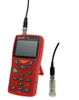
MTI Instruments Inc. Portable Vibration and Balancing System PBS-4100 Plus

Description
Portable vibration analysis and engine trim balance instruments and accessories for commercial and military aviation. Designed to swiftly pinpoint engine problems and eliminate avoidable engine removals. Rapid configuration and intuitive user interface make it straightforward and uncomplicated to use. The strategy of the PBS-4100+ is to correlate vibration magnitude to the specific moving parts within an engine. This way, different vibration content is “matched-up” with each of their respective spools. The overall engine vibration may be considered as the summation of the vibration contributions by each moving part within the engine. It becomes critical to correlate a given rotation with each of the respective moving parts within the engine, as the source of the vibration can then be ascertained and corrected. The PBS-4100+ employs a series of on-board digitizers to measure the magnitude of the vibration and each spools’ rotational speed. Advanced logic is integrated to assess the 12-o’clock position of each engine spool to understand where on the spool an imbalance might be located. Vibration is correlated to the spools using a series of configurable “tracking filters”. A “tracking filter” is a series of specialized computer algorithms, which measure the rotational speed of a given spool, then filter the vibration content outside of a narrow band of interest. The narrow band of interest is the characteristic frequency of vibration around each spool’s rotational speed. Using the tracking filter for each speed, the contribution of vibration of each spool is separated. As vibration varies with engine speed, measurements are “trended”. In testing an engine, the operator will execute a vibration survey on the turbine engine. The survey is a slow cycling of engine speed from idle to maximum, then back down to idle again. As this occurs, the PBS-4100+ will measure the vibration contribution from each of the spools and plot its findings on a series of plots (most notably, a “Speed versus Vibration” plot. In addition, the overall vibration is also plotted. Features Up to 4 vibration channels and 3 speed channels for comprehensive machine testing Intuitive color graphical user interface with touch screen for fast and reliable operation Large color front panel display for easy viewing Instinctive Balance Wizard for trouble-free and accurate trim balancing at the touch of a button Built in diagnostics and traceability reporting – reduce maintenance costs with no downtime Versatile aircraft cable sets and connection accessories for all engine and aircraft types
Datasheet
Description
Portable vibration analysis and engine trim balance instruments and accessories for commercial and military aviation. Designed to swiftly pinpoint engine problems and eliminate avoidable engine removals. Rapid configuration and intuitive user interface make it straightforward and uncomplicated to use. The strategy of the PBS-4100+ is to correlate vibration magnitude to the specific moving parts within an engine. This way, different vibration content is “matched-up” with each of their respective spools. The overall engine vibration may be considered as the summation of the vibration contributions by each moving part within the engine. It becomes critical to correlate a given rotation with each of the respective moving parts within the engine, as the source of the vibration can then be ascertained and corrected. The PBS-4100+ employs a series of on-board digitizers to measure the magnitude of the vibration and each spools’ rotational speed. Advanced logic is integrated to assess the 12-o’clock position of each engine spool to understand where on the spool an imbalance might be located. Vibration is correlated to the spools using a series of configurable “tracking filters”. A “tracking filter” is a series of specialized computer algorithms, which measure the rotational speed of a given spool, then filter the vibration content outside of a narrow band of interest. The narrow band of interest is the characteristic frequency of vibration around each spool’s rotational speed. Using the tracking filter for each speed, the contribution of vibration of each spool is separated. As vibration varies with engine speed, measurements are “trended”. In testing an engine, the operator will execute a vibration survey on the turbine engine. The survey is a slow cycling of engine speed from idle to maximum, then back down to idle again. As this occurs, the PBS-4100+ will measure the vibration contribution from each of the spools and plot its findings on a series of plots (most notably, a “Speed versus Vibration” plot. In addition, the overall vibration is also plotted. Features Up to 4 vibration channels and 3 speed channels for comprehensive machine testing Intuitive color graphical user interface with touch screen for fast and reliable operation Large color front panel display for easy viewing Instinctive Balance Wizard for trouble-free and accurate trim balancing at the touch of a button Built in diagnostics and traceability reporting – reduce maintenance costs with no downtime Versatile aircraft cable sets and connection accessories for all engine and aircraft types
Datasheet

Suppliers

Company
Product
Description
Supplier Links
Portable Vibration and Balancing System - PBS-4100 Plus - MTI Instruments Inc.
Albany, NY, USA
Portable Vibration and Balancing System
PBS-4100 Plus
Portable Vibration and Balancing System PBS-4100 Plus
Portable vibration analysis and engine trim balance instruments and accessories for commercial and military aviation. Designed to swiftly pinpoint engine problems and eliminate avoidable engine removals. Rapid configuration and intuitive user interface make it straightforward and uncomplicated to use. The strategy of the PBS-4100+ is to correlate vibration magnitude to the specific moving parts within an engine. This way, different vibration content is “matched-up” with each of their respective spools. The overall engine vibration may be considered as the summation of the vibration contributions by each moving part within the engine. It becomes critical to correlate a given rotation with each of the respective moving parts within the engine, as the source of the vibration can then be ascertained and corrected. The PBS-4100+ employs a series of on-board digitizers to measure the magnitude of the vibration and each spools’ rotational speed. Advanced logic is integrated to assess the 12-o’clock position of each engine spool to understand where on the spool an imbalance might be located. Vibration is correlated to the spools using a series of configurable “tracking filters”. A “tracking filter” is a series of specialized computer algorithms, which measure the rotational speed of a given spool, then filter the vibration content outside of a narrow band of interest. The narrow band of interest is the characteristic frequency of vibration around each spool’s rotational speed. Using the tracking filter for each speed, the contribution of vibration of each spool is separated. As vibration varies with engine speed, measurements are “trended”. In testing an engine, the operator will execute a vibration survey on the turbine engine. The survey is a slow cycling of engine speed from idle to maximum, then back down to idle again. As this occurs, the PBS-4100+ will measure the vibration contribution from each of the spools and plot its findings on a series of plots (most notably, a “Speed versus Vibration” plot. In addition, the overall vibration is also plotted. Features Up to 4 vibration channels and 3 speed channels for comprehensive machine testing Intuitive color graphical user interface with touch screen for fast and reliable operation Large color front panel display for easy viewing Instinctive Balance Wizard for trouble-free and accurate trim balancing at the touch of a button Built in diagnostics and traceability reporting – reduce maintenance costs with no downtime Versatile aircraft cable sets and connection accessories for all engine and aircraft types

Portable vibration analysis and engine trim balance instruments and accessories for commercial and military aviation. Designed to swiftly pinpoint engine problems and eliminate avoidable engine removals. Rapid configuration and intuitive user interface make it straightforward and uncomplicated to use.

The strategy of the PBS-4100+ is to correlate vibration magnitude to the specific moving parts within an engine. This way, different vibration content is “matched-up” with each of their respective spools. The overall engine vibration may be considered as the summation of the vibration contributions by each moving part within the engine. It becomes critical to correlate a given rotation with each of the respective moving parts within the engine, as the source of the vibration can then be ascertained and corrected.

The PBS-4100+ employs a series of on-board digitizers to measure the magnitude of the vibration and each spools’ rotational speed. Advanced logic is integrated to assess the 12-o’clock position of each engine spool to understand where on the spool an imbalance might be located. Vibration is correlated to the spools using a series of configurable “tracking filters”. A “tracking filter” is a series of specialized computer algorithms, which measure the rotational speed of a given spool, then filter the vibration content outside of a narrow band of interest. The narrow band of interest is the characteristic frequency of vibration around each spool’s rotational speed.

Using the tracking filter for each speed, the contribution of vibration of each spool is separated. As vibration varies with engine speed, measurements are “trended”.

In testing an engine, the operator will execute a vibration survey on the turbine engine. The survey is a slow cycling of engine speed from idle to maximum, then back down to idle again. As this occurs, the PBS-4100+ will measure the vibration contribution from each of the spools and plot its findings on a series of plots (most notably, a “Speed versus Vibration” plot. In addition, the overall vibration is also plotted.

Features

  • Up to 4 vibration channels and 3 speed channels for comprehensive machine testing
  • Intuitive color graphical user interface with touch screen for fast and reliable operation
  • Large color front panel display for easy viewing
  • Instinctive Balance Wizard for trouble-free and accurate trim balancing at the touch of a button
  • Built in diagnostics and traceability reporting – reduce maintenance costs with no downtime
  • Versatile aircraft cable sets and connection accessories for all engine and aircraft types
Supplier's Site Datasheet

Technical Specifications

  MTI Instruments Inc.
Product Category Vibration Measurement Instruments and Vibration Analyzers
Product Number PBS-4100 Plus
Product Name Portable Vibration and Balancing System
Device Type Instrument / Meter
User Interface Computer Interface; Digital Front Panel; Manual
Form Factor Portable
Features Event triggered; Self Test / Self Calibrating
Unlock Full Specs
to access all available technical data

Similar Products

Vibration Meter - PCE-VT 3800 - PCE Instruments / PCE Americas Inc.
PCE Instruments / PCE Americas Inc.
Specs
Device Type Instrument / Meter
User Interface Digital Front Panel
Form Factor Handheld; Portable
View Details
Vibration Meters - 2543502 - RS Components, Ltd.
RS Components, Ltd.
Specs
Sensor Input Acceleration; Linear Velocity; Displacement; Acceleration, Displacement, Velocity
Operating Temperature 14 F (-10 C)
View Details
Vibration monitor with intuitive switch point setting - VKV021 - ifm efector inc.
Specs
Linear Velocity 0.0 to 0.9843 in/sec (0.0 to 1.5 m/min)
Frequency Range 10 to 1000 Hz
Accuracy 0.25 +/-% FS
View Details
5 suppliers