Gelest, Inc. VINYLTRIETHOXYSILANE SIV9112.0

Description
Additional Properties Hydrolytic Sensitivity 7: reacts slowly with moisture/water Application Reacts with enamines to give (E)-?-silylenamines, which cross-couple w/ aryl iodides to give ?-aryl enamines.1 Extensive review on the use in silicon-based cross-coupling reactions.2 Reference 1. Marciniec, B. et al. J. Org. Chem. 2005, 70, 8550. 2. Denmark, S. E. et al. Organic Reactions, Vol. 75, Denmark, S. E. ed., John Wiley and Sons, 233, 2011. Safety Hazard Info oral rat, LD50: 22,500 mg/kg Packaging Under Nitrogen Olefin Functional Trialkoxy Silane Silane coupling agents have the ability to form a durable bond between organic and inorganic materials to generate desired heterogeneous environments or to incorporate the bulk properties of different phases into a uniform composite structure. The general formula has two classes of functionality. The hydrolyzable group forms stable condensation products with siliceous surfaces and other oxides such as those of aluminum, zirconium, tin, titanium, and nickel. The organofunctional group alters the wetting or adhesion characteristics of the substrate, utilizes the substrate to catalyze chemical transformations at the heterogeneous interface, orders the interfacial region, or modifies its partition characteristics, and significantly effects the covalent bond between organic and inorganic materials. Alkenylsilane Cross-Coupling Agent The cross-coupling reaction is a highly useful methodology for the formation of carbon-carbon bonds. It involves two reagents, with one typically being a suitable organometallic reagent - the nucleophile - and the other a suitable organic substrate, normally an unsaturated halide, tosylate or similar - the electrophile. Vinyltriethoxysilane ; Triethoxyvinylsilane ; TEVS; VTES; Ethenyltriethoxysila ne; Triethoxysilylethyle ne; Triethoxy(vinyl)sila ne ΔHvap: 6.8 kcal/mol ΔHform: -463.5 kcal/mol Dipole moment: 1.69 debye Specific wetting surface area: 412 m2/g Copolymerization parameters- e,Q: -0.42, 0.028 γc of treated surfaces: 25 mN/m Vapor pressure, 20 °C: 5 mm Specific heat: 0.25 cal/g/° Relative hydrolysis rate versus SIV9220.0, vinyltrimethoxysilan e; 0.05 Forms copolymers with ethylene for moisture induced coupling of polyethylene Couples fillers or fiberglass to resins See VEE-005 for polymeric version Reacts with enamines to give (E)-β:-silylenamines , which cross-couple with aryl iodides to give β-aryl enamines Employed as a coupling agent, adhesion promoter, and crosslinking agent Used in microparticle surface modification for fillers Compatible with sulfur and peroxide cured rubber, polyester, polyolefin, styrene, and acrylic based materials For vinylations Available as an oligomeric hydrolysate, SIV9112.2 Extensive review of silicon based cross-coupling agents: Denmark, S. E. et al. "Organic Reactions, Volume 75" Denmark, S. E. ed., John Wiley and Sons, 233, 2011
Datasheet
Description
Additional Properties Hydrolytic Sensitivity 7: reacts slowly with moisture/water Application Reacts with enamines to give (E)-?-silylenamines, which cross-couple w/ aryl iodides to give ?-aryl enamines.1 Extensive review on the use in silicon-based cross-coupling reactions.2 Reference 1. Marciniec, B. et al. J. Org. Chem. 2005, 70, 8550. 2. Denmark, S. E. et al. Organic Reactions, Vol. 75, Denmark, S. E. ed., John Wiley and Sons, 233, 2011. Safety Hazard Info oral rat, LD50: 22,500 mg/kg Packaging Under Nitrogen Olefin Functional Trialkoxy Silane Silane coupling agents have the ability to form a durable bond between organic and inorganic materials to generate desired heterogeneous environments or to incorporate the bulk properties of different phases into a uniform composite structure. The general formula has two classes of functionality. The hydrolyzable group forms stable condensation products with siliceous surfaces and other oxides such as those of aluminum, zirconium, tin, titanium, and nickel. The organofunctional group alters the wetting or adhesion characteristics of the substrate, utilizes the substrate to catalyze chemical transformations at the heterogeneous interface, orders the interfacial region, or modifies its partition characteristics, and significantly effects the covalent bond between organic and inorganic materials. Alkenylsilane Cross-Coupling Agent The cross-coupling reaction is a highly useful methodology for the formation of carbon-carbon bonds. It involves two reagents, with one typically being a suitable organometallic reagent - the nucleophile - and the other a suitable organic substrate, normally an unsaturated halide, tosylate or similar - the electrophile. Vinyltriethoxysilane ; Triethoxyvinylsilane ; TEVS; VTES; Ethenyltriethoxysila ne; Triethoxysilylethyle ne; Triethoxy(vinyl)sila ne ΔHvap: 6.8 kcal/mol ΔHform: -463.5 kcal/mol Dipole moment: 1.69 debye Specific wetting surface area: 412 m2/g Copolymerization parameters- e,Q: -0.42, 0.028 γc of treated surfaces: 25 mN/m Vapor pressure, 20 °C: 5 mm Specific heat: 0.25 cal/g/° Relative hydrolysis rate versus SIV9220.0, vinyltrimethoxysilan e; 0.05 Forms copolymers with ethylene for moisture induced coupling of polyethylene Couples fillers or fiberglass to resins See VEE-005 for polymeric version Reacts with enamines to give (E)-β:-silylenamines , which cross-couple with aryl iodides to give β-aryl enamines Employed as a coupling agent, adhesion promoter, and crosslinking agent Used in microparticle surface modification for fillers Compatible with sulfur and peroxide cured rubber, polyester, polyolefin, styrene, and acrylic based materials For vinylations Available as an oligomeric hydrolysate, SIV9112.2 Extensive review of silicon based cross-coupling agents: Denmark, S. E. et al. "Organic Reactions, Volume 75" Denmark, S. E. ed., John Wiley and Sons, 233, 2011
Datasheet

Suppliers

Company
Product
Description
Supplier Links
VINYLTRIETHOXYSILANE - SIV9112.0 - Gelest, Inc.
Morrisville, PA, United States
VINYLTRIETHOXYSILANE
SIV9112.0
VINYLTRIETHOXYSILANE SIV9112.0
Additional Properties Hydrolytic Sensitivity 7: reacts slowly with moisture/water Application Reacts with enamines to give (E)-?-silylenamines, which cross-couple w/ aryl iodides to give ?-aryl enamines.1 Extensive review on the use in silicon-based cross-coupling reactions.2 Reference 1. Marciniec, B. et al. J. Org. Chem. 2005, 70, 8550. 2. Denmark, S. E. et al. Organic Reactions, Vol. 75, Denmark, S. E. ed., John Wiley and Sons, 233, 2011. Safety Hazard Info oral rat, LD50: 22,500 mg/kg Packaging Under Nitrogen Olefin Functional Trialkoxy Silane Silane coupling agents have the ability to form a durable bond between organic and inorganic materials to generate desired heterogeneous environments or to incorporate the bulk properties of different phases into a uniform composite structure. The general formula has two classes of functionality. The hydrolyzable group forms stable condensation products with siliceous surfaces and other oxides such as those of aluminum, zirconium, tin, titanium, and nickel. The organofunctional group alters the wetting or adhesion characteristics of the substrate, utilizes the substrate to catalyze chemical transformations at the heterogeneous interface, orders the interfacial region, or modifies its partition characteristics, and significantly effects the covalent bond between organic and inorganic materials. Alkenylsilane Cross-Coupling Agent The cross-coupling reaction is a highly useful methodology for the formation of carbon-carbon bonds. It involves two reagents, with one typically being a suitable organometallic reagent - the nucleophile - and the other a suitable organic substrate, normally an unsaturated halide, tosylate or similar - the electrophile. Vinyltriethoxysilane ; Triethoxyvinylsilane ; TEVS; VTES; Ethenyltriethoxysila ne; Triethoxysilylethyle ne; Triethoxy(vinyl)sila ne ΔHvap: 6.8 kcal/mol ΔHform: -463.5 kcal/mol Dipole moment: 1.69 debye Specific wetting surface area: 412 m2/g Copolymerization parameters- e,Q: -0.42, 0.028 γc of treated surfaces: 25 mN/m Vapor pressure, 20 °C: 5 mm Specific heat: 0.25 cal/g/° Relative hydrolysis rate versus SIV9220.0, vinyltrimethoxysilan e; 0.05 Forms copolymers with ethylene for moisture induced coupling of polyethylene Couples fillers or fiberglass to resins See VEE-005 for polymeric version Reacts with enamines to give (E)-β:-silylenamines , which cross-couple with aryl iodides to give β-aryl enamines Employed as a coupling agent, adhesion promoter, and crosslinking agent Used in microparticle surface modification for fillers Compatible with sulfur and peroxide cured rubber, polyester, polyolefin, styrene, and acrylic based materials For vinylations Available as an oligomeric hydrolysate, SIV9112.2 Extensive review of silicon based cross-coupling agents: Denmark, S. E. et al. "Organic Reactions, Volume 75" Denmark, S. E. ed., John Wiley and Sons, 233, 2011

Additional Properties


  • Hydrolytic Sensitivity 7: reacts slowly with moisture/water
    Application
    Reacts with enamines to give (E)-?-silylenamines, which cross-couple w/ aryl iodides to give ?-aryl enamines.1 Extensive review on the use in silicon-based cross-coupling reactions.2
    Reference
    1. Marciniec, B. et al. J. Org. Chem. 2005, 70, 8550. 2. Denmark, S. E. et al. Organic Reactions, Vol. 75, Denmark, S. E. ed., John Wiley and Sons, 233, 2011.
    Safety
  • Hazard Info oral rat, LD50: 22,500 mg/kg
  • Packaging Under Nitrogen
    Olefin Functional Trialkoxy Silane
    Silane coupling agents have the ability to form a durable bond between organic and inorganic materials to generate desired heterogeneous environments or to incorporate the bulk properties of different phases into a uniform composite structure. The general formula has two classes of functionality. The hydrolyzable group forms stable condensation products with siliceous surfaces and other oxides such as those of aluminum, zirconium, tin, titanium, and nickel. The organofunctional group alters the wetting or adhesion characteristics of the substrate, utilizes the substrate to catalyze chemical transformations at the heterogeneous interface, orders the interfacial region, or modifies its partition characteristics, and significantly effects the covalent bond between organic and inorganic materials.
    Alkenylsilane Cross-Coupling Agent
    The cross-coupling reaction is a highly useful methodology for the formation of carbon-carbon bonds. It involves two reagents, with one typically being a suitable organometallic reagent - the nucleophile - and the other a suitable organic substrate, normally an unsaturated halide, tosylate or similar - the electrophile.
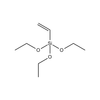
    Vinyltriethoxysilane; Triethoxyvinylsilane; TEVS; VTES; Ethenyltriethoxysilane; Triethoxysilylethylene; Triethoxy(vinyl)silane
  • ΔHvap: 6.8 kcal/mol
  • ΔHform: -463.5 kcal/mol
  • Dipole moment: 1.69 debye
  • Specific wetting surface area: 412 m2/g
  • Copolymerization parameters- e,Q: -0.42, 0.028
  • γc of treated surfaces: 25 mN/m
  • Vapor pressure, 20 °C: 5 mm
  • Specific heat: 0.25 cal/g/°
  • Relative hydrolysis rate versus SIV9220.0, vinyltrimethoxysilane; 0.05
  • Forms copolymers with ethylene for moisture induced coupling of polyethylene
  • Couples fillers or fiberglass to resins
  • See VEE-005 for polymeric version
  • Reacts with enamines to give (E)-β:-silylenamines, which cross-couple with aryl iodides to give β-aryl enamines
  • Employed as a coupling agent, adhesion promoter, and crosslinking agent
  • Used in microparticle surface modification for fillers
  • Compatible with sulfur and peroxide cured rubber, polyester, polyolefin, styrene, and acrylic based materials
  • For vinylations
  • Available as an oligomeric hydrolysate, SIV9112.2
  • Extensive review of silicon based cross-coupling agents: Denmark, S. E. et al. "Organic Reactions, Volume 75" Denmark, S. E. ed., John Wiley and Sons, 233, 2011
Supplier's Site Datasheet

Technical Specifications

  Gelest, Inc.
Product Category Inorganic Chemicals and Compounds
Product Number SIV9112.0
Product Name VINYLTRIETHOXYSILANE
Chemical Formula C 8 H 1 8 O 3 Si
Unlock Full Specs
to access all available technical data

Similar Products

pH Buffer 9.21 - 238219 - Hamilton Company
Hamilton Company
Specs
Type Other; Buffer
Chemical Name Sodiumtetraborate Decahydrate
Chemical Formula B4Na2O7 10·H2O
View Details
Basic Materials & Chemicals - Caustic Soda - LG Chemical of America Inc.
Specs
Bases All Inorganic Bases; Sodium Hydroxide (Caustic Soda)
Chemical Name Sodium Hydroxide
Chemical Formula NaOH 33 / NaOH 50
View Details
H202 30% ULSI -  - Technic, Inc.
Technic, Inc.
Specs
Chemical Name Hydrogen Peroxide
Chemical Formula H2O2
View Details
Sulfamide - 13589 - Medical Isotopes, Inc.
Medical Isotopes, Inc.
Specs
Chemical Formula H 4 N 2 O 2 S
CAS Number 7803-58-9
View Details