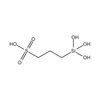
SIT8378.3 -- 3-(TRIHYDROXYSILYL)-1-PROPANESULFONIC ACID, 30-35% IN WATER
Gelest, Inc.3-(TRIHYDROXYSILYL)-1-PROPANESULFONIC ACID, 30-35% in waterSIT8378.3
Description
Additional Properties
Hydrolytic Sensitivity 0: forms stable aqueous solutions Application Employed in preparation of nanoscale ionic silicas.1 Forms sulfonated fuel cell electrodes.2 Reference 1. Giannelis, E. et al. Appl. Organomet. Chem. 2010, 24, 581. 2. Eastcott, J. et al. J. Power Sources 2012,197,102. Safety
Packaging Under Nitrogen Sulfonate Functional Trihydroxy Silane Silane coupling agents have the ability to form a durable bond between organic and inorganic materials to generate desired heterogeneous environments or to incorporate the bulk properties of different phases into a uniform composite structure. The general formula has two classes of functionality. The hydrolyzable group forms stable condensation products with siliceous surfaces and other oxides such as those of aluminum, zirconium, tin, titanium, and nickel. The organofunctional group alters the wetting or adhesion characteristics of the substrate, utilizes the substrate to catalyze chemical transformations at the heterogeneous interface, orders the interfacial region, or modifies its partition characteristics, and significantly effects the covalent bond between organic and inorganic materials. 3-(Trihydroxysilyl)-
1-propanesulfonic acid; Sulfopropylsilanetri
ol; Trihydropropylsilyls
ulfuric acid
pH: <1
Employed in preparation of nanoscale ionic silicas
Forms sulfonated fuel cell electrodes
30-35% in water
Gelest, Inc.
Done
Datasheet
Description
Additional Properties
Hydrolytic Sensitivity 0: forms stable aqueous solutions Application Employed in preparation of nanoscale ionic silicas.1 Forms sulfonated fuel cell electrodes.2 Reference 1. Giannelis, E. et al. Appl. Organomet. Chem. 2010, 24, 581. 2. Eastcott, J. et al. J. Power Sources 2012,197,102. Safety
Packaging Under Nitrogen Sulfonate Functional Trihydroxy Silane Silane coupling agents have the ability to form a durable bond between organic and inorganic materials to generate desired heterogeneous environments or to incorporate the bulk properties of different phases into a uniform composite structure. The general formula has two classes of functionality. The hydrolyzable group forms stable condensation products with siliceous surfaces and other oxides such as those of aluminum, zirconium, tin, titanium, and nickel. The organofunctional group alters the wetting or adhesion characteristics of the substrate, utilizes the substrate to catalyze chemical transformations at the heterogeneous interface, orders the interfacial region, or modifies its partition characteristics, and significantly effects the covalent bond between organic and inorganic materials. 3-(Trihydroxysilyl)-
1-propanesulfonic acid; Sulfopropylsilanetri
ol; Trihydropropylsilyls
ulfuric acid
pH: <1
Employed in preparation of nanoscale ionic silicas
Forms sulfonated fuel cell electrodes
30-35% in water
3-(TRIHYDROXYSILYL)-1-PROPANESULFONIC ACID, 30-35% in water
SIT8378.3
3-(TRIHYDROXYSILYL)-1-PROPANESULFONIC ACID, 30-35% in water
SIT8378.3
Additional Properties
Hydrolytic Sensitivity 0: forms stable aqueous solutions Application Employed in preparation of nanoscale ionic silicas.1 Forms sulfonated fuel cell electrodes.2 Reference 1. Giannelis, E. et al. Appl. Organomet. Chem. 2010, 24, 581. 2. Eastcott, J. et al. J. Power Sources 2012,197,102. Safety
Packaging Under Nitrogen Sulfonate Functional Trihydroxy Silane Silane coupling agents have the ability to form a durable bond between organic and inorganic materials to generate desired heterogeneous environments or to incorporate the bulk properties of different phases into a uniform composite structure. The general formula has two classes of functionality. The hydrolyzable group forms stable condensation products with siliceous surfaces and other oxides such as those of aluminum, zirconium, tin, titanium, and nickel. The organofunctional group alters the wetting or adhesion characteristics of the substrate, utilizes the substrate to catalyze chemical transformations at the heterogeneous interface, orders the interfacial region, or modifies its partition characteristics, and significantly effects the covalent bond between organic and inorganic materials. 3-(Trihydroxysilyl)-
1-propanesulfonic acid; Sulfopropylsilanetri
ol; Trihydropropylsilyls
ulfuric acid
pH: <1
Employed in preparation of nanoscale ionic silicas
Forms sulfonated fuel cell electrodes
30-35% in water
Additional Properties
Hydrolytic Sensitivity 0: forms stable aqueous solutions
Application
Employed in preparation of nanoscale ionic silicas.1 Forms sulfonated fuel cell electrodes.2
Reference
1. Giannelis, E. et al. Appl. Organomet. Chem. 2010, 24, 581. 2. Eastcott, J. et al. J. Power Sources 2012,197,102.
Safety
Packaging Under Nitrogen
Sulfonate Functional Trihydroxy Silane
Silane coupling agents have the ability to form a durable bond between organic and inorganic materials to generate desired heterogeneous environments or to incorporate the bulk properties of different phases into a uniform composite structure. The general formula has two classes of functionality. The hydrolyzable group forms stable condensation products with siliceous surfaces and other oxides such as those of aluminum, zirconium, tin, titanium, and nickel. The organofunctional group alters the wetting or adhesion characteristics of the substrate, utilizes the substrate to catalyze chemical transformations at the heterogeneous interface, orders the interfacial region, or modifies its partition characteristics, and significantly effects the covalent bond between organic and inorganic materials.
3-(Trihydroxysilyl)-1-propanesulfonic acid; Sulfopropylsilanetriol; Trihydropropylsilylsulfuric acid
pH: <1
Employed in preparation of nanoscale ionic silicas
Forms sulfonated fuel cell electrodes
30-35% in water
Supplier's Site
Datasheet
Technical Specifications
Gelest, Inc.
Product Category
Inorganic Chemicals and Compounds
Product Number
SIT8378.3
Product Name
3-(TRIHYDROXYSILYL)-1-PROPANESULFONIC ACID, 30-35% in water