Additional Properties
Hydrolytic Sensitivity 1: no significant reaction with aqueous systems Safety
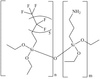
Packaging Under Nitrogen Amine Functional Oligomeric Hydrolysate Silane coupling agents have the ability to form a durable bond between organic and inorganic materials to generate desired heterogeneous environments or to incorporate the bulk properties of different phases into a uniform composite structure. The general formula has two classes of functionality. The hydrolyzable group forms stable condensation products with siliceous surfaces and other oxides such as those of aluminum, zirconium, tin, titanium, and nickel. The organofunctional group alters the wetting or adhesion characteristics of the substrate, utilizes the substrate to catalyze chemical transformations at the heterogeneous interface, orders the interfacial region, or modifies its partition characteristics, and significantly effects the covalent bond between organic and inorganic materials. Cohydrolysate of: 3-Aminopropyltrietho
xysilane; γ-Aminopropyltrietho
xysilane;Triethoxysi
lylpropylamine; APTES; AMEO; GAPS; A-1100 with 1H,1H,2H,2H-Perfluor
ooctyltriethoxysilan
e; POTS
Cohydrolysate of SIA0610.0 and SIT8175.0
Aqueous solution
Gelest, Inc.
Done
Datasheet
Description
Additional Properties
Hydrolytic Sensitivity 1: no significant reaction with aqueous systems Safety
Packaging Under Nitrogen Amine Functional Oligomeric Hydrolysate Silane coupling agents have the ability to form a durable bond between organic and inorganic materials to generate desired heterogeneous environments or to incorporate the bulk properties of different phases into a uniform composite structure. The general formula has two classes of functionality. The hydrolyzable group forms stable condensation products with siliceous surfaces and other oxides such as those of aluminum, zirconium, tin, titanium, and nickel. The organofunctional group alters the wetting or adhesion characteristics of the substrate, utilizes the substrate to catalyze chemical transformations at the heterogeneous interface, orders the interfacial region, or modifies its partition characteristics, and significantly effects the covalent bond between organic and inorganic materials. Cohydrolysate of: 3-Aminopropyltrietho
xysilane; γ-Aminopropyltrietho
xysilane;Triethoxysi
lylpropylamine; APTES; AMEO; GAPS; A-1100 with 1H,1H,2H,2H-Perfluor
ooctyltriethoxysilan
e; POTS
Cohydrolysate of SIA0610.0 and SIT8175.0
Aqueous solution
Additional Properties
Hydrolytic Sensitivity 1: no significant reaction with aqueous systems
Safety
Packaging Under Nitrogen
Amine Functional Oligomeric Hydrolysate
Silane coupling agents have the ability to form a durable bond between organic and inorganic materials to generate desired heterogeneous environments or to incorporate the bulk properties of different phases into a uniform composite structure. The general formula has two classes of functionality. The hydrolyzable group forms stable condensation products with siliceous surfaces and other oxides such as those of aluminum, zirconium, tin, titanium, and nickel. The organofunctional group alters the wetting or adhesion characteristics of the substrate, utilizes the substrate to catalyze chemical transformations at the heterogeneous interface, orders the interfacial region, or modifies its partition characteristics, and significantly effects the covalent bond between organic and inorganic materials.
Cohydrolysate of: 3-Aminopropyltriethoxysilane; γ-Aminopropyltriethoxysilane;Triethoxysilylpropylamine; APTES; AMEO; GAPS; A-1100 with 1H,1H,2H,2H-Perfluorooctyltriethoxysilane; POTS