Additional Properties
Hydrolytic Sensitivity 7: reacts slowly with moisture/water Application Candidate material for nanowires.1 Reference 1. Arkles, B. et al. U.S. Patent 8,575,381, 2012. Safety
Packaging Under Nitrogen Volatile Carbosilane Carbosilanes are compounds in which the elements of silicon and carbon alternate in a molecular framework or polymeric backbone in an approximate ratio of 1:1. By appropriate selection of the carbosilane precursor and deposition conditions the silicon carbide framework can be shifted toward substituted silicon and diamond-like structures. Volatile Higher Silane Volatile higher silanes are low temperature, high deposition rate precursors. By appropriate selection of precursor and deposition conditions, silicon deposition can be shifted from amorphous hydrogenated silicon toward microcrystalline silicon structures. As the number of silicon atoms increases beyond two, electrons are capable of sigma–sigma bond conjugation. The dissociative adsorption of two of the three hydrogen atoms on terminal silicon atoms has a lower energy barrier. 2,2,3,3-Tetramethylt
etrasilane
Candidate material for nanowires
Converts to a carbosilane at temperatures above 650 °C
Gelest, Inc.
Done
Datasheet
Description
Additional Properties
Hydrolytic Sensitivity 7: reacts slowly with moisture/water Application Candidate material for nanowires.1 Reference 1. Arkles, B. et al. U.S. Patent 8,575,381, 2012. Safety
Packaging Under Nitrogen Volatile Carbosilane Carbosilanes are compounds in which the elements of silicon and carbon alternate in a molecular framework or polymeric backbone in an approximate ratio of 1:1. By appropriate selection of the carbosilane precursor and deposition conditions the silicon carbide framework can be shifted toward substituted silicon and diamond-like structures. Volatile Higher Silane Volatile higher silanes are low temperature, high deposition rate precursors. By appropriate selection of precursor and deposition conditions, silicon deposition can be shifted from amorphous hydrogenated silicon toward microcrystalline silicon structures. As the number of silicon atoms increases beyond two, electrons are capable of sigma–sigma bond conjugation. The dissociative adsorption of two of the three hydrogen atoms on terminal silicon atoms has a lower energy barrier. 2,2,3,3-Tetramethylt
etrasilane
Candidate material for nanowires
Converts to a carbosilane at temperatures above 650 °C
Additional Properties
Hydrolytic Sensitivity 7: reacts slowly with moisture/water Application Candidate material for nanowires.1 Reference 1. Arkles, B. et al. U.S. Patent 8,575,381, 2012. Safety
Packaging Under Nitrogen Volatile Carbosilane Carbosilanes are compounds in which the elements of silicon and carbon alternate in a molecular framework or polymeric backbone in an approximate ratio of 1:1. By appropriate selection of the carbosilane precursor and deposition conditions the silicon carbide framework can be shifted toward substituted silicon and diamond-like structures. Volatile Higher Silane Volatile higher silanes are low temperature, high deposition rate precursors. By appropriate selection of precursor and deposition conditions, silicon deposition can be shifted from amorphous hydrogenated silicon toward microcrystalline silicon structures. As the number of silicon atoms increases beyond two, electrons are capable of sigma–sigma bond conjugation. The dissociative adsorption of two of the three hydrogen atoms on terminal silicon atoms has a lower energy barrier. 2,2,3,3-Tetramethylt
etrasilane
Candidate material for nanowires
Converts to a carbosilane at temperatures above 650 °C
Additional Properties
Hydrolytic Sensitivity 7: reacts slowly with moisture/water
Application
Candidate material for nanowires.1
Reference
1. Arkles, B. et al. U.S. Patent 8,575,381, 2012.
Safety
Packaging Under Nitrogen
Volatile Carbosilane
Carbosilanes are compounds in which the elements of silicon and carbon alternate in a molecular framework or polymeric backbone in an approximate ratio of 1:1. By appropriate selection of the carbosilane precursor and deposition conditions the silicon carbide framework can be shifted toward substituted silicon and diamond-like structures.
Volatile Higher Silane
Volatile higher silanes are low temperature, high deposition rate precursors. By appropriate selection of precursor and deposition conditions, silicon deposition can be shifted from amorphous hydrogenated silicon toward microcrystalline silicon structures. As the number of silicon atoms increases beyond two, electrons are capable of sigma–sigma bond conjugation. The dissociative adsorption of two of the three hydrogen atoms on terminal silicon atoms has a lower energy barrier.
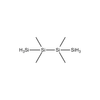
2,2,3,3-Tetramethyltetrasilane
Candidate material for nanowires
Converts to a carbosilane at temperatures above 650 °C