Description
Additional Properties
Hydrolytic Sensitivity 7: reacts slowly with moisture/water Application Cross couples with aryl halides.1 Extensive review on the use in silicon-based cross-coupling reactions.10 Phenylates heteroaromatic carboxamides.2 Directly couples with 1o alkyl bromides and iodides.3 Converts carboxylic acids to phenyl esters and vinyl carboxylates.4 Converts arylselenyl bromides to arylphenylselenides.
5 Reacts with anhydrides to transfer both phenyl and methoxy and thus form the mixed diester.6 Used in the nickel-catalyzed direct phenylation of C-H bonds in heteroaromatic system such as benzoxazoles.7 Immobilization reagent for aligned metallic single wall nanotubes (SWNT).8,9 Reference 1. Mowery, M. E.; DeShong, P. J. Org. Chem. 1999, 64, 1684. 10. Denmark, S. E. et al. Organic Reactions, Vol. 75, Denmark, S. E. ed., John Wiley and Sons, 233, 2011. 2. Lam, P. Y. S. et al. Tetrahedron Lett. 2001. 42, 2427. 3. Young, J.-Y.; Fu, G. C. J. Am. Chem. Soc. 2003, 125, 5616. 4. Luo, F. et al. Synthesis 2010, 2005. 5. Bhadra, S. et al. J. Org. Chem. 2010, 75, 4864. 6. Luo, F. et al. J. Org. Chem. 2010, 75, 5379. 7. Hachilya, H. et al. Angew. Chem., Int. Ed. Engl. 2010, 49, 2202. 8. LeMieux, M. Science 2008, 321, 101. 9. Nish, A. et al. Nature Nanotechnol. 2007, 2, 640. Safety
Hazard Info ivn mouse, LD50: 180 mg/kg
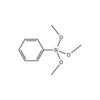
Packaging Under Nitrogen Arylsilane Cross-Coupling Agent The cross-coupling reaction is a highly useful methodology for the formation of carbon-carbon bonds. It involves two reagents, with one typically being a suitable organometallic reagent - the nucleophile - and the other a suitable organic substrate, normally an unsaturated halide, tosylate or similar - the electrophile. Aromatic Silane - Conventional Surface Bonding Aliphatic, fluorinated aliphatic or substituted aromatic hydrocarbon substituents are the hydrophobic entities which enable silanes to induce surface hydrophobicity. The organic substitution of the silane must be non-polar. The hydrophobic effect of the organic substitution can be related to the free energy of transfer of hydrocarbon molecules from an aqueous phase to a homogeneous hydrocarbon phase. A successful hydrophobic coating must eliminate or mitigate hydrogen bonding and shield polar surfaces from interaction with water by creating a non-polar interphase. Although silane and silicone derived coatings are in general the most hydrophobic, they maintain a high degree of permeability to water vapor. This allows coatings to breathe and reduce deterioration at the coating interface associated with entrapped water. Since ions are not transported through non-polar silane and silicone coatings, they offer protection to composite structures ranging from pigmented coatings to rebar reinforced concrete. A selection guide for hydrophobic silanes can be found on pages 22-31 of the Hydrophobicity, Hydrophilicity and Silane Surface Modification brochure. Phenyltrimethoxysila
ne, Trimethoxysilylbenze
ne
Viscosity, 25 °C: 2.1 cSt
Vapor pressure, 108 °: 20 mm
Dipole moment: 1.77
Dielectric constant: 4.44
Cross-couples w/ aryl bromides w/o fluoride and w/ NaOH
High yields w/ Pd and carbene ligands
Cross-coupled in presence of aryl aldehyde
Undergoes 1,4-addition to enones
1,2- and 1,4-addition to aldehyde
Undergoes coupling and asymmetric coupling w/ α-bromoesters
Reacts with 2° amines to give anilines
N-arylates nitrogen heterocycles
Cross-coupled w/ alkynyl bromides and iodides
Used with p-aminophenyltrimeth
oxysilane, SIA0599.1 , to increase the dispersibility of mesoporous silica
Intermediate for high temperature silicone resins
Hydrophobic additive to other silanes with excellent thermal stability
Cross couples with aryl halides
Phenylates heteroaromatic carboxamides
Directly couples with primary alkyl bromides and iodides
Converts carboxylic acids to phenyl esters and vinyl carboxylates
Converts arylselenyl bromides to arylphenylselenides
Reacts with anhydrides to form the mixed diester, phenyl and methoxy transfer
Used in nickel-catalyzed direct phenylation of C-H bonds in heteroaromatic systems, benzoxazoles
Immobilization reagent for aligned metallic single wall nanotubes (SWNT)
High purity grade available, SIP6822.1
Extensive review of silicon based cross-coupling agents: Denmark, S. E. et al. "Organic Reactions, Volume 75" Denmark, S. E. ed., John Wiley and Sons, 233, 2011