Additional Properties
Hydrolytic Sensitivity 7: reacts slowly with moisture/water Application Modification of novolac resin affords bilevel resists having attributes of trilevel resists.1 Reference 1. Reichmanis, E.; Smolinsky, G. U.S. Patent 4,481,049, 1984. Safety
Hazard Info oral rat, LD50: >2,000 mg/kg
Packaging Under Nitrogen
Store Cold Methacrylate Functional Trialkoxy Silane Silane coupling agents have the ability to form a durable bond between organic and inorganic materials to generate desired heterogeneous environments or to incorporate the bulk properties of different phases into a uniform composite structure. The general formula has two classes of functionality. The hydrolyzable group forms stable condensation products with siliceous surfaces and other oxides such as those of aluminum, zirconium, tin, titanium, and nickel. The organofunctional group alters the wetting or adhesion characteristics of the substrate, utilizes the substrate to catalyze chemical transformations at the heterogeneous interface, orders the interfacial region, or modifies its partition characteristics, and significantly effects the covalent bond between organic and inorganic materials. Methacryloxymethyltr
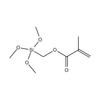
imethoxysilane
Coupling agent for UV cure systems
Modification of novolac resin affords bilevel resists having attributes of trilevel resists
Hydrolysis rate is greater than ten (10) times faster than methacryloxypropyltr
imethoxysilane (SIM6487.4)
Used in microparticle surface modification
Comonomer for free-radical polymerizaiton
Inhibited with MEHQ
Gelest, Inc.
Done
Datasheet
Description
Additional Properties
Hydrolytic Sensitivity 7: reacts slowly with moisture/water Application Modification of novolac resin affords bilevel resists having attributes of trilevel resists.1 Reference 1. Reichmanis, E.; Smolinsky, G. U.S. Patent 4,481,049, 1984. Safety
Hazard Info oral rat, LD50: >2,000 mg/kg
Packaging Under Nitrogen
Store Cold Methacrylate Functional Trialkoxy Silane Silane coupling agents have the ability to form a durable bond between organic and inorganic materials to generate desired heterogeneous environments or to incorporate the bulk properties of different phases into a uniform composite structure. The general formula has two classes of functionality. The hydrolyzable group forms stable condensation products with siliceous surfaces and other oxides such as those of aluminum, zirconium, tin, titanium, and nickel. The organofunctional group alters the wetting or adhesion characteristics of the substrate, utilizes the substrate to catalyze chemical transformations at the heterogeneous interface, orders the interfacial region, or modifies its partition characteristics, and significantly effects the covalent bond between organic and inorganic materials. Methacryloxymethyltr
imethoxysilane
Coupling agent for UV cure systems
Modification of novolac resin affords bilevel resists having attributes of trilevel resists
Hydrolysis rate is greater than ten (10) times faster than methacryloxypropyltr
imethoxysilane (SIM6487.4)
Used in microparticle surface modification
Comonomer for free-radical polymerizaiton
Inhibited with MEHQ
Additional Properties
Hydrolytic Sensitivity 7: reacts slowly with moisture/water Application Modification of novolac resin affords bilevel resists having attributes of trilevel resists.1 Reference 1. Reichmanis, E.; Smolinsky, G. U.S. Patent 4,481,049, 1984. Safety
Hazard Info oral rat, LD50: >2,000 mg/kg
Packaging Under Nitrogen
Store Cold Methacrylate Functional Trialkoxy Silane Silane coupling agents have the ability to form a durable bond between organic and inorganic materials to generate desired heterogeneous environments or to incorporate the bulk properties of different phases into a uniform composite structure. The general formula has two classes of functionality. The hydrolyzable group forms stable condensation products with siliceous surfaces and other oxides such as those of aluminum, zirconium, tin, titanium, and nickel. The organofunctional group alters the wetting or adhesion characteristics of the substrate, utilizes the substrate to catalyze chemical transformations at the heterogeneous interface, orders the interfacial region, or modifies its partition characteristics, and significantly effects the covalent bond between organic and inorganic materials. Methacryloxymethyltr
imethoxysilane
Coupling agent for UV cure systems
Modification of novolac resin affords bilevel resists having attributes of trilevel resists
Hydrolysis rate is greater than ten (10) times faster than methacryloxypropyltr
imethoxysilane (SIM6487.4)
Used in microparticle surface modification
Comonomer for free-radical polymerizaiton
Inhibited with MEHQ
Additional Properties
Hydrolytic Sensitivity 7: reacts slowly with moisture/water
Application
Modification of novolac resin affords bilevel resists having attributes of trilevel resists.1
Reference
1. Reichmanis, E.; Smolinsky, G. U.S. Patent 4,481,049, 1984.
Safety
Hazard Info oral rat, LD50: >2,000 mg/kg
Packaging Under Nitrogen
Store Cold
Methacrylate Functional Trialkoxy Silane
Silane coupling agents have the ability to form a durable bond between organic and inorganic materials to generate desired heterogeneous environments or to incorporate the bulk properties of different phases into a uniform composite structure. The general formula has two classes of functionality. The hydrolyzable group forms stable condensation products with siliceous surfaces and other oxides such as those of aluminum, zirconium, tin, titanium, and nickel. The organofunctional group alters the wetting or adhesion characteristics of the substrate, utilizes the substrate to catalyze chemical transformations at the heterogeneous interface, orders the interfacial region, or modifies its partition characteristics, and significantly effects the covalent bond between organic and inorganic materials.
Methacryloxymethyltrimethoxysilane
Coupling agent for UV cure systems
Modification of novolac resin affords bilevel resists having attributes of trilevel resists
Hydrolysis rate is greater than ten (10) times faster than methacryloxypropyltrimethoxysilane (SIM6487.4)