SIM6481.1 -- N-(3-METHACRYLOXY-2-HYDROXYPROPYL)-3-AMINOPROPYLTRIETHOXYSILANE, 50% IN ETHANOL
Gelest, Inc.N-(3-METHACRYLOXY-2-HYDROXYPROPYL)-3-AMINOPROPYLTRIETHOXYSILANE, 50% in ethanolSIM6481.1
Description
Additional Properties
Hydrolytic Sensitivity 7: reacts slowly with moisture/water Application Employed in conservation/consoli
dation of stone.1 Reference 1. Wheeler, G. In Ninth Int'l Cong. On Deterioration and Conservation of Stone; Fassina, Ed.; Elsevier: 2000; Vol. 2, 541. Safety
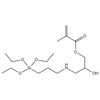
Packaging Under Nitrogen Methacrylate Functional Trialkoxy Silane Silane coupling agents have the ability to form a durable bond between organic and inorganic materials to generate desired heterogeneous environments or to incorporate the bulk properties of different phases into a uniform composite structure. The general formula has two classes of functionality. The hydrolyzable group forms stable condensation products with siliceous surfaces and other oxides such as those of aluminum, zirconium, tin, titanium, and nickel. The organofunctional group alters the wetting or adhesion characteristics of the substrate, utilizes the substrate to catalyze chemical transformations at the heterogeneous interface, orders the interfacial region, or modifies its partition characteristics, and significantly effects the covalent bond between organic and inorganic materials. N-(3-Methacryloxy-2-
hydroxypropyl)-3-ami
nopropyltriethoxysil
ane
Coupling agent for UV cure systems
Employed in conservation and consolidation of stone
Used in microparticle surface modification
Comonomer for free-radical polymerizaiton
Inhibited with MEHQ
Gelest, Inc.
Done
Description
Additional Properties
Hydrolytic Sensitivity 7: reacts slowly with moisture/water Application Employed in conservation/consoli
dation of stone.1 Reference 1. Wheeler, G. In Ninth Int'l Cong. On Deterioration and Conservation of Stone; Fassina, Ed.; Elsevier: 2000; Vol. 2, 541. Safety
Packaging Under Nitrogen Methacrylate Functional Trialkoxy Silane Silane coupling agents have the ability to form a durable bond between organic and inorganic materials to generate desired heterogeneous environments or to incorporate the bulk properties of different phases into a uniform composite structure. The general formula has two classes of functionality. The hydrolyzable group forms stable condensation products with siliceous surfaces and other oxides such as those of aluminum, zirconium, tin, titanium, and nickel. The organofunctional group alters the wetting or adhesion characteristics of the substrate, utilizes the substrate to catalyze chemical transformations at the heterogeneous interface, orders the interfacial region, or modifies its partition characteristics, and significantly effects the covalent bond between organic and inorganic materials. N-(3-Methacryloxy-2-
hydroxypropyl)-3-ami
nopropyltriethoxysil
ane
Coupling agent for UV cure systems
Employed in conservation and consolidation of stone
Used in microparticle surface modification
Comonomer for free-radical polymerizaiton
Inhibited with MEHQ
Datasheet
Datasheet Summary Powered by GS/AI
N-(3-METHACRYLOXY-2-HYDROXYPROPYL)-3-AMINOPROPYLTRIETHOXYSILANE, 50% in ethanol, is a liquid chemical intermediate classified as an organosilane in solvent. It has a chemical formula of C16H33NO6Si and is primarily used in applications such as conservation and consolidation of stone, microparticle surface modification, and as a comonomer for free-radical polymerization. The product is known for its ability to form durable bonds between organic and inorganic materials, enhancing adhesion and modifying interfacial characteristics.
This product is classified as flammable and poses risks of skin and eye irritation. It contains ethanol, which is also classified as a carcinogen by IARC in alcoholic beverages. Proper safety precautions, including the use of protective equipment and measures to prevent ignition, are necessary when handling this product. It is packaged under nitrogen to maintain stability and prevent premature reactions.
Datasheet Summary Powered by GS/AI
N-(3-METHACRYLOXY-2-HYDROXYPROPYL)-3-AMINOPROPYLTRIETHOXYSILANE, 50% in ethanol, is a liquid chemical intermediate classified as an organosilane in solvent. It has a chemical formula of C16H33NO6Si and is primarily used in applications such as conservation and consolidation of stone, microparticle surface modification, and as a comonomer for free-radical polymerization. The product is known for its ability to form durable bonds between organic and inorganic materials, enhancing adhesion and modifying interfacial characteristics.
This product is classified as flammable and poses risks of skin and eye irritation. It contains ethanol, which is also classified as a carcinogen by IARC in alcoholic beverages. Proper safety precautions, including the use of protective equipment and measures to prevent ignition, are necessary when handling this product. It is packaged under nitrogen to maintain stability and prevent premature reactions.
N-(3-METHACRYLOXY-2-HYDROXYPROPYL)-3-AMINOPROPYLTRIETHOXYSILANE, 50% in ethanol
SIM6481.1
N-(3-METHACRYLOXY-2-HYDROXYPROPYL)-3-AMINOPROPYLTRIETHOXYSILANE, 50% in ethanol
SIM6481.1
Additional Properties
Hydrolytic Sensitivity 7: reacts slowly with moisture/water Application Employed in conservation/consoli
dation of stone.1 Reference 1. Wheeler, G. In Ninth Int'l Cong. On Deterioration and Conservation of Stone; Fassina, Ed.; Elsevier: 2000; Vol. 2, 541. Safety
Packaging Under Nitrogen Methacrylate Functional Trialkoxy Silane Silane coupling agents have the ability to form a durable bond between organic and inorganic materials to generate desired heterogeneous environments or to incorporate the bulk properties of different phases into a uniform composite structure. The general formula has two classes of functionality. The hydrolyzable group forms stable condensation products with siliceous surfaces and other oxides such as those of aluminum, zirconium, tin, titanium, and nickel. The organofunctional group alters the wetting or adhesion characteristics of the substrate, utilizes the substrate to catalyze chemical transformations at the heterogeneous interface, orders the interfacial region, or modifies its partition characteristics, and significantly effects the covalent bond between organic and inorganic materials. N-(3-Methacryloxy-2-
hydroxypropyl)-3-ami
nopropyltriethoxysil
ane
Coupling agent for UV cure systems
Employed in conservation and consolidation of stone
Used in microparticle surface modification
Comonomer for free-radical polymerizaiton
Inhibited with MEHQ
Additional Properties
Hydrolytic Sensitivity 7: reacts slowly with moisture/water
Application
Employed in conservation/consolidation of stone.1
Reference
1. Wheeler, G. In Ninth Int'l Cong. On Deterioration and Conservation of Stone; Fassina, Ed.; Elsevier: 2000; Vol. 2, 541.
Safety
Packaging Under Nitrogen
Methacrylate Functional Trialkoxy Silane
Silane coupling agents have the ability to form a durable bond between organic and inorganic materials to generate desired heterogeneous environments or to incorporate the bulk properties of different phases into a uniform composite structure. The general formula has two classes of functionality. The hydrolyzable group forms stable condensation products with siliceous surfaces and other oxides such as those of aluminum, zirconium, tin, titanium, and nickel. The organofunctional group alters the wetting or adhesion characteristics of the substrate, utilizes the substrate to catalyze chemical transformations at the heterogeneous interface, orders the interfacial region, or modifies its partition characteristics, and significantly effects the covalent bond between organic and inorganic materials.
N-(3-Methacryloxy-2-hydroxypropyl)-3-aminopropyltriethoxysilane
Coupling agent for UV cure systems
Employed in conservation and consolidation of stone
Used in microparticle surface modification
Comonomer for free-radical polymerizaiton
Inhibited with MEHQ
Supplier's Site
Datasheet
Technical Specifications
Gelest, Inc.
Product Category
Inorganic Chemicals and Compounds
Product Number
SIM6481.1
Product Name
N-(3-METHACRYLOXY-2-HYDROXYPROPYL)-3-AMINOPROPYLTRIETHOXYSILANE, 50% in ethanol