Description
Additional Properties
Hydrolytic Sensitivity 7: reacts slowly with moisture/water Application For enzyme immobilization.1 Treatment of mesoporous silica yields highly efficient heavy metal scavenger.2 Couples fluorescent biological tags to semiconductor CdS nanoparticles.3 Modified mesoporous silica supports Pd in coupling reactions.4 Used to make thiol-organosilica nanoparticles.5 Forms modified glass and silica surfaces suitable for SILAR fabrication of CdS thin films.6 Reference 1. Stjernlöf, P. et al. Tetrahedron Lett. 1990, 31, 5773. 2. Liu, J. et al. Science 1997, 276, 923. 3. Bruchez, M. et al. Science 1998, 281, 2013. 4. Crudden, C. et al. J. Am. Chem. Soc. 2005, 127, 10045. 5. Nakamura, M.; Ishimura, K. Langmuir 2008, 24, 5099. 6. Sun, H. et al. J. Dispersion Sci. Technol. 2005, 26, 719. Safety
Hazard Info oral rat, LD50: 2,380 mg/kg
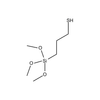
Packaging Under Nitrogen 3-Mercaptopropyltrim
ethoxysilane; 3-(trimethoxysilyl)p
ropanethiol; 3-trimethoxysilyl)pr
opylmercaptan
Sulfur functional trialkoxy silane
γc of treated surfaces: 41 mN/m
Viscosity: 2 cSt
Specific wetting surface: 348 m2/g
Coupling agent for ethylene propylene diene monomer, EPDM, and mechanical rubber applications
Adhesion promoter for polysulfide adhesives
For enzyme immobilization
Treatment of mesoporous silica yields highly efficient heavy metal scavenger
Couples fluorescent biological tags to semiconductor CdS nanoparticles
Modified mesoporous silica supports Pd in coupling reactions
Used to make thiol-organosilica nanoparticles
Forms modified glass and silica surfaces suitable for successive ionic layer adsorption and reaction (SILAR) fabrication of CdS thin films