Additional Properties
Hydrolytic Sensitivity 7: reacts slowly with moisture/water Application Forms UV-curable coating resins by controlled hydrolysis.1 Used to make epoxy-organosilica particles w/ high positive Zeta potential.2 Reference 1. Crivello, J.; Mao. Z. Chem. Mater. 1997, 9, 1554. 2. Nakamura, M.; Ishimura, K. Langmuir 2008, 24, 12228. Safety
Hazard Info oral rat, LD50: 12,300 mg/kg
Packaging Under Nitrogen 2-(3,4-Epoxycyclohex
yl)ethyltrimethoxysi
lane; (2-trimethoxysilylet
hyl)cyclohexyloxiran
e
Epoxy functional trialkoxy silane
Viscosity: 5.2 cSt
Coefficient of thermal expansion: 0.8 x 10⁻³
Vapor pressure, 152 °C: 10 mm
Specific wetting surface: 317 m2/g
γc of treated surfaces: 39.5 mN/m
Ring epoxide more reactive than glycidoxypropyl systems
UV initiated polymerization of epoxy group with weak acid donors
Forms UV-curable coating resins by controlled hydrolysis
Used to make epoxy-organosilica particles w/ high positive Zeta potential
Epoxy silane treated surfaces convert to hydrophilic-diols when exposed to moisture
Gelest, Inc.
Done
Datasheet
Description
Additional Properties
Hydrolytic Sensitivity 7: reacts slowly with moisture/water Application Forms UV-curable coating resins by controlled hydrolysis.1 Used to make epoxy-organosilica particles w/ high positive Zeta potential.2 Reference 1. Crivello, J.; Mao. Z. Chem. Mater. 1997, 9, 1554. 2. Nakamura, M.; Ishimura, K. Langmuir 2008, 24, 12228. Safety
Hazard Info oral rat, LD50: 12,300 mg/kg
Packaging Under Nitrogen 2-(3,4-Epoxycyclohex
yl)ethyltrimethoxysi
lane; (2-trimethoxysilylet
hyl)cyclohexyloxiran
e
Epoxy functional trialkoxy silane
Viscosity: 5.2 cSt
Coefficient of thermal expansion: 0.8 x 10⁻³
Vapor pressure, 152 °C: 10 mm
Specific wetting surface: 317 m2/g
γc of treated surfaces: 39.5 mN/m
Ring epoxide more reactive than glycidoxypropyl systems
UV initiated polymerization of epoxy group with weak acid donors
Forms UV-curable coating resins by controlled hydrolysis
Used to make epoxy-organosilica particles w/ high positive Zeta potential
Epoxy silane treated surfaces convert to hydrophilic-diols when exposed to moisture
Additional Properties
Hydrolytic Sensitivity 7: reacts slowly with moisture/water Application Forms UV-curable coating resins by controlled hydrolysis.1 Used to make epoxy-organosilica particles w/ high positive Zeta potential.2 Reference 1. Crivello, J.; Mao. Z. Chem. Mater. 1997, 9, 1554. 2. Nakamura, M.; Ishimura, K. Langmuir 2008, 24, 12228. Safety
Hazard Info oral rat, LD50: 12,300 mg/kg
Packaging Under Nitrogen 2-(3,4-Epoxycyclohex
yl)ethyltrimethoxysi
lane; (2-trimethoxysilylet
hyl)cyclohexyloxiran
e
Epoxy functional trialkoxy silane
Viscosity: 5.2 cSt
Coefficient of thermal expansion: 0.8 x 10⁻³
Vapor pressure, 152 °C: 10 mm
Specific wetting surface: 317 m2/g
γc of treated surfaces: 39.5 mN/m
Ring epoxide more reactive than glycidoxypropyl systems
UV initiated polymerization of epoxy group with weak acid donors
Forms UV-curable coating resins by controlled hydrolysis
Used to make epoxy-organosilica particles w/ high positive Zeta potential
Epoxy silane treated surfaces convert to hydrophilic-diols when exposed to moisture
Additional Properties
Hydrolytic Sensitivity 7: reacts slowly with moisture/water
Application
Forms UV-curable coating resins by controlled hydrolysis.1 Used to make epoxy-organosilica particles w/ high positive Zeta potential.2
Reference
1. Crivello, J.; Mao. Z. Chem. Mater. 1997, 9, 1554. 2. Nakamura, M.; Ishimura, K. Langmuir 2008, 24, 12228.
Safety
Hazard Info oral rat, LD50: 12,300 mg/kg
Packaging Under Nitrogen
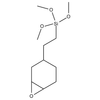
2-(3,4-Epoxycyclohexyl)ethyltrimethoxysilane; (2-trimethoxysilylethyl)cyclohexyloxirane
Epoxy functional trialkoxy silane
Viscosity: 5.2 cSt
Coefficient of thermal expansion: 0.8 x 10⁻³
Vapor pressure, 152 °C: 10 mm
Specific wetting surface: 317 m2/g
γc of treated surfaces: 39.5 mN/m
Ring epoxide more reactive than glycidoxypropyl systems
UV initiated polymerization of epoxy group with weak acid donors
Forms UV-curable coating resins by controlled hydrolysis
Used to make epoxy-organosilica particles w/ high positive Zeta potential
Epoxy silane treated surfaces convert to hydrophilic-diols when exposed to moisture