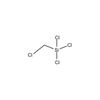
Gelest, Inc. CHLOROMETHYLTRICHLOROSILANE SIC2298.0

Description
Additional Properties Hydrolytic Sensitivity 8: reacts rapidly with moisture, water, protic solvents Surface Tension (mN/m) 26. Application Building block for carbosilanes.1 Reference 1. Whitmarsh, C.; Interante, L. US Patent 5,153,295, 1992. Safety Hazard Info ipr rat, LD100: 150 mg/kg Packaging Under Nitrogen Halogen Functional Trichloro Silane Silane coupling agents have the ability to form a durable bond between organic and inorganic materials to generate desired heterogeneous environments or to incorporate the bulk properties of different phases into a uniform composite structure. The general formula has two classes of functionality. The hydrolyzable group forms stable condensation products with siliceous surfaces and other oxides such as those of aluminum, zirconium, tin, titanium, and nickel. The organofunctional group alters the wetting or adhesion characteristics of the substrate, utilizes the substrate to catalyze chemical transformations at the heterogeneous interface, orders the interfacial region, or modifies its partition characteristics, and significantly effects the covalent bond between organic and inorganic materials. (Trichlorosilyl)chlo romethane; Chloromethyltrichlor osilane Viscosity, 20 °: 0.5 cSt Vapor pressure, 20 °C: 18 mm Thermal conductivity, 27°C: 0.1420 W/m°C Heat capacity, 27°C: 0.912 kJ/kg°C ΔHvap: 157.8 kJ/mole Dipole moment: 1.61 debye Surface tension, 27 °C: 26.5 mN/m Critical temperature: 310 °C Autoignition temperature: 380 °C Building block for carbosilanes Decomposes at temperatures >250 °C Grignard reagent behaves as nucleophilic hydroxymethylation agent Forms stable Grignard reagent that after reaction and oxidation transfers a hydroxymethyl moiety Generates HCl as a hydrolysis byproduct
Datasheet
Description
Additional Properties Hydrolytic Sensitivity 8: reacts rapidly with moisture, water, protic solvents Surface Tension (mN/m) 26. Application Building block for carbosilanes.1 Reference 1. Whitmarsh, C.; Interante, L. US Patent 5,153,295, 1992. Safety Hazard Info ipr rat, LD100: 150 mg/kg Packaging Under Nitrogen Halogen Functional Trichloro Silane Silane coupling agents have the ability to form a durable bond between organic and inorganic materials to generate desired heterogeneous environments or to incorporate the bulk properties of different phases into a uniform composite structure. The general formula has two classes of functionality. The hydrolyzable group forms stable condensation products with siliceous surfaces and other oxides such as those of aluminum, zirconium, tin, titanium, and nickel. The organofunctional group alters the wetting or adhesion characteristics of the substrate, utilizes the substrate to catalyze chemical transformations at the heterogeneous interface, orders the interfacial region, or modifies its partition characteristics, and significantly effects the covalent bond between organic and inorganic materials. (Trichlorosilyl)chlo romethane; Chloromethyltrichlor osilane Viscosity, 20 °: 0.5 cSt Vapor pressure, 20 °C: 18 mm Thermal conductivity, 27°C: 0.1420 W/m°C Heat capacity, 27°C: 0.912 kJ/kg°C ΔHvap: 157.8 kJ/mole Dipole moment: 1.61 debye Surface tension, 27 °C: 26.5 mN/m Critical temperature: 310 °C Autoignition temperature: 380 °C Building block for carbosilanes Decomposes at temperatures >250 °C Grignard reagent behaves as nucleophilic hydroxymethylation agent Forms stable Grignard reagent that after reaction and oxidation transfers a hydroxymethyl moiety Generates HCl as a hydrolysis byproduct
Datasheet

Suppliers

Company
Product
Description
Supplier Links
CHLOROMETHYLTRICHLOROSILANE - SIC2298.0 - Gelest, Inc.
Morrisville, PA, United States
CHLOROMETHYLTRICHLOROSILANE
SIC2298.0
CHLOROMETHYLTRICHLOROSILANE SIC2298.0
Additional Properties Hydrolytic Sensitivity 8: reacts rapidly with moisture, water, protic solvents Surface Tension (mN/m) 26. Application Building block for carbosilanes.1 Reference 1. Whitmarsh, C.; Interante, L. US Patent 5,153,295, 1992. Safety Hazard Info ipr rat, LD100: 150 mg/kg Packaging Under Nitrogen Halogen Functional Trichloro Silane Silane coupling agents have the ability to form a durable bond between organic and inorganic materials to generate desired heterogeneous environments or to incorporate the bulk properties of different phases into a uniform composite structure. The general formula has two classes of functionality. The hydrolyzable group forms stable condensation products with siliceous surfaces and other oxides such as those of aluminum, zirconium, tin, titanium, and nickel. The organofunctional group alters the wetting or adhesion characteristics of the substrate, utilizes the substrate to catalyze chemical transformations at the heterogeneous interface, orders the interfacial region, or modifies its partition characteristics, and significantly effects the covalent bond between organic and inorganic materials. (Trichlorosilyl)chlo romethane; Chloromethyltrichlor osilane Viscosity, 20 °: 0.5 cSt Vapor pressure, 20 °C: 18 mm Thermal conductivity, 27°C: 0.1420 W/m°C Heat capacity, 27°C: 0.912 kJ/kg°C ΔHvap: 157.8 kJ/mole Dipole moment: 1.61 debye Surface tension, 27 °C: 26.5 mN/m Critical temperature: 310 °C Autoignition temperature: 380 °C Building block for carbosilanes Decomposes at temperatures >250 °C Grignard reagent behaves as nucleophilic hydroxymethylation agent Forms stable Grignard reagent that after reaction and oxidation transfers a hydroxymethyl moiety Generates HCl as a hydrolysis byproduct

Additional Properties


  • Hydrolytic Sensitivity 8: reacts rapidly with moisture, water, protic solvents
  • Surface Tension (mN/m) 26.
    Application
    Building block for carbosilanes.1
    Reference
    1. Whitmarsh, C.; Interante, L. US Patent 5,153,295, 1992.
    Safety
  • Hazard Info ipr rat, LD100: 150 mg/kg
  • Packaging Under Nitrogen
    Halogen Functional Trichloro Silane
    Silane coupling agents have the ability to form a durable bond between organic and inorganic materials to generate desired heterogeneous environments or to incorporate the bulk properties of different phases into a uniform composite structure. The general formula has two classes of functionality. The hydrolyzable group forms stable condensation products with siliceous surfaces and other oxides such as those of aluminum, zirconium, tin, titanium, and nickel. The organofunctional group alters the wetting or adhesion characteristics of the substrate, utilizes the substrate to catalyze chemical transformations at the heterogeneous interface, orders the interfacial region, or modifies its partition characteristics, and significantly effects the covalent bond between organic and inorganic materials.
    (Trichlorosilyl)chloromethane; Chloromethyltrichlorosilane
  • Viscosity, 20 °: 0.5 cSt
  • Vapor pressure, 20 °C: 18 mm
  • Thermal conductivity, 27°C: 0.1420 W/m°C
  • Heat capacity, 27°C: 0.912 kJ/kg°C
  • ΔHvap: 157.8 kJ/mole
  • Dipole moment: 1.61 debye
  • Surface tension, 27 °C: 26.5 mN/m
  • Critical temperature: 310 °C
  • Autoignition temperature: 380 °C
  • Building block for carbosilanes
  • Decomposes at temperatures >250 °C
  • Grignard reagent behaves as nucleophilic hydroxymethylation agent
  • Forms stable Grignard reagent that after reaction and oxidation transfers a hydroxymethyl moiety
  • Generates HCl as a hydrolysis byproduct
Supplier's Site Datasheet

Technical Specifications

  Gelest, Inc.
Product Category Organic Chemicals
Product Number SIC2298.0
Product Name CHLOROMETHYLTRICHLOROSILANE
Chemical Formula CH 2 Cl 4 Si
CAS Number 1558-25-4
Boiling Point 243 to 244 F (117 to 118 C)
Flash Point 156 F (69 C)
Unlock Full Specs
to access all available technical data

Similar Products

Intermediates and Ingredients for Pharmaceuticals and Agrochemical Compounds -  - AGC Chemicals Americas, Inc.
Specs
Chemical Family All Halogenated
Chemical Name Trifluoroacetic Acid, Trifluoroacetic Anhydride, Ethyl Trifluoroacetate, Sodium Trifluoroacetate, 2,3,4-Trifluoro aniline, Trifluoroacetamide, & More
CAS Number 76-05-1, 407-25-0, 383-63-1, 2923-18-4, 3862-73-5, 354-38-1, 148043-73-6, 30071-93-3, 677-69-0, 122665-97-8, 118612-00-3, 136040-19-2, and More
View Details
DMI 1,3 Dimethyl-2-Imidazolidinone -  - Mitsui Chemicals America, Inc.
Mitsui Chemicals America, Inc.
Specs
Trigger Solvent
Chemical Name DMI 1,3 Dimethyl-2-Imidazolidinone
State of Matter Liquid / Solution
View Details
