Description
Additional Properties
Hydrolytic Sensitivity 7: reacts slowly with moisture/water Application Undergoes radical1,2 and anionic polymerization.3,4,5 Reference 1. Packirisamy, S. et al. J. Polym. Sci., Part A: Polym. Chem. 1989, 27, 2811. 2. Xu, Y. et al. Polymer 1991, 32, 3103. 3. Hirao, A. et al. Makromol. Chem., Rapid Commun. 1982, 3, 941. 4. Hirao, A. et al. Makromol. Chem. 1985, 186, 1157. 5. Ito, H. et al. Polym. Mater. Sci. Eng. Preprints 1993, 68, 12. Safety
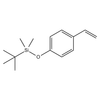
Packaging Under Nitrogen Alkenylsilane Cross-Coupling Agent The cross-coupling reaction is a highly useful methodology for the formation of carbon-carbon bonds. It involves two reagents, with one typically being a suitable organometallic reagent - the nucleophile - and the other a suitable organic substrate, normally an unsaturated halide, tosylate or similar - the electrophile. p-(t-Butyldimethylsi
loxy)styrene; p-Vinyl-t-Butyldimet
hylbenzene
Useful for Heck cross-coupling to substituted protectedhydroxy functional styrenes
Undergoes radical and anionic polymerization
Extensive review of silicon based cross-coupling agents: Denmark, S. E. et al. "Organic Reactions, Volume 75" Denmark, S. E. ed., John Wiley and Sons, 233, 2011