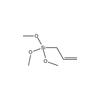
Description
Additional Properties
Hydrolytic Sensitivity 7: reacts slowly with moisture/water Application Allylation of ketones, aldehydes and imines with dual activation of a Lewis Acid and fluoride ion.1 Used in the regioselective generation of the thermodynamically more stable enol trimethoxysilyl ethers, which in turn are used in the asymmetric generation of quaternary carbon centers.2 Converts arylselenyl bromides to arylallylselenides.3 Allylates aryl iodides.4 Fieser F&F: Vol 18, p 14; Vol 19, p 360; Vol 20, p 85; Vol 21, p 3, Vol 12, p 395 Reference 1. Yamasaki, S. et al. J. Am. Chem. Soc. 2002, 124, 6536. 2. Ichibakase, T. et al. Tetrahedron Lett. 2008, 49, 4427. 3. Bhadra, S. et al. J. Org. Chem. 2010, 75, 4864. 4. Mowery, M. E.; DeShong, P. J. Org. Chem. 1999, 64, 1684. Safety
Packaging Under Nitrogen Olefin Functional Trialkoxy Silane Silane coupling agents have the ability to form a durable bond between organic and inorganic materials to generate desired heterogeneous environments or to incorporate the bulk properties of different phases into a uniform composite structure. The general formula has two classes of functionality. The hydrolyzable group forms stable condensation products with siliceous surfaces and other oxides such as those of aluminum, zirconium, tin, titanium, and nickel. The organofunctional group alters the wetting or adhesion characteristics of the substrate, utilizes the substrate to catalyze chemical transformations at the heterogeneous interface, orders the interfacial region, or modifies its partition characteristics, and significantly effects the covalent bond between organic and inorganic materials. Alkenylsilane Cross-Coupling Agent The cross-coupling reaction is a highly useful methodology for the formation of carbon-carbon bonds. It involves two reagents, with one typically being a suitable organometallic reagent - the nucleophile - and the other a suitable organic substrate, normally an unsaturated halide, tosylate or similar - the electrophile. Allyltrimethoxysilan
e; 1-Trimethoxysilylpro
p-2-ene
Adhesion promoter for vinyl-addition silicones
Allylation of ketones, aldehydes and imines with dual activation of a Lewis Acid and fluoride ion
Used in the regioselective generation of the thermodynamically more stable enol trimethoxysilyl ethers, which in turn are used in the asymmetric generation of quaternary carbon centers
Converts arylselenyl bromides to arylallylselenides
Allylates aryl iodides
Used in microparticle surface modification
Comonomer for polyolefin polymerization
Extensive review of silicon based cross-coupling agents: Denmark, S. E. et al. "Organic Reactions, Volume 75" Denmark, S. E. ed., John Wiley and Sons, 233, 2011